State of the Planet

News from the Columbia Climate School

201531

  • Preparing for Disasters, with the Focus on Children

    Preparing for Disasters, with the Focus on Children

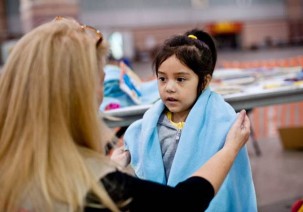
    A new initiative directed by the Earth Institute’s National Center for Disaster Preparedness at Columbia will focus on protecting children from all types of disasters, starting with a pilot program in two communities in New York and Arkansas.

  • Students Learn About a Plan to Rehabilitate the Jordan River Valley

    Students Learn About a Plan to Rehabilitate the Jordan River Valley

    Nine Columbia graduate students landed in Amman, Jordan last Friday night, after over 20 hours of travel, to begin the field study component of their course in Regional Environmental Sustainability in the Middle East. Though exhausted, they were eager to get to the hotel to meet students from Tel Aviv University – who had crossed…

  • Tree Rings Confirm Unprecedented Warming in Central Asia

    Tree Rings Confirm Unprecedented Warming in Central Asia

    A new study of tree rings from Mongolia dating back more than 1,000 years confirms that recent warming in central Asia has no parallel in any known record.

  • From the Nile to the Sundarbans: the Undergraduate Capstones

    From the Nile to the Sundarbans: the Undergraduate Capstones

    This spring, students in the Undergraduate Program in Sustainable Development presented innovative solutions to sustainability issues as part of their Capstone Workshop. Their clients ranged from the United States Military Academy at West Point to the Sabin Center for Climate Change Law.

  • Under Pressure, a (Simulated) Climate Agreement

    Under Pressure, a (Simulated) Climate Agreement

    Coming up with an international climate agreement is hard work. But the students at the Make It Work simulated negotiations in Paris managed to find a way, though they left disagreeing over just how effective the pact would be.

  • A Carbon Tax Is Not Feasible or Practical

    The idea behind the carbon tax is that by raising the price of fossil fuels, one promotes energy efficiency and, as fossil fuels become more expensive, renewable energy technologies will become more competitive. I am certain this is true. But few elected officials are going to advocate higher fossil fuel prices.

  • Faculty Profile: Robert Lieberman

    Faculty Profile: Robert Lieberman

    Robert Lieberman is a professor of political science and public affairs and vice dean for academic affairs at the School of International and Public Affairs at Columbia University. His research interests include American political development, public policy, race and politics, and social welfare policy. He brings an important perspective to both his department and the…

  • Hurricane Histories and Carbon Mysteries

    Hurricane Histories and Carbon Mysteries

    The Bahamas might be a vacation destination for most people. But for us, they represent an excellent site to study several different questions about past, present and future climates.

  • Learning to Compromise

    Learning to Compromise

    After countless hours of workshopping, brainstorming, writing, and rewriting, I thought that a consensus between parties would not be so far off. However, with 220 opinions boiled down into 42 delegations, it was painfully difficult.

Photo of the Earth from space with the text "Lamont at AGU25" on top.

AGU25, the premier Earth and space science conference, takes place December 15-19, 2025 in New Orleans, Louisiana. This year’s theme—Where Science Connects Us—puts in focus how science depends on connection, from the lab to the field to the ballot box. Once again, Lamont-Doherty Earth Observatory and Columbia Climate School scientists, experts, students, and educators are playing an active role, sharing our research and helping shape the future of our planet. #AGU25 Learn More

  • Preparing for Disasters, with the Focus on Children

    Preparing for Disasters, with the Focus on Children

    A new initiative directed by the Earth Institute’s National Center for Disaster Preparedness at Columbia will focus on protecting children from all types of disasters, starting with a pilot program in two communities in New York and Arkansas.

  • Students Learn About a Plan to Rehabilitate the Jordan River Valley

    Students Learn About a Plan to Rehabilitate the Jordan River Valley

    Nine Columbia graduate students landed in Amman, Jordan last Friday night, after over 20 hours of travel, to begin the field study component of their course in Regional Environmental Sustainability in the Middle East. Though exhausted, they were eager to get to the hotel to meet students from Tel Aviv University – who had crossed…

  • Tree Rings Confirm Unprecedented Warming in Central Asia

    Tree Rings Confirm Unprecedented Warming in Central Asia

    A new study of tree rings from Mongolia dating back more than 1,000 years confirms that recent warming in central Asia has no parallel in any known record.

  • From the Nile to the Sundarbans: the Undergraduate Capstones

    From the Nile to the Sundarbans: the Undergraduate Capstones

    This spring, students in the Undergraduate Program in Sustainable Development presented innovative solutions to sustainability issues as part of their Capstone Workshop. Their clients ranged from the United States Military Academy at West Point to the Sabin Center for Climate Change Law.

  • Under Pressure, a (Simulated) Climate Agreement

    Under Pressure, a (Simulated) Climate Agreement

    Coming up with an international climate agreement is hard work. But the students at the Make It Work simulated negotiations in Paris managed to find a way, though they left disagreeing over just how effective the pact would be.

  • A Carbon Tax Is Not Feasible or Practical

    The idea behind the carbon tax is that by raising the price of fossil fuels, one promotes energy efficiency and, as fossil fuels become more expensive, renewable energy technologies will become more competitive. I am certain this is true. But few elected officials are going to advocate higher fossil fuel prices.

  • Faculty Profile: Robert Lieberman

    Faculty Profile: Robert Lieberman

    Robert Lieberman is a professor of political science and public affairs and vice dean for academic affairs at the School of International and Public Affairs at Columbia University. His research interests include American political development, public policy, race and politics, and social welfare policy. He brings an important perspective to both his department and the…

  • Hurricane Histories and Carbon Mysteries

    Hurricane Histories and Carbon Mysteries

    The Bahamas might be a vacation destination for most people. But for us, they represent an excellent site to study several different questions about past, present and future climates.

  • Learning to Compromise

    Learning to Compromise

    After countless hours of workshopping, brainstorming, writing, and rewriting, I thought that a consensus between parties would not be so far off. However, with 220 opinions boiled down into 42 delegations, it was painfully difficult.