State of the Planet

News from the Columbia Climate School

201638

  • Mozambique Core Brings Up 7 Million Years of Climate History

    Mozambique Core Brings Up 7 Million Years of Climate History

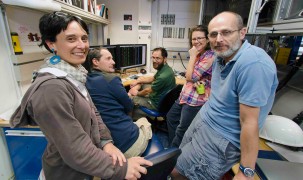
    With calm seas, the JOIDES Resolution’s latest sediment core comes up with what appears to be a fantastic, cyclic climate signal that is continuous back 7 million years, writes Sidney Hemming.

  • Attributing Extreme Weather to Causes—Including Climate Change

    Attributing Extreme Weather to Causes—Including Climate Change

    New research and more powerful computer models are advancing scientists’ ability to tease apart the forces that can worsen extreme weather. In a new report, a committee of the National Academy of Sciences that includes Columbia’s Adam Sobel assesses the young field of attribution studies.

  • Pump Meltwater Back on Antarctica? Do You Have 850,000 Wind Turbines?

    Pump Meltwater Back on Antarctica? Do You Have 850,000 Wind Turbines?

    A new study that looked at the feasibility of lowering sea levels by pumping water onto icy Antarctica offers a warning about the costs today’s greenhouse gas emissions may be creating for future generations.

  • Scientists Prepare ‘Climate City’ for Take-Off

    Scientists Prepare ‘Climate City’ for Take-Off

    Sometime soon, a flock of “Climate Birds” could be ascending from a former NATO base in northeast France to take the measure of climate change around the world.

  • Watch: Building Solutions for Water Challenges

    Watch: Building Solutions for Water Challenges

    From aging and leaky pipes to pollution and shrinking aquifers, America’s water infrastructure faces a growing set of challenges. A new video describes how the America’s Water Initiative, a program based at the Columbia Water Center, is trying to address those issues.

  • Student Profile: Alireza Zamani

    Student Profile: Alireza Zamani

    For Alireza Zamani, the MPA in Environmental Science and Policy program provided a unique opportunity to build professional skills he can use in his future career as an environmental professional.

  • Anchor Institutions and their Significance to Community and Economic Development

    Anchor Institutions and their Significance to Community and Economic Development

    Partnerships between anchor institutions and local organizations and businesses are vital to solving problems in localities and regions. Through engagement, investment and collaboration, anchor institutions can continue to play a crucial role in providing significant social and economic development opportunities to the communities in which they operate.

  • We’re Headed for Mozambique!

    We’re Headed for Mozambique!

    After weeks of anticipation, permission arrived just in time to core off Mozambique. Sidney Hemming and her team of scientists aboard the JOIDES Resolution are excited about what they might learn from the ocean sediment.

  • Are Zika Virus and the Climate Related?

    Are Zika Virus and the Climate Related?

    Madeleine Thomson, a scientist at the International Research Institute for Climate and Society, studies the relationship between diseases like Zika, dengue, malaria and others and changes in climate. She spoke at length recently with the Wellcome Trust, a health-focused charity, about the connection.

Photo of the Earth from space with the text "Lamont at AGU25" on top.

AGU25, the premier Earth and space science conference, takes place December 15-19, 2025 in New Orleans, Louisiana. This year’s theme—Where Science Connects Us—puts in focus how science depends on connection, from the lab to the field to the ballot box. Once again, Lamont-Doherty Earth Observatory and Columbia Climate School scientists, experts, students, and educators are playing an active role, sharing our research and helping shape the future of our planet. #AGU25 Learn More

  • Mozambique Core Brings Up 7 Million Years of Climate History

    Mozambique Core Brings Up 7 Million Years of Climate History

    With calm seas, the JOIDES Resolution’s latest sediment core comes up with what appears to be a fantastic, cyclic climate signal that is continuous back 7 million years, writes Sidney Hemming.

  • Attributing Extreme Weather to Causes—Including Climate Change

    Attributing Extreme Weather to Causes—Including Climate Change

    New research and more powerful computer models are advancing scientists’ ability to tease apart the forces that can worsen extreme weather. In a new report, a committee of the National Academy of Sciences that includes Columbia’s Adam Sobel assesses the young field of attribution studies.

  • Pump Meltwater Back on Antarctica? Do You Have 850,000 Wind Turbines?

    Pump Meltwater Back on Antarctica? Do You Have 850,000 Wind Turbines?

    A new study that looked at the feasibility of lowering sea levels by pumping water onto icy Antarctica offers a warning about the costs today’s greenhouse gas emissions may be creating for future generations.

  • Scientists Prepare ‘Climate City’ for Take-Off

    Scientists Prepare ‘Climate City’ for Take-Off

    Sometime soon, a flock of “Climate Birds” could be ascending from a former NATO base in northeast France to take the measure of climate change around the world.

  • Watch: Building Solutions for Water Challenges

    Watch: Building Solutions for Water Challenges

    From aging and leaky pipes to pollution and shrinking aquifers, America’s water infrastructure faces a growing set of challenges. A new video describes how the America’s Water Initiative, a program based at the Columbia Water Center, is trying to address those issues.

  • Student Profile: Alireza Zamani

    Student Profile: Alireza Zamani

    For Alireza Zamani, the MPA in Environmental Science and Policy program provided a unique opportunity to build professional skills he can use in his future career as an environmental professional.

  • Anchor Institutions and their Significance to Community and Economic Development

    Anchor Institutions and their Significance to Community and Economic Development

    Partnerships between anchor institutions and local organizations and businesses are vital to solving problems in localities and regions. Through engagement, investment and collaboration, anchor institutions can continue to play a crucial role in providing significant social and economic development opportunities to the communities in which they operate.

  • We’re Headed for Mozambique!

    We’re Headed for Mozambique!

    After weeks of anticipation, permission arrived just in time to core off Mozambique. Sidney Hemming and her team of scientists aboard the JOIDES Resolution are excited about what they might learn from the ocean sediment.

  • Are Zika Virus and the Climate Related?

    Are Zika Virus and the Climate Related?

    Madeleine Thomson, a scientist at the International Research Institute for Climate and Society, studies the relationship between diseases like Zika, dengue, malaria and others and changes in climate. She spoke at length recently with the Wellcome Trust, a health-focused charity, about the connection.