201058
-
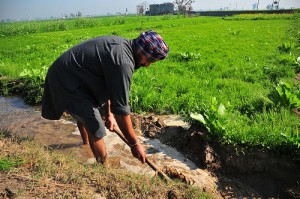
Punjab Farmers Adapt to Shrinking Water Supply
Driving through Punjab in early February, the green of newly sprouted wheat is all around. Trenches in between rows of stalks are being dug and linked to larger conduits where the water is flowing. Nearby an electric generator hums as water is pumped from 100 feet below. As the season goes, so does the water…
-
Ensuring a Prosperous China by 2049 and Providing Best Practices for Ghana
Two new gifts from donor Winnington Group of Hong Kong are helping support the Millennium Cities Initiative and the Earth Institute’s new China 2049 project, which seeks to answer the following crucial questions: What will the Chinese economy look like one hundred years after the establishment of the People’s Republic of China? How can public…
-
Climate Change Leaders Join Jeff Sachs in Discussion on Post-Copenhagen Action
Nearly 100 people including several UN ambassadors, corporate executives, foundation leaders and key representatives from NGOs and academia gathered at Columbia University to attend a brainstorm session on a way forward after December’s Climate Change Conference in Copenhagen. Led by Earth Institute Director Jeff Sachs, the agenda covered topics including improvements to the United Nations…
-
Water Scarcity Conflicts Loom, but also Potential Cooperation
Regions likely to become drier because of climate change include Central Asia and northern Africa. Up to 250 million people in Africa could suffer extra stress on water supplies by 2020, according to the U.N. panel of climate experts.
-
Jaunt to Nearby Island Becomes Four-Day Epic
Going to Antarctica involves a whole lot of paperwork. Before I left, I filled out an extensive medical history, was tested for every disease imaginable, gave my pants size, shoe size, hat size, until I had only one form remaining. That was the waiver acknowledging that working in Antarctica is inherently dangerous and that by…
-
So Much Depends on Sea Ice
Where we work and how we get there depends on the sea ice. The Oden is a powerful icebreaker but it is often faster and more fuel-efficient to go around heavy sea ice then to chop our way through. If the sea ice is several feet thick, we often choose to detour. We actually consult…
-
Getting Back on Track: Ending Global Hunger and Undernutrition
One of the targets of the first Millennium Development Goal (MDG) is to reduce the proportion of people who suffer from hunger by half between 1990 and 2015, with hunger measured as the proportion of the population who are undernourished and the prevalence of children under five who are underweight.
-
Public water means water savings
On February 12, Columbia Water Center staff had the opportunity to hear a presentation from Sheetal Sekhri, an Assistant Professor at the University of Virginia Department of Economics, on ‘The Impact of Public Groundwater Provision Schemes on Water Tables: Evidence from Rural India’. Staff engaged her in a spirited discussion of the results of her…
-
Supporting Students from Developing Countries with Scholarships and Internships
A recent anonymous gift of $200,000 to the Earth Institute will provide financial support for students from developing countries. The gift will fund two scholarships for students either in our MA in Climate and Society or MPA in Environmental Science and Policy program, and will also provide funding for summer internships.


AGU25, the premier Earth and space science conference, takes place December 15-19, 2025 in New Orleans, Louisiana. This year’s theme—Where Science Connects Us—puts in focus how science depends on connection, from the lab to the field to the ballot box. Once again, Lamont-Doherty Earth Observatory and Columbia Climate School scientists, experts, students, and educators are playing an active role, sharing our research and helping shape the future of our planet. #AGU25 Learn More
