CLIMATE, EARTH SCIENCES, PRESS RELEASE
Climate Change Stopped the Next Ice Age
New research shows that 2,000 years ago, remnants of a once-vast Arctic ice sheet began growing again, marking the start of a new glacial period—what we commonly call an ice age. But by the 1960s, global warming had raised summer temperatures enough to reverse that growth.


Recent Stories
-

Climate Risk Meets Retail: Inside Princess Polly’s SoHo Flagship
-

How a Massive Ancient Ice Shelf Stabilized Glaciers—and What It Means for Antarctica
-

Beyond Net-Zero Targets: Lisa Sachs on Designing Systems for Decarbonization
-
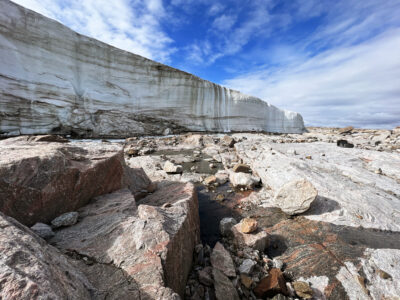
Climate Change Stopped the Next Ice Age
-
Highlights From the 2026 Open House at Lamont-Doherty Earth Observatory
-

Discover Climate LIVE K12 Sessions for 2026-27
-
Giant Canyon on Mars Is Still Tectonically Active Today
-
Finding My Wild: A Summit for Pride and the Planet
-

Microplastics Are Chemically Active, and Could Cause Biological Harm


October 28, 2026 is Columbia Giving Day! Your gift to Columbia Climate School helps advance interdisciplinary research, educate the next generation of leaders, and transform bold ideas into real-world solutions for climate, Earth, and society.
Education & Community

Interactives & Explainers


Upcoming Events
- Monday, October 26, 2026 2:00 PM – 3:00 PM Where: Seismology Building, 61 Route 9W, Palisades, NY 10964 Description: Cheng Mei, LDEO, presents: Numerical Modeling of Injection-Induced Seismicity on Rough Faults Contact: Kate Scholz
- Monday, October 26, 2026 11:00 AM – 12:00 PM Where: Gary C. Comer Geochemistry Building, 61 Route 9W, Palisades, NY 10964 Description: Biology and Paleo Environment Weekly Seminar Series – Abstract and Title to come Contact: Annika Gomez
- Thursday, October 15, 2026 5:00 AM – Thu , November 5, 2026 12:00 PM Where: Online Event Description: How did humanity become so interconnected, and what can that history teach us about building a sustainable future? The Ages of Globalization with Professor Jeffrey D. Sachs is now open with new offerings on Columbia Plus. Over seven ages, from ancient empires […]
Viewpoints


Latest Comments
I read somewhere that the Little Ice Age had something to do with volcano eruptions worldwide. And I also read…
Fascinating hypothesis, with lessons for us. A thousand years ago, the 3.3 meters–essentially 10 feet– of sea level rise over…


Media Highlights
- Westervelt, a study coauthor and an associate research professor at Lamont-Doherty Earth Observatory, which is part of the Columbia Climate School. “It reduced particulate pollution inside the congestion zone by a modest amount.”…
- Murray and the team addressed that problem by using the Columbia Tropical Cyclone Hazard computer model created by study co-authors Chia-Ying Lee and Suzana Camargo at Columbia University…
- In 2027, said Jonas Jägermeyr of Columbia University’s climate school, the super El Niño “could drive global temperatures and weather extremes to new highs.”
This is the work of the ages—future and present—that will compel all nations to get up to speed on sustainable…