State of the Planet

News from the Columbia Climate School

201114

  • Natural Processes Can Limit Spread of Arsenic in Water, Says Study

    Wells From Asia to North America Vulnerable

  • Scholarship Funds to Educate Girls in Africa

    Husband-wife team of agricultural researchers establishes new fund

  • Critter Corner: News Roundup on Biodiversity – Week of 10/3

    Critter Corner: News Roundup on Biodiversity – Week of 10/3

    Read more about how humans are just modified fish, the discovery of a rare seahorse, the relationship between climate change, elk, and aspen, and the the structure of ambrosia beetle colonies in this week’s edition of The Critter Corner.

  • Imagining the Hudson before Humans

    Imagining the Hudson before Humans

    Pollution is just one way that humans have transformed the Hudson River. A small way, it turns out. We have altered the Hudson’s shape, the speed of its flow and the mix of plants and trees along its banks. In a new book, Environmental History of the Hudson River, two Lamont-Doherty scientists who contributed chapters—Frank…

  • Climate News Roundup: Week of 10/02

    Climate News Roundup: Week of 10/02

    With Death of Forests, a Loss of Key Climate Protectors; U.S. aviation lobbying ‘will not change European emission trading laws’; Climate change eradicating Arctic’s oldest ice; Is climate change affecting fall foliage?

  • This Year in Conservation – FREE Panel Discussion

    This Year in Conservation – FREE Panel Discussion

    The Center for Biodiversity and Conservation is hosting a free evening program on Wednesday, October 12.

  • Using Tree Rings to Understand and Protect New York’s Water

    Using Tree Rings to Understand and Protect New York’s Water

    The upper Delaware River Basin System is one of the largest water supply systems for the city of New York. Today our understanding and management of these reservoir systems is based on the short historical records of data, which are limited. Scientists need to find a way to look further into the past. One of…

  • Pharmaceuticals in the Water Supply: Is this a threat?

    Pharmaceuticals in the Water Supply: Is this a threat?

    According to the GAO, a “study focused on untreated source water used by public drinking water systems” found that 53 of 74 sites tested had at least one pharmaceutical present, and in 2010 the EPA showed that 54 active pharmaceutical ingredients and 10 metabolites, the product of biological changes to a chemical, had been found…

  • Wasteland Transformed into Magnificent Freshkills Park

    Wasteland Transformed into Magnificent Freshkills Park

    Odors of putrid garbage and mismanaged waste are being replaced by fragrant grass and flowers at Staten Island’s Freshkills Park, once the world’s biggest landfill.

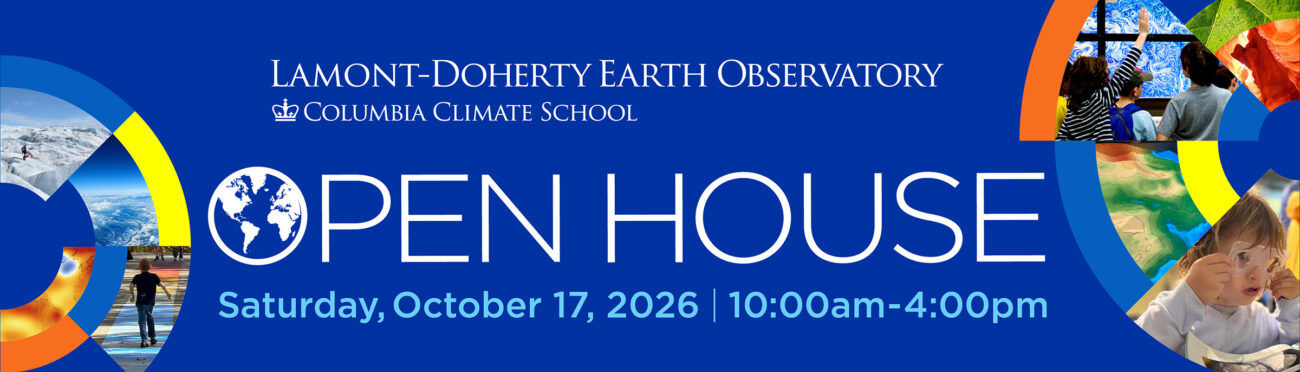
Blue banner with kids and Earth photos. Text: "Lamont-Doherty Earth Observatory Open House, Saturday, October 17, 2026, 10am-4pm.

On Saturday, October 17, 2026 from 10am to 4pm, Lamont-Doherty Earth Observatory Open House—our biggest, best science fun and discovery event of the year—will take place on our beautiful campus in Palisades, NY. Mark your calendar and join us for this free, family-friendly celebration of science! RSVP Today!

  • Natural Processes Can Limit Spread of Arsenic in Water, Says Study

    Wells From Asia to North America Vulnerable

  • Scholarship Funds to Educate Girls in Africa

    Husband-wife team of agricultural researchers establishes new fund

  • Critter Corner: News Roundup on Biodiversity – Week of 10/3

    Critter Corner: News Roundup on Biodiversity – Week of 10/3

    Read more about how humans are just modified fish, the discovery of a rare seahorse, the relationship between climate change, elk, and aspen, and the the structure of ambrosia beetle colonies in this week’s edition of The Critter Corner.

  • Imagining the Hudson before Humans

    Imagining the Hudson before Humans

    Pollution is just one way that humans have transformed the Hudson River. A small way, it turns out. We have altered the Hudson’s shape, the speed of its flow and the mix of plants and trees along its banks. In a new book, Environmental History of the Hudson River, two Lamont-Doherty scientists who contributed chapters—Frank…

  • Climate News Roundup: Week of 10/02

    Climate News Roundup: Week of 10/02

    With Death of Forests, a Loss of Key Climate Protectors; U.S. aviation lobbying ‘will not change European emission trading laws’; Climate change eradicating Arctic’s oldest ice; Is climate change affecting fall foliage?

  • This Year in Conservation – FREE Panel Discussion

    This Year in Conservation – FREE Panel Discussion

    The Center for Biodiversity and Conservation is hosting a free evening program on Wednesday, October 12.

  • Using Tree Rings to Understand and Protect New York’s Water

    Using Tree Rings to Understand and Protect New York’s Water

    The upper Delaware River Basin System is one of the largest water supply systems for the city of New York. Today our understanding and management of these reservoir systems is based on the short historical records of data, which are limited. Scientists need to find a way to look further into the past. One of…

  • Pharmaceuticals in the Water Supply: Is this a threat?

    Pharmaceuticals in the Water Supply: Is this a threat?

    According to the GAO, a “study focused on untreated source water used by public drinking water systems” found that 53 of 74 sites tested had at least one pharmaceutical present, and in 2010 the EPA showed that 54 active pharmaceutical ingredients and 10 metabolites, the product of biological changes to a chemical, had been found…

  • Wasteland Transformed into Magnificent Freshkills Park

    Wasteland Transformed into Magnificent Freshkills Park

    Odors of putrid garbage and mismanaged waste are being replaced by fragrant grass and flowers at Staten Island’s Freshkills Park, once the world’s biggest landfill.