State of the Planet

News from the Columbia Climate School

201212

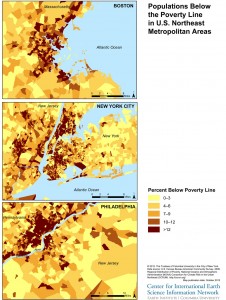
  • Mapping Vulnerable Populations to Support Disaster Preparedness

    Mapping Vulnerable Populations to Support Disaster Preparedness

    As demonstrated by Hurricane Katrina in New Orleans, poverty is a critical factor in the vulnerability of populations to natural hazards.

  • Join us for Fall 2012 Sustainability Management Midterm Briefings

    Join us for Fall 2012 Sustainability Management Midterm Briefings

    On Tuesday, October 23, students from Columbia’s Master of Science in Sustainability Management program (MSSM) will be presenting their Midterm Briefings for the Capstone Workshop. The Midterm Briefings presentations are an opportunity for students to act as sustainability consultants by applying the sustainability management skills that they learn in the program to real world clients.

  • New Software Speeds Carbon Footprinting

    New Software Speeds Carbon Footprinting

    Taking a big step towards helping companies accurately label the carbon footprint of their products, researchers at the Earth Institute have developed new software that can calculate the carbon footprints of thousands of products simultaneously.

  • Sustainability Management Alum Embarking on Corporate Consulting Career

    Sustainability Management Alum Embarking on Corporate Consulting Career

    MS in Sustainability Management alum Sarah Gudernatch (’12) knew from the moment she started the program that she wanted to work in corporate sustainability. After having worked in the non-profit and real-estate sectors, she felt that business was where she could really make a difference. As a Sustainability Consultant at Two Tomorrows, an international corporate…

  • MDP Students Map Kisumu Health Facilities

    MDP Students Map Kisumu Health Facilities

    Two Masters in Development Practice students, Paloma Ruiz Gonzalez and Marianna Costa Checa, used their MDP practicum this past summer to assist the Millennium Cities Initiative in mapping and surveying all health facilities in the Millennium City of Kisumu, Kenya, at the request of the city government and local health officials.

  • Composting—Turning Garbage into Black Gold

    Composting—Turning Garbage into Black Gold

    Forty percent of our food is wasted, but through composting, food waste can be turned into black gold—so called because compost, the mixture of decayed organic matter, is valuable as a nutrient-rich soil additive. In the United States, however, less than 3 percent of food waste is composted.

  • Partnering for Impact

    Partnering for Impact

    Our highly interconnected and interdependent world has given rise to an extraordinary collaborative effort to design a future that is sustainable, prosperous and empowering. The recently concluded Clinton Global Initiative 2012 annual meeting’s theme, “Designing for Impact,” focused on designing our lives, environments and the global systems that can create more opportunity and equality.

  • 2010 Korea Bomb ‘Tests’ Probably False Alarms, Says Study

    Amid Nuclear Tensions, a Seismic Reality Check

  • Field Trip to the Lamont-Doherty Earth Observatory

    Students visit Lamont-Doherty Earth Observatory, the Earth Institute’s center for scientific research, which housed research facilities in fields ranging from marine geology to climate change.

Photo of the Earth from space with the text "Lamont at AGU25" on top.

AGU25, the premier Earth and space science conference, takes place December 15-19, 2025 in New Orleans, Louisiana. This year’s theme—Where Science Connects Us—puts in focus how science depends on connection, from the lab to the field to the ballot box. Once again, Lamont-Doherty Earth Observatory and Columbia Climate School scientists, experts, students, and educators are playing an active role, sharing our research and helping shape the future of our planet. #AGU25 Learn More

  • Mapping Vulnerable Populations to Support Disaster Preparedness

    Mapping Vulnerable Populations to Support Disaster Preparedness

    As demonstrated by Hurricane Katrina in New Orleans, poverty is a critical factor in the vulnerability of populations to natural hazards.

  • Join us for Fall 2012 Sustainability Management Midterm Briefings

    Join us for Fall 2012 Sustainability Management Midterm Briefings

    On Tuesday, October 23, students from Columbia’s Master of Science in Sustainability Management program (MSSM) will be presenting their Midterm Briefings for the Capstone Workshop. The Midterm Briefings presentations are an opportunity for students to act as sustainability consultants by applying the sustainability management skills that they learn in the program to real world clients.

  • New Software Speeds Carbon Footprinting

    New Software Speeds Carbon Footprinting

    Taking a big step towards helping companies accurately label the carbon footprint of their products, researchers at the Earth Institute have developed new software that can calculate the carbon footprints of thousands of products simultaneously.

  • Sustainability Management Alum Embarking on Corporate Consulting Career

    Sustainability Management Alum Embarking on Corporate Consulting Career

    MS in Sustainability Management alum Sarah Gudernatch (’12) knew from the moment she started the program that she wanted to work in corporate sustainability. After having worked in the non-profit and real-estate sectors, she felt that business was where she could really make a difference. As a Sustainability Consultant at Two Tomorrows, an international corporate…

  • MDP Students Map Kisumu Health Facilities

    MDP Students Map Kisumu Health Facilities

    Two Masters in Development Practice students, Paloma Ruiz Gonzalez and Marianna Costa Checa, used their MDP practicum this past summer to assist the Millennium Cities Initiative in mapping and surveying all health facilities in the Millennium City of Kisumu, Kenya, at the request of the city government and local health officials.

  • Composting—Turning Garbage into Black Gold

    Composting—Turning Garbage into Black Gold

    Forty percent of our food is wasted, but through composting, food waste can be turned into black gold—so called because compost, the mixture of decayed organic matter, is valuable as a nutrient-rich soil additive. In the United States, however, less than 3 percent of food waste is composted.

  • Partnering for Impact

    Partnering for Impact

    Our highly interconnected and interdependent world has given rise to an extraordinary collaborative effort to design a future that is sustainable, prosperous and empowering. The recently concluded Clinton Global Initiative 2012 annual meeting’s theme, “Designing for Impact,” focused on designing our lives, environments and the global systems that can create more opportunity and equality.

  • 2010 Korea Bomb ‘Tests’ Probably False Alarms, Says Study

    Amid Nuclear Tensions, a Seismic Reality Check

  • Field Trip to the Lamont-Doherty Earth Observatory

    Students visit Lamont-Doherty Earth Observatory, the Earth Institute’s center for scientific research, which housed research facilities in fields ranging from marine geology to climate change.