State of the Planet

News from the Columbia Climate School

201251

  • Collaborating on Policy and Practice with Garry Conille, Prime Minister of Haiti

    Collaborating on Policy and Practice with Garry Conille, Prime Minister of Haiti

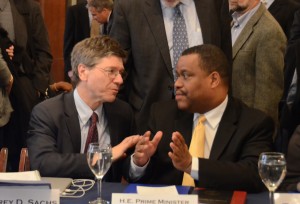
    The Earth Institute welcomed Prime Minister Garry Conille of Haiti on Dec. 2 for a day of policy discussions and a seminar with the students of the Master’s in Public Affairs Development Practice program at Columbia’s School of International and Public Affairs.

  • Did the Oceans Influence Human Evolution?

    Did the Oceans Influence Human Evolution?

    Scientists often invoke climate as a possible factor in human evolution; but only recently have they developed the ability to get enough information about past climates and related fossil evidence to see any details. A half-dozen leading paleontologists and climate scientists discussed recent advances in a symposium this week at the annual meeting of the…

  • U.S., 5 Nations to Cut Methane, Soot Emissions

    U.S., 5 Nations to Cut Methane, Soot Emissions

    The United States and five other countries agreed this week to fund an effort to cut emissions of methane, soot and other pollutants to start to slow the rate of human-induced climate change.

  • Global Climate Modeling for the Masses: You Can Try This at Home

    Global Climate Modeling for the Masses: You Can Try This at Home

    Since 2005, the Educational Global Climate Modeling Project has been downloaded 50,000 times, and adopted for teaching and research at hundreds of universities and other institutions.

  • MPA Student Complements Classroom Learning with Hydrofracking Policy Experience

    MPA Student Complements Classroom Learning with Hydrofracking Policy Experience

    “I had been very interested in hydrofracking before I started the MPA in Environmental Science and Policy (MPA-ESP) program, but really became passionate about the negative the environmental impacts of the practice through my workshop, which analyzed and created an implementation plan for the FRAC Act of 2011.” Josh Garrett, MPA-ESP Class of 2012 student,…

  • Climate Services: No need to wait for disasters to happen

    Climate Services: No need to wait for disasters to happen

    “We need climate information to be able to see disasters coming ahead of time, not just hours, but also weeks, months, and even decades in terms of trends.” — Maarten Van Aalst, the Director of the Red Cross/Red Crescent Climate Centre talks about the importance of climate services for humanitarian operations planning and preparedness, for…

  • Climate News Roundup: Week of 2/13

    Climate News Roundup: Week of 2/13

    Leak Offers Glimpse of Campaign Against Climate Science, New Global Deal on Climate Change, What’s Next for Renewable Energy in the Mediterranean?, Climate Change Increases Risk of Storm Surge, According to MIT Study

  • Extraordinary Support for Unprecedented Global Challenges

    Extraordinary Support for Unprecedented Global Challenges

    The Earth Institute’s annual donor report for fiscal year 2011 is now available in an interactive digital format. We remain committed to finding extraordinary support to unprecedented global challenges, many of which are outlined in this report. We have highlighted some of our innovative projects in research, policy, and education, as well as the partnerships…

  • What Darwin Saw

    What Darwin Saw

    Sir Charles Darwin realized that humanity is interwoven with nature, that all of life is in a state of constant flux. The empowerment of nature, made possible by Darwin’s integration of human life into the whole, and grounded in his lived experience and profound humility, is the foundation of modern ecology.

Photo of the Earth from space with the text "Lamont at AGU25" on top.

AGU25, the premier Earth and space science conference, takes place December 15-19, 2025 in New Orleans, Louisiana. This year’s theme—Where Science Connects Us—puts in focus how science depends on connection, from the lab to the field to the ballot box. Once again, Lamont-Doherty Earth Observatory and Columbia Climate School scientists, experts, students, and educators are playing an active role, sharing our research and helping shape the future of our planet. #AGU25 Learn More

  • Collaborating on Policy and Practice with Garry Conille, Prime Minister of Haiti

    Collaborating on Policy and Practice with Garry Conille, Prime Minister of Haiti

    The Earth Institute welcomed Prime Minister Garry Conille of Haiti on Dec. 2 for a day of policy discussions and a seminar with the students of the Master’s in Public Affairs Development Practice program at Columbia’s School of International and Public Affairs.

  • Did the Oceans Influence Human Evolution?

    Did the Oceans Influence Human Evolution?

    Scientists often invoke climate as a possible factor in human evolution; but only recently have they developed the ability to get enough information about past climates and related fossil evidence to see any details. A half-dozen leading paleontologists and climate scientists discussed recent advances in a symposium this week at the annual meeting of the…

  • U.S., 5 Nations to Cut Methane, Soot Emissions

    U.S., 5 Nations to Cut Methane, Soot Emissions

    The United States and five other countries agreed this week to fund an effort to cut emissions of methane, soot and other pollutants to start to slow the rate of human-induced climate change.

  • Global Climate Modeling for the Masses: You Can Try This at Home

    Global Climate Modeling for the Masses: You Can Try This at Home

    Since 2005, the Educational Global Climate Modeling Project has been downloaded 50,000 times, and adopted for teaching and research at hundreds of universities and other institutions.

  • MPA Student Complements Classroom Learning with Hydrofracking Policy Experience

    MPA Student Complements Classroom Learning with Hydrofracking Policy Experience

    “I had been very interested in hydrofracking before I started the MPA in Environmental Science and Policy (MPA-ESP) program, but really became passionate about the negative the environmental impacts of the practice through my workshop, which analyzed and created an implementation plan for the FRAC Act of 2011.” Josh Garrett, MPA-ESP Class of 2012 student,…

  • Climate Services: No need to wait for disasters to happen

    Climate Services: No need to wait for disasters to happen

    “We need climate information to be able to see disasters coming ahead of time, not just hours, but also weeks, months, and even decades in terms of trends.” — Maarten Van Aalst, the Director of the Red Cross/Red Crescent Climate Centre talks about the importance of climate services for humanitarian operations planning and preparedness, for…

  • Climate News Roundup: Week of 2/13

    Climate News Roundup: Week of 2/13

    Leak Offers Glimpse of Campaign Against Climate Science, New Global Deal on Climate Change, What’s Next for Renewable Energy in the Mediterranean?, Climate Change Increases Risk of Storm Surge, According to MIT Study

  • Extraordinary Support for Unprecedented Global Challenges

    Extraordinary Support for Unprecedented Global Challenges

    The Earth Institute’s annual donor report for fiscal year 2011 is now available in an interactive digital format. We remain committed to finding extraordinary support to unprecedented global challenges, many of which are outlined in this report. We have highlighted some of our innovative projects in research, policy, and education, as well as the partnerships…

  • What Darwin Saw

    What Darwin Saw

    Sir Charles Darwin realized that humanity is interwoven with nature, that all of life is in a state of constant flux. The empowerment of nature, made possible by Darwin’s integration of human life into the whole, and grounded in his lived experience and profound humility, is the foundation of modern ecology.