State of the Planet

News from the Columbia Climate School

201256

  • Putting the ‘Death’ Back Into Death Valley?

    Popular Tourist Stop May Have More Potential to Explode Than Thought

  • Climate News Roundup: Week of 1/17

    Climate News Roundup: Week of 1/17

    Rejecting Pipeline Proposal, Obama Blames Congress; Five Myths About the Keystone Pipeline; GM microbe breakthrough paves way for large-scale seaweed farming for biofuels; Clean Energy Investment Rises to $260 Billion, Boosted by Solar.

  • Road to Rio Event Engages Columbia Community and Local High School Students

    Road to Rio Event Engages Columbia Community and Local High School Students

    In anticipation of Rio+20, two Columbia University master’s programs, MPA in Environmental Science and Policy and MA in Climate and Society, collaborated on an event to discuss how climate change impacts human rights. Global Kids, a local high school group, participated in preparation for attending Rio+20 in June 2012.

  • LEED Green Building Skills Give Graduate Students an Edge

    LEED Green Building Skills Give Graduate Students an Edge

    “LEED GA exam seems like the logical next stop to getting my sustainability career off the ground,” said a master’s student that recently benefitted from a LEED training sponsored by Columbia. The Earth Institute and Columbia University provides graduate students with top notch instruction in the classroom and practical sustainability training for their careers.

  • African Forests, Threatened, but Resilient

    African Forests, Threatened, but Resilient

    Forests and climate change are fundamentally interrelated.  Forests play a role in mitigating climate change by trapping and storing carbon in their trees.  Currently, the world’s forests and forest soils store more than one trillion tons of carbon – twice the amount in the atmosphere. The African continent is home to 30% of the world’s…

  • Columbia University opens first center for Africa in Nairobi

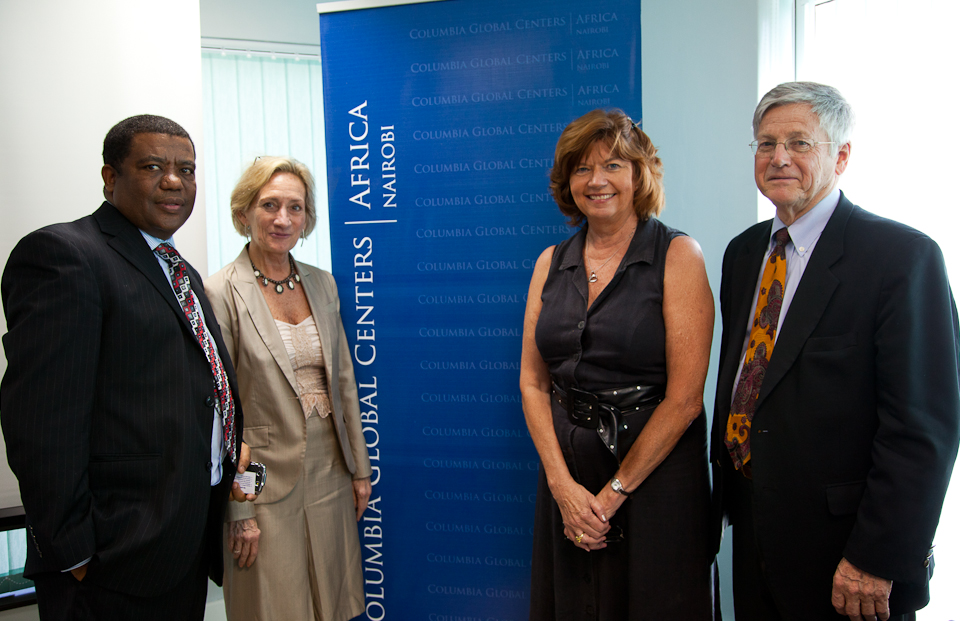
    Columbia University opens first center for Africa in Nairobi

    On the 13th of January, the latest addition to Columbia University’s network of global centers opened its doors in Nairobi, Kenya. The first institution of its kind on the continent, the new Columbia Global Centers | Africa represents an important milestone in the history of the University.

  • Agricultural Development in Africa: NEPAD’s Contribution over a Decade

    Agricultural Development in Africa: NEPAD’s Contribution over a Decade

    The New Partnership for Africa’s Development (NEPAD), a program of the African Union, was launched in Lusaka, Zambia in July 2001. NEPAD offered a fundamentally new approach to development. African leaders set out to pursue new priorities and methods to transform the continent politically and socio-economically, focusing on Africa’s growth, development and participation in the…

  • Scientists Make Progress in Assessing Tornado Seasons

    Study Offers First Step in Short-Term Forecasting

  • Does La Niña Lead to Flu Pandemics?

    Does La Niña Lead to Flu Pandemics?

    Four major flu pandemics of the last century, including the deadly 1918 flu, were all proceeded by La Niña conditions in the Pacific, according to a recent paper.

Photo of the Earth from space with the text "Lamont at AGU25" on top.

AGU25, the premier Earth and space science conference, takes place December 15-19, 2025 in New Orleans, Louisiana. This year’s theme—Where Science Connects Us—puts in focus how science depends on connection, from the lab to the field to the ballot box. Once again, Lamont-Doherty Earth Observatory and Columbia Climate School scientists, experts, students, and educators are playing an active role, sharing our research and helping shape the future of our planet. #AGU25 Learn More

  • Putting the ‘Death’ Back Into Death Valley?

    Popular Tourist Stop May Have More Potential to Explode Than Thought

  • Climate News Roundup: Week of 1/17

    Climate News Roundup: Week of 1/17

    Rejecting Pipeline Proposal, Obama Blames Congress; Five Myths About the Keystone Pipeline; GM microbe breakthrough paves way for large-scale seaweed farming for biofuels; Clean Energy Investment Rises to $260 Billion, Boosted by Solar.

  • Road to Rio Event Engages Columbia Community and Local High School Students

    Road to Rio Event Engages Columbia Community and Local High School Students

    In anticipation of Rio+20, two Columbia University master’s programs, MPA in Environmental Science and Policy and MA in Climate and Society, collaborated on an event to discuss how climate change impacts human rights. Global Kids, a local high school group, participated in preparation for attending Rio+20 in June 2012.

  • LEED Green Building Skills Give Graduate Students an Edge

    LEED Green Building Skills Give Graduate Students an Edge

    “LEED GA exam seems like the logical next stop to getting my sustainability career off the ground,” said a master’s student that recently benefitted from a LEED training sponsored by Columbia. The Earth Institute and Columbia University provides graduate students with top notch instruction in the classroom and practical sustainability training for their careers.

  • African Forests, Threatened, but Resilient

    African Forests, Threatened, but Resilient

    Forests and climate change are fundamentally interrelated.  Forests play a role in mitigating climate change by trapping and storing carbon in their trees.  Currently, the world’s forests and forest soils store more than one trillion tons of carbon – twice the amount in the atmosphere. The African continent is home to 30% of the world’s…

  • Columbia University opens first center for Africa in Nairobi

    Columbia University opens first center for Africa in Nairobi

    On the 13th of January, the latest addition to Columbia University’s network of global centers opened its doors in Nairobi, Kenya. The first institution of its kind on the continent, the new Columbia Global Centers | Africa represents an important milestone in the history of the University.

  • Agricultural Development in Africa: NEPAD’s Contribution over a Decade

    Agricultural Development in Africa: NEPAD’s Contribution over a Decade

    The New Partnership for Africa’s Development (NEPAD), a program of the African Union, was launched in Lusaka, Zambia in July 2001. NEPAD offered a fundamentally new approach to development. African leaders set out to pursue new priorities and methods to transform the continent politically and socio-economically, focusing on Africa’s growth, development and participation in the…

  • Scientists Make Progress in Assessing Tornado Seasons

    Study Offers First Step in Short-Term Forecasting

  • Does La Niña Lead to Flu Pandemics?

    Does La Niña Lead to Flu Pandemics?

    Four major flu pandemics of the last century, including the deadly 1918 flu, were all proceeded by La Niña conditions in the Pacific, according to a recent paper.