State of the Planet

News from the Columbia Climate School

201425

  • Some Do Not Like It Hot

    Some Do Not Like It Hot

    The Great Dying, The Big One — The Permo-Triassic! (In a time machine, not sure if that’s where I’d aim …) As extinctions go, this one’s a blockbuster classic, When most of Earth’s species dropped out of the game.

  • Project Aims to Strengthen Climate Resilience

    Project Aims to Strengthen Climate Resilience

    The Caribbean, Asia’s Indo-Gangetic Plain and West Africa are three regions known to be extremely vulnerable to climate variability and change, particularly to droughts, extreme weather events and stresses on food production, water resources and coastal areas. A new five-year project jointly led by the International Research Institute for Climate and Society and the University…

  • Combining Natural History Collections with Fisher Knowledge for Conservation in Fiji

    Combining Natural History Collections with Fisher Knowledge for Conservation in Fiji

    A team of researchers from Columbia University and the Republic of Fiji has found a unique and time-effective way to improve the design of marine protected areas in on coastal fisheries in Fiji—and, potentially, around the world. This method, which was used to assess a proposed temporary fishery closure in the village of Nagigi, Fiji,…

  • How High Will Sea Levels Rise?

    How High Will Sea Levels Rise?

    Scientists from Lamont-Doherty Earth Observatory are trying to determine how high sea levels may rise in the future by studying the shorelines of the past. Led by a team of researchers including Lamont climate scientist and marine geologist Maureen Raymo, the goal of Pliomax is to increase the accuracy of global sea level estimates for…

  • In India, Reducing the Dependency on Monsoon Precipitation

    In India, Reducing the Dependency on Monsoon Precipitation

    The Centers for International Projects Trust has undertaken various low cost technological innovations to reduce the amount of water used for the production of rice and wheat in India. Such innovations not only reduce water usage in agriculture but also make farmers less vulnerable to climate variability, especially as it relates to the monsoon season.

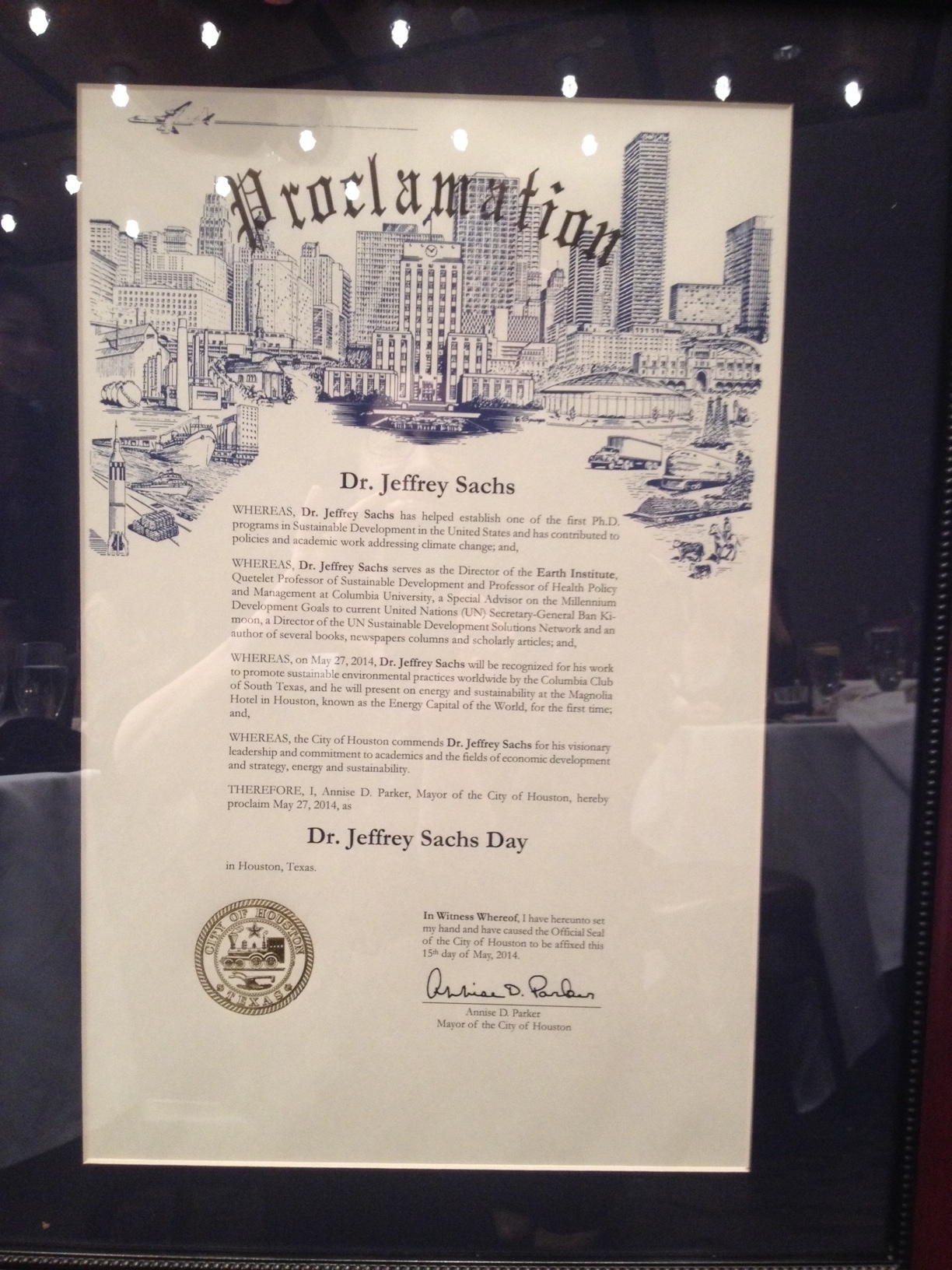
  • Houston Honors Jeffrey Sachs

    Houston Honors Jeffrey Sachs

    The city of Houston honored Jeffrey Sachs on Tuesday proclaiming May 27, 2014 as “Dr. Jeffrey Sachs Day” for his work in the field of sustainable development.

  • Clock Is Ticking in West Antarctic

    Clock Is Ticking in West Antarctic

    “The high-resolution records that we’re getting and the high-resolution models we’re able to make now are sort of moving the questions a little bit closer into human, understandable time frames.”

  • Unexpected Sisters

    Unexpected Sisters

    An ancient island’s trove of treasure: Madagascan fauna Tenrec, fossa, lemur, hippo, dugong, bat, iguana. A giant bird – O, wondrous beast! – a half a ton, and tall, Laid foot-long eggs, had beefy legs, and did not fly at all.

  • Denning to Receive Presidential Award for Outstanding Teaching

    Denning to Receive Presidential Award for Outstanding Teaching

    Professor Glenn Denning, director of the School of International and Public Affairs’ MPA in Development Practice program, will receive a Presidential Award for Outstanding Teaching from Columbia University President Lee C. Bollinger at the University’s commencement ceremony on May 21.

Photo of the Earth from space with the text "Lamont at AGU25" on top.

AGU25, the premier Earth and space science conference, takes place December 15-19, 2025 in New Orleans, Louisiana. This year’s theme—Where Science Connects Us—puts in focus how science depends on connection, from the lab to the field to the ballot box. Once again, Lamont-Doherty Earth Observatory and Columbia Climate School scientists, experts, students, and educators are playing an active role, sharing our research and helping shape the future of our planet. #AGU25 Learn More

  • Some Do Not Like It Hot

    Some Do Not Like It Hot

    The Great Dying, The Big One — The Permo-Triassic! (In a time machine, not sure if that’s where I’d aim …) As extinctions go, this one’s a blockbuster classic, When most of Earth’s species dropped out of the game.

  • Project Aims to Strengthen Climate Resilience

    Project Aims to Strengthen Climate Resilience

    The Caribbean, Asia’s Indo-Gangetic Plain and West Africa are three regions known to be extremely vulnerable to climate variability and change, particularly to droughts, extreme weather events and stresses on food production, water resources and coastal areas. A new five-year project jointly led by the International Research Institute for Climate and Society and the University…

  • Combining Natural History Collections with Fisher Knowledge for Conservation in Fiji

    Combining Natural History Collections with Fisher Knowledge for Conservation in Fiji

    A team of researchers from Columbia University and the Republic of Fiji has found a unique and time-effective way to improve the design of marine protected areas in on coastal fisheries in Fiji—and, potentially, around the world. This method, which was used to assess a proposed temporary fishery closure in the village of Nagigi, Fiji,…

  • How High Will Sea Levels Rise?

    How High Will Sea Levels Rise?

    Scientists from Lamont-Doherty Earth Observatory are trying to determine how high sea levels may rise in the future by studying the shorelines of the past. Led by a team of researchers including Lamont climate scientist and marine geologist Maureen Raymo, the goal of Pliomax is to increase the accuracy of global sea level estimates for…

  • In India, Reducing the Dependency on Monsoon Precipitation

    In India, Reducing the Dependency on Monsoon Precipitation

    The Centers for International Projects Trust has undertaken various low cost technological innovations to reduce the amount of water used for the production of rice and wheat in India. Such innovations not only reduce water usage in agriculture but also make farmers less vulnerable to climate variability, especially as it relates to the monsoon season.

  • Houston Honors Jeffrey Sachs

    Houston Honors Jeffrey Sachs

    The city of Houston honored Jeffrey Sachs on Tuesday proclaiming May 27, 2014 as “Dr. Jeffrey Sachs Day” for his work in the field of sustainable development.

  • Clock Is Ticking in West Antarctic

    Clock Is Ticking in West Antarctic

    “The high-resolution records that we’re getting and the high-resolution models we’re able to make now are sort of moving the questions a little bit closer into human, understandable time frames.”

  • Unexpected Sisters

    Unexpected Sisters

    An ancient island’s trove of treasure: Madagascan fauna Tenrec, fossa, lemur, hippo, dugong, bat, iguana. A giant bird – O, wondrous beast! – a half a ton, and tall, Laid foot-long eggs, had beefy legs, and did not fly at all.

  • Denning to Receive Presidential Award for Outstanding Teaching

    Denning to Receive Presidential Award for Outstanding Teaching

    Professor Glenn Denning, director of the School of International and Public Affairs’ MPA in Development Practice program, will receive a Presidential Award for Outstanding Teaching from Columbia University President Lee C. Bollinger at the University’s commencement ceremony on May 21.