State of the Planet

News from the Columbia Climate School

20145

  • New Data Website Helps Nigeria’s Campaign to Achieve Millennium Development Goals

    Site Tracks Data About Health Clinics, Schools, Other Facilities

  • Student Profile: Denis Tan

    Student Profile: Denis Tan

    For Denis Tan, the MPA in Environmental Science and Policy program has exposed him to a wide variety of real world sustainability issues while training him to be a better team member and manager. Denis hopes to bring his newly acquired training back to his native Singapore to effect change through the creation and development…

  • New Global Maps Detail Human-Caused Ocean Acidification

    Oceans Changing in Step with Rising CO2 Emissions

  • The Greening of China

    The Greening of China

    China became the world’s largest carbon polluter in 2006, surpassing the U.S. But it is also rapidly going green through cutting coal use, investing heavily in renewable energy and launching the world’s largest carbon trading system.

  • Will Africa Finally Achieve a Green Revolution?

    Will Africa Finally Achieve a Green Revolution?

    Earth Institute agricultural scientist Pedro A. Sanchez argues in a new essay that new developments in both science and politics give him hope that sub-Saharan Africa will be able to feed itself by 2050, even with a projected population by then of about 2 billion people.

  • MS Alums Identify Ways to Improve Sustainability Data Management

    MS Alums Identify Ways to Improve Sustainability Data Management

    Over the past few months, three 2014 graduates of the Master of Science in Sustainability Management program Kristina Alnes, Charlotte Peyraud, and Christopher Economides along with current MSSM student Angeline Kong have been studying the U.S. market for sustainability and CSR data management solutions. The team—dubbed the ReScore Project Group— published their finding this week…

  • Money, Power and the Media in the Ebola Crisis

    Money, Power and the Media in the Ebola Crisis

    The Ebola crisis has serious implications for governments, the private sector, and public messengers. To address these issues, and to assess the state of the science behind the Ebola crisis, The Earth Institute has sponsored two discussions recently.

  • Study: NASA Sites Vulnerable to Climate Change

    Study: NASA Sites Vulnerable to Climate Change

    NASA has been at the forefront of climate science, launching satellites that take the pulse of Earth’s land, oceans and atmospheric systems. But the agency is increasingly vulnerable itself to the effects of a changing climate.

  • Climate & Society Institute Opens 1st International Office in Uruguay

    Climate & Society Institute Opens 1st International Office in Uruguay

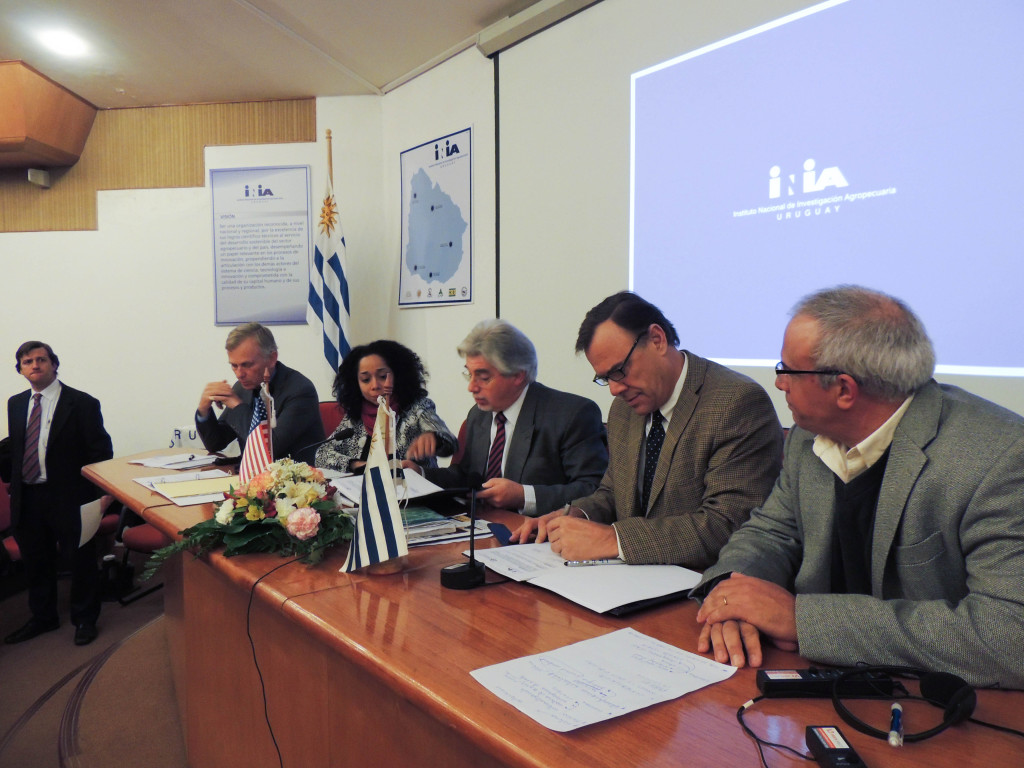
    The International Research Institute for Climate and Society has signed an agreement with Uruguay’s Instituto Nacional de Investigación Agropecuaria to open an IRI office outside of Montevideo and to expand ongoing scientific collaboration between Uruguay and Columbia University.

Photo of the Earth from space with the text "Lamont at AGU25" on top.

AGU25, the premier Earth and space science conference, takes place December 15-19, 2025 in New Orleans, Louisiana. This year’s theme—Where Science Connects Us—puts in focus how science depends on connection, from the lab to the field to the ballot box. Once again, Lamont-Doherty Earth Observatory and Columbia Climate School scientists, experts, students, and educators are playing an active role, sharing our research and helping shape the future of our planet. #AGU25 Learn More

  • New Data Website Helps Nigeria’s Campaign to Achieve Millennium Development Goals

    Site Tracks Data About Health Clinics, Schools, Other Facilities

  • Student Profile: Denis Tan

    Student Profile: Denis Tan

    For Denis Tan, the MPA in Environmental Science and Policy program has exposed him to a wide variety of real world sustainability issues while training him to be a better team member and manager. Denis hopes to bring his newly acquired training back to his native Singapore to effect change through the creation and development…

  • New Global Maps Detail Human-Caused Ocean Acidification

    Oceans Changing in Step with Rising CO2 Emissions

  • The Greening of China

    The Greening of China

    China became the world’s largest carbon polluter in 2006, surpassing the U.S. But it is also rapidly going green through cutting coal use, investing heavily in renewable energy and launching the world’s largest carbon trading system.

  • Will Africa Finally Achieve a Green Revolution?

    Will Africa Finally Achieve a Green Revolution?

    Earth Institute agricultural scientist Pedro A. Sanchez argues in a new essay that new developments in both science and politics give him hope that sub-Saharan Africa will be able to feed itself by 2050, even with a projected population by then of about 2 billion people.

  • MS Alums Identify Ways to Improve Sustainability Data Management

    MS Alums Identify Ways to Improve Sustainability Data Management

    Over the past few months, three 2014 graduates of the Master of Science in Sustainability Management program Kristina Alnes, Charlotte Peyraud, and Christopher Economides along with current MSSM student Angeline Kong have been studying the U.S. market for sustainability and CSR data management solutions. The team—dubbed the ReScore Project Group— published their finding this week…

  • Money, Power and the Media in the Ebola Crisis

    Money, Power and the Media in the Ebola Crisis

    The Ebola crisis has serious implications for governments, the private sector, and public messengers. To address these issues, and to assess the state of the science behind the Ebola crisis, The Earth Institute has sponsored two discussions recently.

  • Study: NASA Sites Vulnerable to Climate Change

    Study: NASA Sites Vulnerable to Climate Change

    NASA has been at the forefront of climate science, launching satellites that take the pulse of Earth’s land, oceans and atmospheric systems. But the agency is increasingly vulnerable itself to the effects of a changing climate.

  • Climate & Society Institute Opens 1st International Office in Uruguay

    Climate & Society Institute Opens 1st International Office in Uruguay

    The International Research Institute for Climate and Society has signed an agreement with Uruguay’s Instituto Nacional de Investigación Agropecuaria to open an IRI office outside of Montevideo and to expand ongoing scientific collaboration between Uruguay and Columbia University.