State of the Planet

News from the Columbia Climate School

201633

  • When Environmental Oversight Takes a Back Seat

    When Environmental Oversight Takes a Back Seat

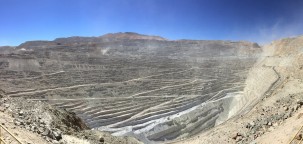
    The government of Peru faces significant pressure to encourage growth and investment in the mining sector, but this has also put pressure on the government’s ability to properly assess environmental impacts.

  • Climate Change and the Paris Agreement: What’s Next?

    Climate Change and the Paris Agreement: What’s Next?

    “Climate change is an extreme example of what happens when you do not have sustainable development. We will not address climate change unless we change the patterns of production and consumption that drove us to this situation in the first place.”

  • Spring 2016 Earth Institute Research Showcase

    Spring 2016 Earth Institute Research Showcase

    Read Flusser studied bamboo and its potential as a feedstock for efficient, second-generation biofuels. Alixandra Prybyla conducted groundbreaking research on the genus Leptarctus, a long-extinct mammal. Marisol Rodriguez worked on a financial model for solar investing. These are just three of the student projects on display at the recent Student Research Showcase.

  • Motivating Sustainable Action on the Ground

    Motivating Sustainable Action on the Ground

    MSSM student Ajay Ranjith Vempati believes that the most important skill he has acquired is understanding the needs of stakeholders and their influence on the implementation of sustainability practices and translating sustainability solutions into dollar impacts.

  • Making Fish Farming More Sustainable

    Making Fish Farming More Sustainable

    Global per capita fish consumption has almost doubled in the last 50 years. And today, about half of all the seafood we eat is produced through fish farming, aquaculture. Can it be done sustainably?

  • Zeroing in on Life Around a Hydrothermal Vent

    Zeroing in on Life Around a Hydrothermal Vent

    Vicki Ferrini has spent a lot of time working on mapping the ocean floor, and now she’s sailing in the South Pacific to get a closer look.

  • Ruth DeFries, Jeffrey Sachs Named University Professors

    Ruth DeFries, Jeffrey Sachs Named University Professors

    Ruth DeFries and Jeffrey Sachs have been named University Professors, the highest rank Columbia University bestows on its faculty.

  • Migration Mysteries of the American Robin

    Migration Mysteries of the American Robin

    Ecologist Natalie Boelman is headed back to the far north to study birds—this time to the town of Slave Lake, in northern Alberta, Canada, to track the migration of American robins. She will have some schoolchildren in New York remotely helping her as she and her colleagues get to work.

  • Philanthropy and Inequality

    Philanthropy and Inequality

    In the field of philanthropy, foundations have been confronted with how to address structural racism and various forms of systemic inequities. How can foundations play a greater role in reducing racial disparities, promoting criminal justice reform, and tackling any range of manifestations of inequality?

Photo of the Earth from space with the text "Lamont at AGU25" on top.

AGU25, the premier Earth and space science conference, takes place December 15-19, 2025 in New Orleans, Louisiana. This year’s theme—Where Science Connects Us—puts in focus how science depends on connection, from the lab to the field to the ballot box. Once again, Lamont-Doherty Earth Observatory and Columbia Climate School scientists, experts, students, and educators are playing an active role, sharing our research and helping shape the future of our planet. #AGU25 Learn More

  • When Environmental Oversight Takes a Back Seat

    When Environmental Oversight Takes a Back Seat

    The government of Peru faces significant pressure to encourage growth and investment in the mining sector, but this has also put pressure on the government’s ability to properly assess environmental impacts.

  • Climate Change and the Paris Agreement: What’s Next?

    Climate Change and the Paris Agreement: What’s Next?

    “Climate change is an extreme example of what happens when you do not have sustainable development. We will not address climate change unless we change the patterns of production and consumption that drove us to this situation in the first place.”

  • Spring 2016 Earth Institute Research Showcase

    Spring 2016 Earth Institute Research Showcase

    Read Flusser studied bamboo and its potential as a feedstock for efficient, second-generation biofuels. Alixandra Prybyla conducted groundbreaking research on the genus Leptarctus, a long-extinct mammal. Marisol Rodriguez worked on a financial model for solar investing. These are just three of the student projects on display at the recent Student Research Showcase.

  • Motivating Sustainable Action on the Ground

    Motivating Sustainable Action on the Ground

    MSSM student Ajay Ranjith Vempati believes that the most important skill he has acquired is understanding the needs of stakeholders and their influence on the implementation of sustainability practices and translating sustainability solutions into dollar impacts.

  • Making Fish Farming More Sustainable

    Making Fish Farming More Sustainable

    Global per capita fish consumption has almost doubled in the last 50 years. And today, about half of all the seafood we eat is produced through fish farming, aquaculture. Can it be done sustainably?

  • Zeroing in on Life Around a Hydrothermal Vent

    Zeroing in on Life Around a Hydrothermal Vent

    Vicki Ferrini has spent a lot of time working on mapping the ocean floor, and now she’s sailing in the South Pacific to get a closer look.

  • Ruth DeFries, Jeffrey Sachs Named University Professors

    Ruth DeFries, Jeffrey Sachs Named University Professors

    Ruth DeFries and Jeffrey Sachs have been named University Professors, the highest rank Columbia University bestows on its faculty.

  • Migration Mysteries of the American Robin

    Migration Mysteries of the American Robin

    Ecologist Natalie Boelman is headed back to the far north to study birds—this time to the town of Slave Lake, in northern Alberta, Canada, to track the migration of American robins. She will have some schoolchildren in New York remotely helping her as she and her colleagues get to work.

  • Philanthropy and Inequality

    Philanthropy and Inequality

    In the field of philanthropy, foundations have been confronted with how to address structural racism and various forms of systemic inequities. How can foundations play a greater role in reducing racial disparities, promoting criminal justice reform, and tackling any range of manifestations of inequality?