State of the Planet

News from the Columbia Climate School

Earth Sciences109

  • Drilling into the Jurassic in New Jersey

    Drilling into the Jurassic in New Jersey

    One hour from New York City, where the suburbs of New Jersey give way to farms, a team of scientists are drilling for ancient rocks on the edge of a cornfield. The rocks hold clues about what the earth was like about 201 million years ago,during the great extinction that allowed dinosaurs to dominate. Listen…

  • The Intersection of Population and Elevation Examined

    The Intersection of Population and Elevation Examined

    This map shows the estimated number of people in 2010 living at different elevation levels across several Southern Asian countries. The database it’s taken from lets users without specialized geospatial training or software compare populations in various environmental contexts in different countries.

  • New Program in Tropical Biology and Sustainability

    The Tropical Biology and Sustainability Program will allow students the opportunity to study ecology, evolutionary biology, conservation biology, environmental engineering, and sustainable development in the environmental hub of East Africa.

  • Shrinking Glaciers: A Chronology of Climate Change

    Shrinking Glaciers: A Chronology of Climate Change

    During the last ice age, glaciers dominated New Zealand’s Southern Alps until warming temperatures some 20,000 years ago sent them into retreat. Scientists at Lamont-Doherty Earth Observatory, with their colleagues, are investigating the rocky remnants these glaciers left behind to learn precisely when the ice withdrew, and what glacier retreats globally can tell us about…

  • Chasing Ghengis Khan

    Chasing Ghengis Khan

    Once you, as an outsider, spend considerable time in Mongolia, especially during Naadam and especially in the open Gobi steppe with people who still live as their ancestors did centuries ago, you will also begin to chase Chinggis Khaan.

  • In the Woods Listening for the Langseth

    In the Woods Listening for the Langseth

    Our sensors record the same seismic signals as the ocean bottom seismometers the R/V Oceanus deployed, and we will combine the data later. They can detect R/V Langseth signals up to 100 miles inland! This is something extraordinary, and difficult to believe until seen.

  • Investigating the World’s Oceans, Pole to Pole and Deep Below the Bottom

    Investigating the World’s Oceans, Pole to Pole and Deep Below the Bottom

    Watch a slide show featuring ongoing research by scientists at Columbia University’s Lamont-Doherty Earth Observatory, whose work around the globe is key to understanding past changes in the oceans and what is going on today.

  • Water Samples and Wildlife

    Water Samples and Wildlife

    After a day of coring on Tuesday, we decided to give our arms and backs a rest and collect water and plant samples. We take these samples so that we can characterize the chemical signatures of each plant type, and water from different parts of the system. Then, we can recognize those same signatures in…

  • Passing Ships in the Night

    Passing Ships in the Night

    By Helene Carton As part of our study of the Juan de Fuca plate from its birth at the mid-ocean ridge to its recycling at the Cascadia subduction zone, the R/V Oceanus has the task of conducting Ocean Bottom Seismometer (OBS) operations and oceanographic measurements: this is done in close coordination with the R/V Langseth,…

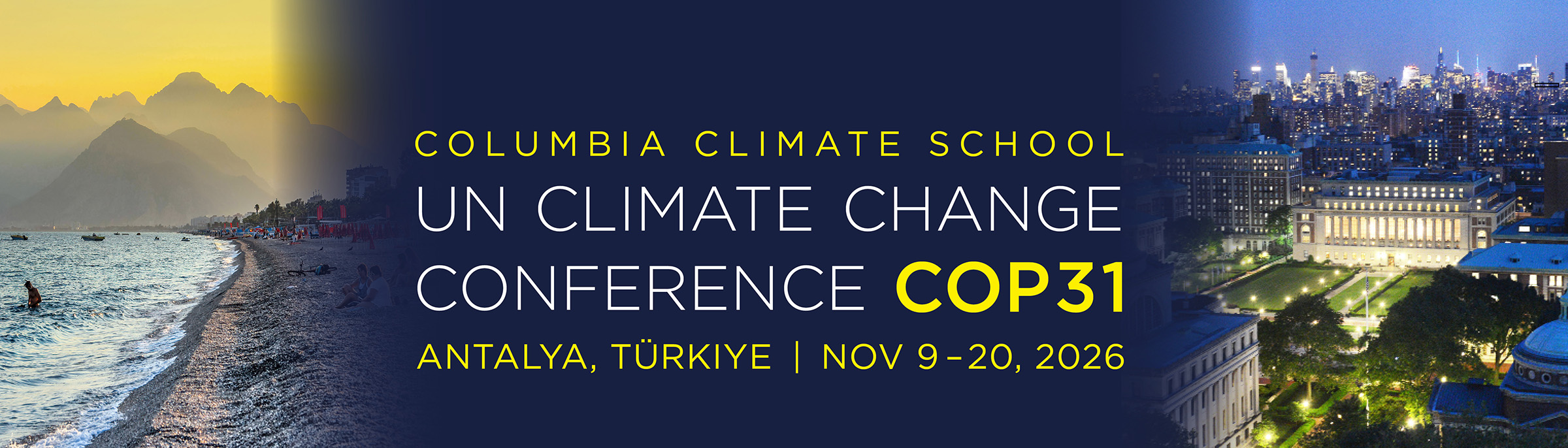
Collage of Turkiye beach scene and Columbia University Campus with text: UN Climate Change Conference COP31, Antalya, Turkiye, Nov 9-20, 2026

COP31, the 2026 United Nations Climate Change Conference, aims to advance dialogue, strengthen consensus, and accelerate climate action on a global scale. From November 9–20, 2026 in Antalya, Türkiye, heads of state, ministers, scientists, business leaders, and civil society will gather to advance efforts in emission targets, climate finance, and adaptation and resilience. Once again, our experts, students, and global thought leaders from Columbia Climate School and across Columbia University are contributing to key events, sharing insights, and helping shape the dialogue toward ambitious, science-based solutions. Learn More

  • Drilling into the Jurassic in New Jersey

    Drilling into the Jurassic in New Jersey

    One hour from New York City, where the suburbs of New Jersey give way to farms, a team of scientists are drilling for ancient rocks on the edge of a cornfield. The rocks hold clues about what the earth was like about 201 million years ago,during the great extinction that allowed dinosaurs to dominate. Listen…

  • The Intersection of Population and Elevation Examined

    The Intersection of Population and Elevation Examined

    This map shows the estimated number of people in 2010 living at different elevation levels across several Southern Asian countries. The database it’s taken from lets users without specialized geospatial training or software compare populations in various environmental contexts in different countries.

  • New Program in Tropical Biology and Sustainability

    The Tropical Biology and Sustainability Program will allow students the opportunity to study ecology, evolutionary biology, conservation biology, environmental engineering, and sustainable development in the environmental hub of East Africa.

  • Shrinking Glaciers: A Chronology of Climate Change

    Shrinking Glaciers: A Chronology of Climate Change

    During the last ice age, glaciers dominated New Zealand’s Southern Alps until warming temperatures some 20,000 years ago sent them into retreat. Scientists at Lamont-Doherty Earth Observatory, with their colleagues, are investigating the rocky remnants these glaciers left behind to learn precisely when the ice withdrew, and what glacier retreats globally can tell us about…

  • Chasing Ghengis Khan

    Chasing Ghengis Khan

    Once you, as an outsider, spend considerable time in Mongolia, especially during Naadam and especially in the open Gobi steppe with people who still live as their ancestors did centuries ago, you will also begin to chase Chinggis Khaan.

  • In the Woods Listening for the Langseth

    In the Woods Listening for the Langseth

    Our sensors record the same seismic signals as the ocean bottom seismometers the R/V Oceanus deployed, and we will combine the data later. They can detect R/V Langseth signals up to 100 miles inland! This is something extraordinary, and difficult to believe until seen.

  • Investigating the World’s Oceans, Pole to Pole and Deep Below the Bottom

    Investigating the World’s Oceans, Pole to Pole and Deep Below the Bottom

    Watch a slide show featuring ongoing research by scientists at Columbia University’s Lamont-Doherty Earth Observatory, whose work around the globe is key to understanding past changes in the oceans and what is going on today.

  • Water Samples and Wildlife

    Water Samples and Wildlife

    After a day of coring on Tuesday, we decided to give our arms and backs a rest and collect water and plant samples. We take these samples so that we can characterize the chemical signatures of each plant type, and water from different parts of the system. Then, we can recognize those same signatures in…

  • Passing Ships in the Night

    Passing Ships in the Night

    By Helene Carton As part of our study of the Juan de Fuca plate from its birth at the mid-ocean ridge to its recycling at the Cascadia subduction zone, the R/V Oceanus has the task of conducting Ocean Bottom Seismometer (OBS) operations and oceanographic measurements: this is done in close coordination with the R/V Langseth,…