Earth Sciences57
-

Researchers Model Differences in East Coast Sea Level Rise
For years, scientists have been warning of a so-called “hot spot” of accelerated sea-level rise along the northeastern U.S. coast. But accurately modeling this acceleration as well as variations in sea-level rise from one region to another has proven challenging. Now new research offers the first comprehensive model for understanding differences in sea level rise…
-

Why I Decided to Stand Up for Climate Science
A young researcher explains why she is taking to advocacy for science.
-

Rock Samples Indicate Water is Key Ingredient for Crust Formation
By examining the cooling rate of rocks that formed more than 10 miles beneath the Earth’s surface, scientists led by The University of Texas at Austin Jackson School of Geosciences have found that water probably penetrates deep into the crust and upper mantle at mid-ocean spreading zones, the places where new crust is made.
-

Webcast Today: Rich and Poor, and the Essence of El Niño
How does El Niño work, and how does it affect our climate, food supplies and water availability? The two men whose scientific work has been key to solving these puzzles will be honored Wednesday with the Vetlesen Prize, marking a major achievement in Earth sciences. And this afternoon, they’ll have something to say about it…
-

Our Economy Depends on Earth Observation and Scientific Research
If we are to continue to grow our economy without destroying the planet’s basic systems that sustain human life, we need to learn a great deal more about our planet and the impact of human activities on natural systems.
-

Pratigya Polissar Sees Landscapes Changing Through a Microscope
The word fossils typically conjures images of T-Rexes and trilobites. Pratigya Polissar thinks micro: A paleoclimatologist, he digs into old sediments and studies molecular fossils—the microscopic remains of plants and animals that can tell us a lot about what was living in a particular time period.
-

Kirsty Tinto: Mapping on and under Antarctica’s Ice
Kirsty Tinto flies aboard a specially equipped airplane in very cold places to study ice sheets and ice shelves. She’s an associate research scientist in the polar geophysics group at Lamont-Doherty Earth Observatory.
-

Park Williams Discovers History and Science in a Tree Ring
Park Williams studies trees and climate, in particular the causes of drought and the effects of climate change on forests. In this latest in a series of Earth Institute videos, we spoke to him about what he does, what’s important about it, and how his interest in history and environmental science blended into a career.
-

Work on Dead Sea Geology Earns Yael Kiro an Award
Yael Kiro, an associate research scientist at Lamont-Doherty Earth Observatory, has received the 2017 Professor Rafi Freund Award from the Israel Geological Society for work published on the ancient climate history of the Dead Sea.


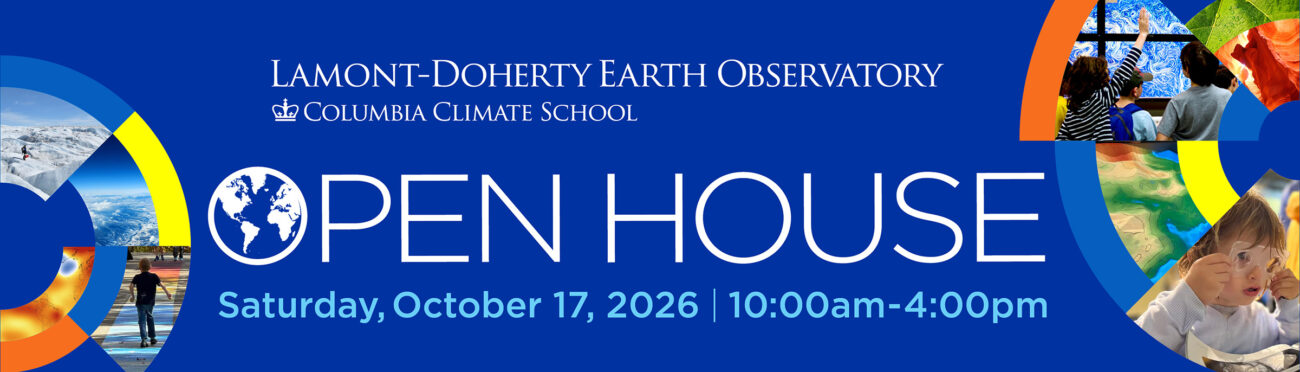
On Saturday, October 17, 2026 from 10am to 4pm, Lamont-Doherty Earth Observatory Open House—our biggest, best science fun and discovery event of the year—will take place on our beautiful campus in Palisades, NY. Mark your calendar and join us for this free, family-friendly celebration of science! RSVP Today!
