General147
-
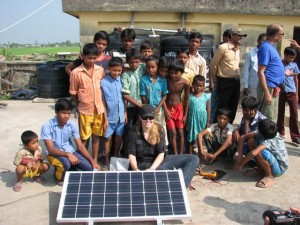
Polder 32
Polder 32 is one of the many inland islands in Bangladesh that was enclosed by an embankment to protect it from flooding. When that embankment failed during Cyclone Aila in 2009, the island was flooded for almost 2 years. Subsidence of the ground inside the embankment with no sedimentation to compensate made it worse. We…
-

Khepupara to Kokilmoni
Leaving Dhaka, we spend an entire day getting to Khepupara in southern Bangladesh. Then we spent a long morning installing a GPS to monitor subsidence of the delta before heading back on the road again.
-

Launching the Season with a Key Mission – IceBridge Antarctica 2012
This month, IceBridge Antarctica resumes. The crews have spent the last few weeks in Palmdale, where the DC8 is based, for instrument installation and test flights prior to our move down to Punta Arenas, our home base for IceBridge Antarctica.
-
Influencing Students Towards a More Sustainable Path
In a recent interview, Dr. Stuart Gaffin provided his thoughts on the direction that the field of sustainability is moving into. In his words, urban environmental research is the topic of the day: “Many cities, including New York, are putting ambitious plans in place to reduce emissions, and implement adaptation practices, including novel green infrastructure…
-

Applying Classroom Theory in the Forest
Under-graduate and graduate students from Columbia University joined professors Kevin Griffin and Matthew Palmer in September for the first of 10 field trips outside of the New York City area. Dr. Griffin and Dr. Palmer teach Forest Ecology, a course that combines classroom theory with hands-on experience and training in methods of ecological field work.
-

The Truth About Verification
The December 2011 precipitation forecast issued by the International Research Institute for Climate and Society called for a 75 percent chance of above normal precipitation over parts of the Philippines between January and March. As the months played out, storms brought roughly eight inches more rain than usual for the period. That’s about 85 percent…
-

Faculty Profile: Lynnette Widder
Master of Science in Sustainability Management (MSSM) professor Lynnette Widder has over fifteen years of experience teaching design, conducting seminars, and organizing architectural excursions for architecture students at the undergraduate and graduate levels. She is the Principal and Co-founder of aardvarchitecture, a small architectural practice that specializes in residential work with an emphasis on high-quality…
-

Faculty Profile: Jeffrey Shaman
Jeffrey Shaman has never been one to study or do anything in isolation, but has always chosen to focus on the intersection of how things work. Given this trait, it is no surprise that his interdisciplinary research looks to reveal how meteorology and hydrology affect the propagation of infectious diseases.
-

To Comilla and Back
I’ve just arrived back in Bangladesh with an engineer to install 6 new GPS stations to add to our studies of earthquake hazards and land subsidence. Our first stop was Comilla University, the westernmost exposed fold of the collision between the Ganges-Bramaputra Delta and the Sumatra-Andaman-Burma plat boundary.



COP31, the 2026 United Nations Climate Change Conference, aims to advance dialogue, strengthen consensus, and accelerate climate action on a global scale. From November 9–20, 2026 in Antalya, Türkiye, heads of state, ministers, scientists, business leaders, and civil society will gather to advance efforts in emission targets, climate finance, and adaptation and resilience. Once again, our experts, students, and global thought leaders from Columbia Climate School and across Columbia University are contributing to key events, sharing insights, and helping shape the dialogue toward ambitious, science-based solutions. Learn More
