State of the Planet

News from the Columbia Climate School

General181

  • Executive Courses in Conservation, Sustainability

    Executive Courses in Conservation, Sustainability

    The Center for Environmental Research and Conservation at Columbia University provides professionals with the knowledge and tools to be effective environmental leaders and decision makers in the 21st century. It is an evening program in which environmental issues are discussed, debated and examined, where participants develop an in-depth understanding of conservation science and practice through…

  • Extinction Exposed – The Sea Otter

    Extinction Exposed – The Sea Otter

    Despite being a keystone species in important ecosystems that span the northern and eastern North Pacific Ocean, sea otters have historically had a complex and sometimes troubling relationship with humans.

  • Drilling for Carbon-Storing Rocks in Suburban New York

    Drilling for Carbon-Storing Rocks in Suburban New York

    Under the shopping malls and highways of suburbia, there might one day be a partial fix for global warming. Since August, engineers have been drilling just west of the Tappan Zee Bridge to collect samples of rock from the Newark Basin, an ancient rock formation stretching beneath New York, New Jersey and Pennsylvania. As they…

  • Crossing Sectors, Growing Economies

    Crossing Sectors, Growing Economies

    Coordinating the resources of academia, government, non-profits and the private sector can promote industrial innovation and create jobs; it also can improve education, limit the spread of diseases and increase access to food.

  • Apply for *NEW* Executive Course in Energy and Sustainability

    Apply for *NEW* Executive Course in Energy and Sustainability

    Learn more about CERC’s new course, Energy and Sustainability, which examines the evolution of issues, attitudes, and policies surrounding energy production and use through time, and its relationship to sustainable living.

  • Population Map Shows How Close Irene Came to Being Even Bigger Disaster

    Population Map Shows How Close Irene Came to Being Even Bigger Disaster

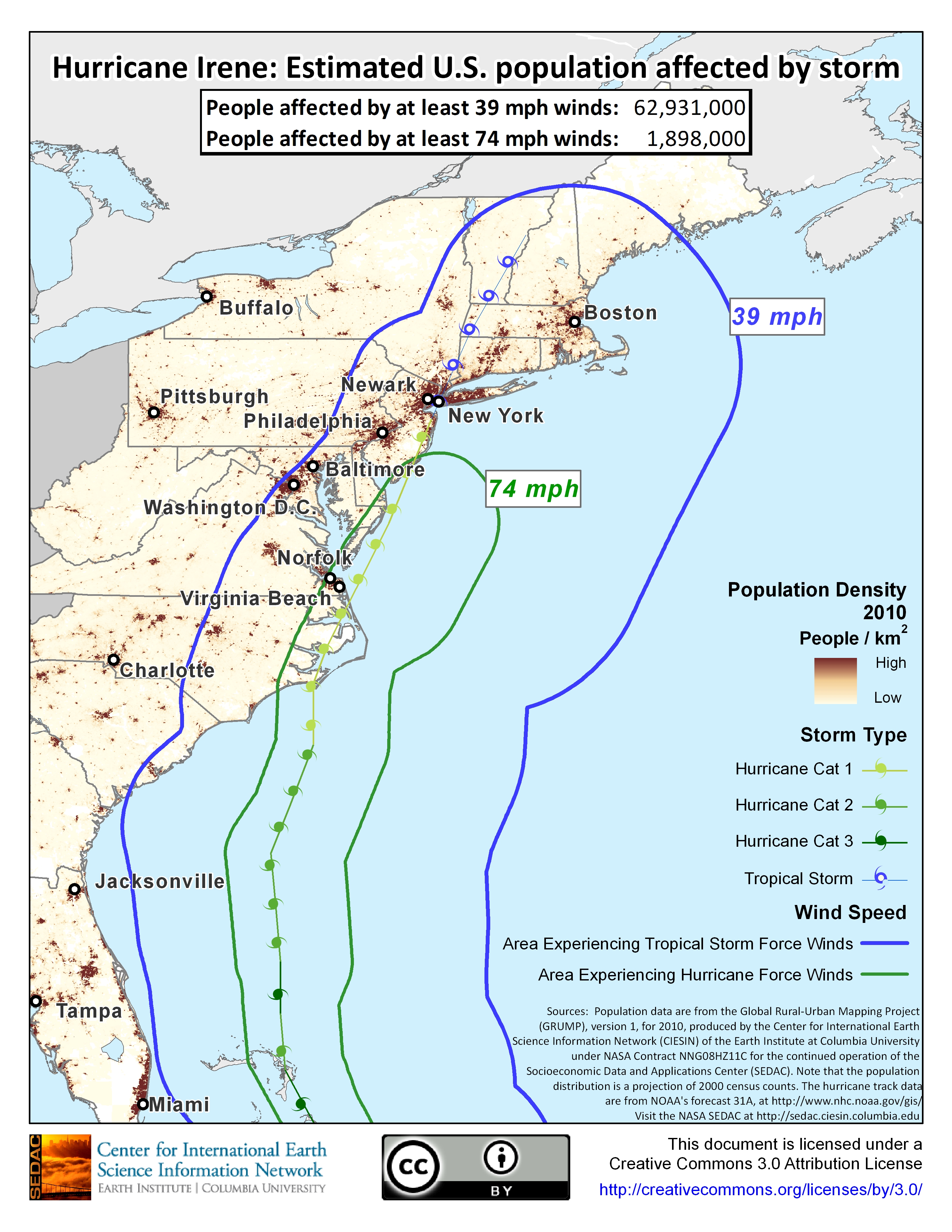
    A stark picture of how close Hurricane Irene came to being an even more serious disaster than it was emerges by overlaying a map of the storm track with a population distribution map.  What made the storm as bad as it was had a lot to do with the fact that its trajectory took it…

  • Insuring Against Drought

    Insuring Against Drought

    Research economist Dan Osgood discusses index insurance and how it is helping some poor rural communities reduce hardships caused by drought in East Africa.

  • Walking the Tightrope of Groundwater Management

    Walking the Tightrope of Groundwater Management

    As climate changes and supplying water becomes more challenging, one company says it has a better management strategy.

  • Track the Number of People in Irene’s Path

    Track the Number of People in Irene’s Path

    As Hurricane Irene barrels up the East Coast, the number of people affected is rising. Based on calculations at 2 pm on Saturday, more than 47 million people were within 100 miles of the storm track; and nearly 69 million within 200 miles, according to Columbia’s Center for International Earth Science Information Network(CIESIN). Visit CIESIN’s…

Collage of Turkiye beach scene and Columbia University Campus with text: UN Climate Change Conference COP31, Antalya, Turkiye, Nov 9-20, 2026

COP31, the 2026 United Nations Climate Change Conference, aims to advance dialogue, strengthen consensus, and accelerate climate action on a global scale. From November 9–20, 2026 in Antalya, Türkiye, heads of state, ministers, scientists, business leaders, and civil society will gather to advance efforts in emission targets, climate finance, and adaptation and resilience. Once again, our experts, students, and global thought leaders from Columbia Climate School and across Columbia University are contributing to key events, sharing insights, and helping shape the dialogue toward ambitious, science-based solutions. Learn More

  • Executive Courses in Conservation, Sustainability

    Executive Courses in Conservation, Sustainability

    The Center for Environmental Research and Conservation at Columbia University provides professionals with the knowledge and tools to be effective environmental leaders and decision makers in the 21st century. It is an evening program in which environmental issues are discussed, debated and examined, where participants develop an in-depth understanding of conservation science and practice through…

  • Extinction Exposed – The Sea Otter

    Extinction Exposed – The Sea Otter

    Despite being a keystone species in important ecosystems that span the northern and eastern North Pacific Ocean, sea otters have historically had a complex and sometimes troubling relationship with humans.

  • Drilling for Carbon-Storing Rocks in Suburban New York

    Drilling for Carbon-Storing Rocks in Suburban New York

    Under the shopping malls and highways of suburbia, there might one day be a partial fix for global warming. Since August, engineers have been drilling just west of the Tappan Zee Bridge to collect samples of rock from the Newark Basin, an ancient rock formation stretching beneath New York, New Jersey and Pennsylvania. As they…

  • Crossing Sectors, Growing Economies

    Crossing Sectors, Growing Economies

    Coordinating the resources of academia, government, non-profits and the private sector can promote industrial innovation and create jobs; it also can improve education, limit the spread of diseases and increase access to food.

  • Apply for *NEW* Executive Course in Energy and Sustainability

    Apply for *NEW* Executive Course in Energy and Sustainability

    Learn more about CERC’s new course, Energy and Sustainability, which examines the evolution of issues, attitudes, and policies surrounding energy production and use through time, and its relationship to sustainable living.

  • Population Map Shows How Close Irene Came to Being Even Bigger Disaster

    Population Map Shows How Close Irene Came to Being Even Bigger Disaster

    A stark picture of how close Hurricane Irene came to being an even more serious disaster than it was emerges by overlaying a map of the storm track with a population distribution map.  What made the storm as bad as it was had a lot to do with the fact that its trajectory took it…

  • Insuring Against Drought

    Insuring Against Drought

    Research economist Dan Osgood discusses index insurance and how it is helping some poor rural communities reduce hardships caused by drought in East Africa.

  • Walking the Tightrope of Groundwater Management

    Walking the Tightrope of Groundwater Management

    As climate changes and supplying water becomes more challenging, one company says it has a better management strategy.

  • Track the Number of People in Irene’s Path

    Track the Number of People in Irene’s Path

    As Hurricane Irene barrels up the East Coast, the number of people affected is rising. Based on calculations at 2 pm on Saturday, more than 47 million people were within 100 miles of the storm track; and nearly 69 million within 200 miles, according to Columbia’s Center for International Earth Science Information Network(CIESIN). Visit CIESIN’s…