State of the Planet

News from the Columbia Climate School

General191

  • Gulf Oil Spill Resources

    Earth Institute researchers in many disciplines are studying the Gulf of Mexico oil spill, and are available to provide information and perspective to press. These include experts in regional seafloor geology; technology of deepwater drilling and spill control; measurement of spill flow; potential movements via underwater or surface currents; possible biological effects; potential effects of…

  • Changing Lives One Surgery at a Time: A Team of Urologists Makes an Impact in Kisumu, Kenya

    Imagine living out in Western Kenya, suffering from a urological disorder, without access to an affordable specialist. That may be difficult for many of us to picture; unfortunately, that is the reality for hundreds of people living in Kisumu, Kenya, and the surrounding province. With only one urologist in the entire catchment area of five…

  • UN Secretary-General Makes First Trip to Millennium Village

    Official press release: United Nations Secretary-General Makes First Trip to Millennium Village A run through of remarks the SG made on the Millennium Development Goals and his trip to Mwandama. First his address to the Malawi Parliament. Then speaking to the press on what he saw in Mwandama. Millennium Promise CEO, John McArthur writes, on…

  • Addressing South Asia’s Urgent Global Issues Through Sustainable Development

    As the world’s leading academic center addressing the practical challenges of sustainable development, the Earth Institute is building a formal presence in South Asia through the Columbia Global Center/South Asia.  The center, established by Columbia University, joins centers already in place in Europe, the Middle-East, and East Asia. Under the leadership of Founding Director Dr.…

  • Communities Participate to Lower Arsenic Exposure More Effectively in Bangladesh

    There are more than 30 million people in Bangladesh at risk from arsenic contaminated water, which can cause health problems including thickening and hardening of the hands and feet, skin cancer, bladder cancer, lung cancer, vascular disease leading to gangrene, and diabetes. Columbia University scientists from the Mailman School of Public Health and Lamont-Doherty Earth…

  • A Distinguished Career: Wally Broecker

    For more than half a century, Wally Broecker’s pioneering climate research and his legendary reputation as a revered mentor to generations of young scientists have been a magnet attracting exceptional students and post-docs to Columbia’s Lamont-Doherty Earth Observatory. On April 16th, the Columbia community celebrated the 50 years Broecker has spent teaching in the University’s…

  • Sustainable Development Concentrators Celebrate Graduation at Special Breakfast Reception

    Students from the undergraduate special concentration in sustainable development celebrated their graduation from Columbia College and the School of General Studies on May 18 at a special breakfast held for them in Columbia’s Faculty House. Family, friends and faculty gathered with students who reflected on the achievements of the last four years and recalled sustainable…

  • MCI’s School2School Program Creates Mutually Beneficial Partnerships

    Can students living continents apart learn from one another, using basic technology? The Millennium Cities School2School partnership program (S2S) is quickly proving that distance learning is not only possible, it is a wonderful way to enhance students’ academic skills and increase their knowledge of important global issues – while allowing them to learn about new…

  • The shrinking face of Jacobshavn Isbrae (Glacier)

    Jacobshavn Isbrae is one of the fastest moving and most productive glaciers in the world. Scientists estimate that close to the snout (front) its movement has accelerated in recent years from 20 to 40 meters a day. At the same time that the front has accelerated the glacier  has been rapidly retreating through ‘calving’ (large sections breaking…
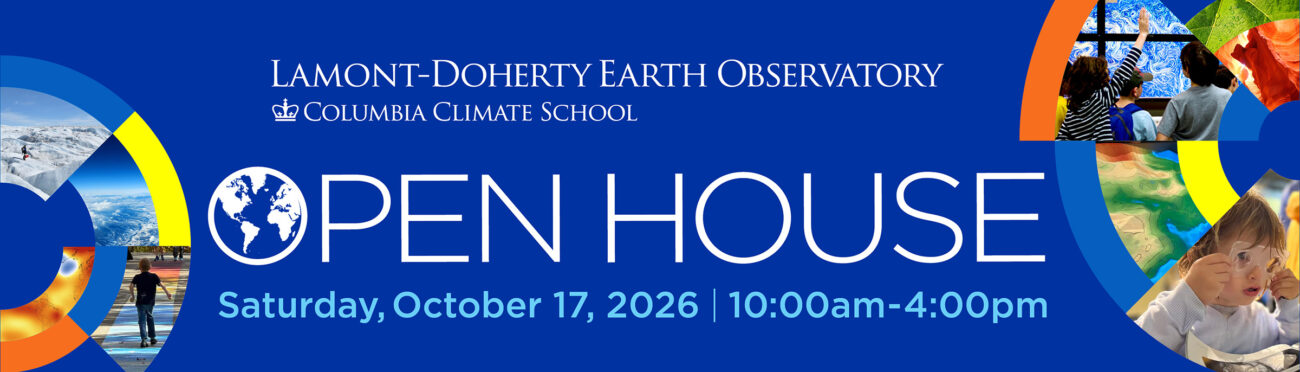
Blue banner with kids and Earth photos. Text: "Lamont-Doherty Earth Observatory Open House, Saturday, October 17, 2026, 10am-4pm.

On Saturday, October 17, 2026 from 10am to 4pm, Lamont-Doherty Earth Observatory Open House—our biggest, best science fun and discovery event of the year—will take place on our beautiful campus in Palisades, NY. Mark your calendar and join us for this free, family-friendly celebration of science! RSVP Today!

  • Gulf Oil Spill Resources

    Earth Institute researchers in many disciplines are studying the Gulf of Mexico oil spill, and are available to provide information and perspective to press. These include experts in regional seafloor geology; technology of deepwater drilling and spill control; measurement of spill flow; potential movements via underwater or surface currents; possible biological effects; potential effects of…

  • Changing Lives One Surgery at a Time: A Team of Urologists Makes an Impact in Kisumu, Kenya

    Imagine living out in Western Kenya, suffering from a urological disorder, without access to an affordable specialist. That may be difficult for many of us to picture; unfortunately, that is the reality for hundreds of people living in Kisumu, Kenya, and the surrounding province. With only one urologist in the entire catchment area of five…

  • UN Secretary-General Makes First Trip to Millennium Village

    Official press release: United Nations Secretary-General Makes First Trip to Millennium Village A run through of remarks the SG made on the Millennium Development Goals and his trip to Mwandama. First his address to the Malawi Parliament. Then speaking to the press on what he saw in Mwandama. Millennium Promise CEO, John McArthur writes, on…

  • Addressing South Asia’s Urgent Global Issues Through Sustainable Development

    As the world’s leading academic center addressing the practical challenges of sustainable development, the Earth Institute is building a formal presence in South Asia through the Columbia Global Center/South Asia.  The center, established by Columbia University, joins centers already in place in Europe, the Middle-East, and East Asia. Under the leadership of Founding Director Dr.…

  • Communities Participate to Lower Arsenic Exposure More Effectively in Bangladesh

    There are more than 30 million people in Bangladesh at risk from arsenic contaminated water, which can cause health problems including thickening and hardening of the hands and feet, skin cancer, bladder cancer, lung cancer, vascular disease leading to gangrene, and diabetes. Columbia University scientists from the Mailman School of Public Health and Lamont-Doherty Earth…

  • A Distinguished Career: Wally Broecker

    For more than half a century, Wally Broecker’s pioneering climate research and his legendary reputation as a revered mentor to generations of young scientists have been a magnet attracting exceptional students and post-docs to Columbia’s Lamont-Doherty Earth Observatory. On April 16th, the Columbia community celebrated the 50 years Broecker has spent teaching in the University’s…

  • Sustainable Development Concentrators Celebrate Graduation at Special Breakfast Reception

    Students from the undergraduate special concentration in sustainable development celebrated their graduation from Columbia College and the School of General Studies on May 18 at a special breakfast held for them in Columbia’s Faculty House. Family, friends and faculty gathered with students who reflected on the achievements of the last four years and recalled sustainable…

  • MCI’s School2School Program Creates Mutually Beneficial Partnerships

    Can students living continents apart learn from one another, using basic technology? The Millennium Cities School2School partnership program (S2S) is quickly proving that distance learning is not only possible, it is a wonderful way to enhance students’ academic skills and increase their knowledge of important global issues – while allowing them to learn about new…

  • The shrinking face of Jacobshavn Isbrae (Glacier)

    Jacobshavn Isbrae is one of the fastest moving and most productive glaciers in the world. Scientists estimate that close to the snout (front) its movement has accelerated in recent years from 20 to 40 meters a day. At the same time that the front has accelerated the glacier  has been rapidly retreating through ‘calving’ (large sections breaking…