State of the Planet

News from the Columbia Climate School

General99

  • Can Eco-Tourism Lead to an ‘Eco-Civilization’?

    Can Eco-Tourism Lead to an ‘Eco-Civilization’?

    Does blending a group of respected business professionals, academics, spiritual leaders, media, policy specialists and artists in a custom eco-tourism experience provide a pathway to developing a passionate and committed group of individuals?

  • Student Profile: Semee Yoon

    Student Profile: Semee Yoon

    It was by chance that Semee Yoon, a Columbia College junior studying economics, ended up working toward the undergraduate special concentration in sustainable development. Her first introduction to the field occurred while working as a translator for the Korean Federation of Environmental Movement. There she acquired exposure to sustainable development firsthand as she translated for…

  • Student Profile: Marta Vicarelli

    Student Profile: Marta Vicarelli

    When Marta Vicarelli first heard the term “sustainable development,” she was in high school. “At that time, environmental concerns were not a priority in the international agenda,” explains Marta, a fourth year Ph.D. candidate in Columbia University’s School of International and Public Affairs (SIPA) program in sustainable development. The Ph.D. program, which started five years…

  • Student Profile: Nathan Chan

    Student Profile: Nathan Chan

    After graduating from college with a dual degree in earth and environmental engineering and English literature from the California Institute of Technology, Nathan Chan searched for a program where he could effectively apply his technical skills while gaining knowledge and experience about management and policy. He found he was looking for in Columbia’s Master of…

  • Student Profile: Hannah Lee

    Student Profile: Hannah Lee

    Hannah Lee, a senior in the Fu Foundation School of Engineering and Applied Science (SEAS), has shown a powerful passion for sustainability, developing countries and leadership during her three years at Columbia.  Lee’s interest in the environment was sparked at an early age, influencing her decision to apply to Columbia and to pursue environmental studies,…

  • Student Profile: Victoria Rosoff

    Student Profile: Victoria Rosoff

    When you hear “Client Service Manager for JPMorgan Chase,” you may not think of the interactions between climate and society. Yet, that is the position that Victoria Rosoff held when she applied for the M.A. Program in Climate and Society. Victoria said, “My classes and my program-related internship throughout the year at Columbia’s International Research…

  • Faculty Profile: Peter Coleman

    Faculty Profile: Peter Coleman

    Peter Coleman, Co-Executive Director of the Advanced Consortium on Cooperation, Conflict and Complexity (AC4), created four short and engaging videos about intractable conflicts for AC4, an interdisciplinary research consortium led by Coleman and housed at the Earth Institute, Columbia University. To watch Coleman’s comfortable and dynamic on-camera performance, you might think that he was an…

  • Splicing the Role of Genetics in Conservation

    Splicing the Role of Genetics in Conservation

    Genetics hold the secret to understanding evolutionary processes. They also hold the secret to how ecological and climatic factors influence the course of evolution. In fact, recent research—ranging in topics from butterfly speciation to the genetic diversity of immune systems in giant pandas—has found that genetics play a vital role in the outcome of conservation…

  • Research Questions in Urban Ecological Sustainability

    Research Questions in Urban Ecological Sustainability

    Despite having been regarded as a series of “externalities” by conventional systems of economic thinking, our natural environment is not merely a backdrop to human activities, but is the very base upon which all human systems are built. This reality is certainly not new to sustainability science, but it is easy to lose sight of…

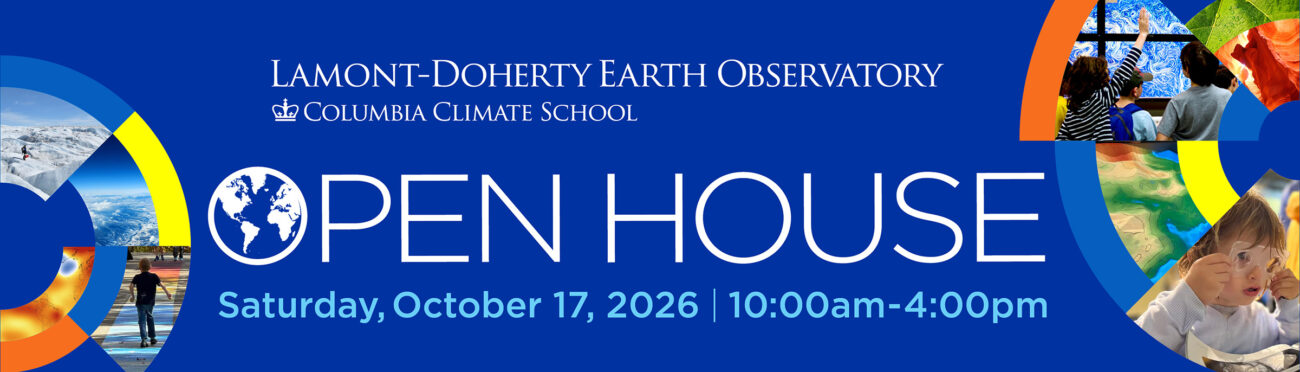
Blue banner with kids and Earth photos. Text: "Lamont-Doherty Earth Observatory Open House, Saturday, October 17, 2026, 10am-4pm.

On Saturday, October 17, 2026 from 10am to 4pm, Lamont-Doherty Earth Observatory Open House—our biggest, best science fun and discovery event of the year—will take place on our beautiful campus in Palisades, NY. Mark your calendar and join us for this free, family-friendly celebration of science! RSVP Today!

  • Can Eco-Tourism Lead to an ‘Eco-Civilization’?

    Can Eco-Tourism Lead to an ‘Eco-Civilization’?

    Does blending a group of respected business professionals, academics, spiritual leaders, media, policy specialists and artists in a custom eco-tourism experience provide a pathway to developing a passionate and committed group of individuals?

  • Student Profile: Semee Yoon

    Student Profile: Semee Yoon

    It was by chance that Semee Yoon, a Columbia College junior studying economics, ended up working toward the undergraduate special concentration in sustainable development. Her first introduction to the field occurred while working as a translator for the Korean Federation of Environmental Movement. There she acquired exposure to sustainable development firsthand as she translated for…

  • Student Profile: Marta Vicarelli

    Student Profile: Marta Vicarelli

    When Marta Vicarelli first heard the term “sustainable development,” she was in high school. “At that time, environmental concerns were not a priority in the international agenda,” explains Marta, a fourth year Ph.D. candidate in Columbia University’s School of International and Public Affairs (SIPA) program in sustainable development. The Ph.D. program, which started five years…

  • Student Profile: Nathan Chan

    Student Profile: Nathan Chan

    After graduating from college with a dual degree in earth and environmental engineering and English literature from the California Institute of Technology, Nathan Chan searched for a program where he could effectively apply his technical skills while gaining knowledge and experience about management and policy. He found he was looking for in Columbia’s Master of…

  • Student Profile: Hannah Lee

    Student Profile: Hannah Lee

    Hannah Lee, a senior in the Fu Foundation School of Engineering and Applied Science (SEAS), has shown a powerful passion for sustainability, developing countries and leadership during her three years at Columbia.  Lee’s interest in the environment was sparked at an early age, influencing her decision to apply to Columbia and to pursue environmental studies,…

  • Student Profile: Victoria Rosoff

    Student Profile: Victoria Rosoff

    When you hear “Client Service Manager for JPMorgan Chase,” you may not think of the interactions between climate and society. Yet, that is the position that Victoria Rosoff held when she applied for the M.A. Program in Climate and Society. Victoria said, “My classes and my program-related internship throughout the year at Columbia’s International Research…

  • Faculty Profile: Peter Coleman

    Faculty Profile: Peter Coleman

    Peter Coleman, Co-Executive Director of the Advanced Consortium on Cooperation, Conflict and Complexity (AC4), created four short and engaging videos about intractable conflicts for AC4, an interdisciplinary research consortium led by Coleman and housed at the Earth Institute, Columbia University. To watch Coleman’s comfortable and dynamic on-camera performance, you might think that he was an…

  • Splicing the Role of Genetics in Conservation

    Splicing the Role of Genetics in Conservation

    Genetics hold the secret to understanding evolutionary processes. They also hold the secret to how ecological and climatic factors influence the course of evolution. In fact, recent research—ranging in topics from butterfly speciation to the genetic diversity of immune systems in giant pandas—has found that genetics play a vital role in the outcome of conservation…

  • Research Questions in Urban Ecological Sustainability

    Research Questions in Urban Ecological Sustainability

    Despite having been regarded as a series of “externalities” by conventional systems of economic thinking, our natural environment is not merely a backdrop to human activities, but is the very base upon which all human systems are built. This reality is certainly not new to sustainability science, but it is easy to lose sight of…