State of the Planet

News from the Columbia Climate School

Water48

  • The Middle East Dries Up—Another Case Study in the Water-Energy-Food Nexus

    The Middle East Dries Up—Another Case Study in the Water-Energy-Food Nexus

    As seductive as it is, depleting non-renewable aquifers to grow food is fundamentally unsustainable for the long term, as Saudi Arabia and other nations are finding out. According to a recent article by Lester Brown, in the 1970s the world’s largest oil producer realized it could use oil-drilling technology to tap deep underwater aquifers and—amazingly,…

  • Pennsylvania’s Gasland Spill

    Pennsylvania’s Gasland Spill

    Pennsylvania well spills tens of thousands of gallons of fracking fluid into a nearby creek; Gasland director Josh Fox talks to Columbia University about renewable energy.

  • “You are Misinformed”–Planning for Flood Regime Change

    “You are Misinformed”–Planning for Flood Regime Change

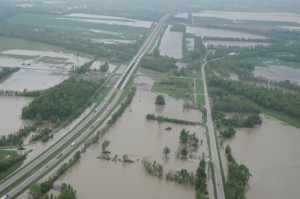
    Lately a lot of people are wondering just how helpful the 100-year flood benchmark really is, as places seem to be getting hit by 100-year floods all the time.

  • Southern Louisiana’s Vanishing Act

    Southern Louisiana’s Vanishing Act

    Louisiana’s wetlands — the largest system in the United States — are shrinking at an alarming rate.

  • Update: Youth-led Project H2O Continues to Inspire

    Update: Youth-led Project H2O Continues to Inspire

    We first reported about the project by a group of Puerto Rican high school students, Project H2O (Help to Others), and the documentary film about the project being made by the parents of one of the students, in August 2010. The students are continuing to develop Project H2O in their school, in an educational phase…

  • Growing Up: Water Efficiency and Sunless Farming

    Growing Up: Water Efficiency and Sunless Farming

    As Earth’s population continues to grow and a dynamic global climate shifts our expectations of where and when food can be grown, scientists are trying to find new ways to get more from less.

  • Before the Flood—Predicting the Deluge

    Before the Flood—Predicting the Deluge

    The Columbia Global Flood Project is based on the conviction that while human beings may not have direct control of where and how much rain falls, there is a great deal more that can be done to manage the risk of extreme flooding around the world.

  • Fracking Panel Comes to NYC

    Fracking Panel Comes to NYC

    In an effort to present various views on hydraulic fracturing, a panel of experts spoke to the public at Barnard College in New York City last Tuesday night. Known colloquially as fracking or hydrofracking, hydraulic fracturing has been regarded by many as a potential threat to New York City’s drinking water supply. The mere possibility…

  • Of Earthquakes and Nuclear Reactors

    Of Earthquakes and Nuclear Reactors

    As Japan’s nuclear meltdown catastrophe continues in the wake of the March 11 magnitude 9.0 earthquake and tsunami, Japanese power company executives and officials face an increasingly challenging situation. Tuesday morning, Tokyo Electric Power Company (TEPCO) — the company operating the Fukushima Daiichi nuclear plant — dumped more than 11,000 gallons of radioactive seawater into…

Photo of the Earth from space with the text "Lamont at AGU25" on top.

AGU25, the premier Earth and space science conference, takes place December 15-19, 2025 in New Orleans, Louisiana. This year’s theme—Where Science Connects Us—puts in focus how science depends on connection, from the lab to the field to the ballot box. Once again, Lamont-Doherty Earth Observatory and Columbia Climate School scientists, experts, students, and educators are playing an active role, sharing our research and helping shape the future of our planet. #AGU25 Learn More

  • The Middle East Dries Up—Another Case Study in the Water-Energy-Food Nexus

    The Middle East Dries Up—Another Case Study in the Water-Energy-Food Nexus

    As seductive as it is, depleting non-renewable aquifers to grow food is fundamentally unsustainable for the long term, as Saudi Arabia and other nations are finding out. According to a recent article by Lester Brown, in the 1970s the world’s largest oil producer realized it could use oil-drilling technology to tap deep underwater aquifers and—amazingly,…

  • Pennsylvania’s Gasland Spill

    Pennsylvania’s Gasland Spill

    Pennsylvania well spills tens of thousands of gallons of fracking fluid into a nearby creek; Gasland director Josh Fox talks to Columbia University about renewable energy.

  • “You are Misinformed”–Planning for Flood Regime Change

    “You are Misinformed”–Planning for Flood Regime Change

    Lately a lot of people are wondering just how helpful the 100-year flood benchmark really is, as places seem to be getting hit by 100-year floods all the time.

  • Southern Louisiana’s Vanishing Act

    Southern Louisiana’s Vanishing Act

    Louisiana’s wetlands — the largest system in the United States — are shrinking at an alarming rate.

  • Update: Youth-led Project H2O Continues to Inspire

    Update: Youth-led Project H2O Continues to Inspire

    We first reported about the project by a group of Puerto Rican high school students, Project H2O (Help to Others), and the documentary film about the project being made by the parents of one of the students, in August 2010. The students are continuing to develop Project H2O in their school, in an educational phase…

  • Growing Up: Water Efficiency and Sunless Farming

    Growing Up: Water Efficiency and Sunless Farming

    As Earth’s population continues to grow and a dynamic global climate shifts our expectations of where and when food can be grown, scientists are trying to find new ways to get more from less.

  • Before the Flood—Predicting the Deluge

    Before the Flood—Predicting the Deluge

    The Columbia Global Flood Project is based on the conviction that while human beings may not have direct control of where and how much rain falls, there is a great deal more that can be done to manage the risk of extreme flooding around the world.

  • Fracking Panel Comes to NYC

    Fracking Panel Comes to NYC

    In an effort to present various views on hydraulic fracturing, a panel of experts spoke to the public at Barnard College in New York City last Tuesday night. Known colloquially as fracking or hydrofracking, hydraulic fracturing has been regarded by many as a potential threat to New York City’s drinking water supply. The mere possibility…

  • Of Earthquakes and Nuclear Reactors

    Of Earthquakes and Nuclear Reactors

    As Japan’s nuclear meltdown catastrophe continues in the wake of the March 11 magnitude 9.0 earthquake and tsunami, Japanese power company executives and officials face an increasingly challenging situation. Tuesday morning, Tokyo Electric Power Company (TEPCO) — the company operating the Fukushima Daiichi nuclear plant — dumped more than 11,000 gallons of radioactive seawater into…