Posts
-
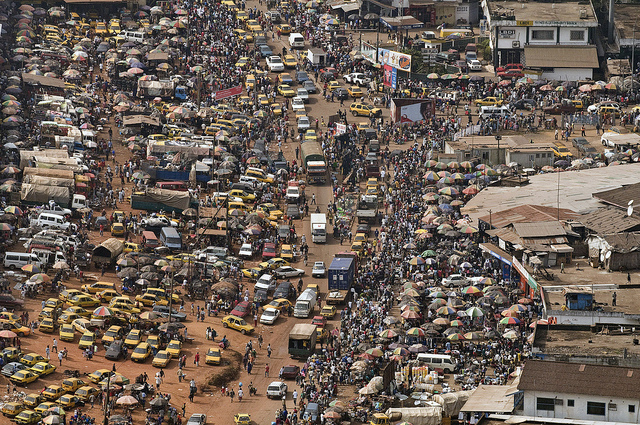
7 Billion: Not the World We Remember
If you’re 12 years old, the world’s population has grown a billion in your lifetime. If you’re 24, by 2 billion. If you were born in 1960, the world around you has grown from 3 billion to 7 billion people.
-

Artificial Trees: Giving Us Time to Act?
Soon after Klaus Lackner met Allen Wright at Biosphere 2 in Arizona, they began dreaming up a way to pull CO2 out of the air. After years of work, the two have come up with a working laboratory-scale prototype…
-

New Public Outreach Prize Goes to Earth Institute Climatologist
A major new international prize for public communication on climate-change issues has been awarded to Gavin Schmidt of the Earth Institute-affiliated NASA Goddard Institute for Space Studies. The $25,000 Climate Communications Prize was announced today by the American Geophysical Union (AGU), the world’s largest organization of earth and space scientists. Schmidt, an influential climate modeler who has authored more than…
-

Sprouting Trees From the Underground Forest — A Simple Way to Fight Desertification and Climate Change
Beginning in Niger in the 1980s, Tony Rinaudo, an African aid missionary, began working with farmers to develop a new approach to reforesting degraded landscape. The practice he developed involved selective pruning of shrub shoots to a main stem, which was then pruned of its lower leaves and branches. Within a few years, new woodlands…
-

Climate News Roundup: Week of 10/09
Nations Heading to Durban Climate Talks Remain Deeply Divided, Oct 10, New York Times U.N. climate chief Christiana Figueres lauded a climate change meeting in Panama as “good progress” this weekend, even as environmental activists warned that the world’s only structure for curbing greenhouse gas emissions appears about to crumble. The next time diplomats meet,…
-

8 Ways to Look at 7 Billion
Interested in learning more about the world’s population? Here are some recent articles about the history, context and implications of 7 billion people living on earth.
-

Green Sidewalk is Electrifying
Utilizing innovative technology to transform physical impact into electricity, PaveGen is literally, as the company tagline describes, “Generating Energy from footsteps.”
-

Vertical Farms: From Vision to Reality
Dr. Dickson Despommier believes vertical farming—the growing of crops indoors in multi-story urban buildings—can help feed the growing global population and undo the environmental damage caused by conventional agriculture.
-

Ecological and Urban Resilience
Resilience science has been evolving over the past decade, expanding beyond ecology to reflect systems of thinking in fields such as economics and political science. And, as more and more people move into densely populated cities, using massive amounts of water, energy, and other resources, the need to combine these disciplines to consider the resilience…


