Posts
-

For Better or for Worse: A Decade of Global Environmental Performance Trends Examined
The Pilot Trend Environmental Performance Index (Trend EPI) ranks countries on improvement or decline in their environmental performance, over the past decade.
-

Population, Consumption and the Future
As the world population grows toward 10 billion, consumption of water, food and energy is expanding at a rate that cannot be maintained without depleting the planet’s resources. If we fail to address these two issues together, we face a grim future of economic, social and environmental ills, warns a new report prepared by a…
-

New Book Teaches How to Think like a Geologist
Geologists really do see the world differently, whether it’s imagining the ancient processes that give rise to mountains or untangling the complexities that produce weather. A new book, co-edited by Lamont scientist Kim Kastens, explores the ways that geologists analyze and understand the earth system, and offers tips for those seeking to better understand it.
-

Fossil Teeth, Traces of Climate & Evolution
From fossil teeth to carbon traces of plants in the soil, scientists are studying how changes in climate may have influenced early human evolution in Africa. Researchers from around the world gathered for a symposium held recently at the Lamont-Doherty Earth Observatory. Watch the videos.
-

Dead Plants Strengthen Beliefs in Global Warming
Subtle stimuli in the environment exert a strong influence on the way we think about global warming. The notion that surrounding objects unconsciously influence our thoughts and behavior is of interest to individuals who are interested in developing strategies to promote sustainable behavior.
-

Plankton Fishing in the Bering Sea
As Discovery Channel fans know, the Bering Sea supports one of the world’s most productive fisheries, accounting for more than 50 percent of U.S. fish and shellfish catches. The goal of our study is to understand how climate change is impacting phytoplankton, and ultimately the Bering Sea ecosystem.
-

Sustainability Management Students Present Innovative Solutions to Clients’ Challenges
“We are incredibly proud of our work as well as the work of our classmates whose presentations highlighted our ability to use the skills that we have learned in the classroom to address contemporary sustainability challenges in the clearest possible way,” stated Pamela Quinlan, presenter for the Workshop Project “Development of a New Communications Strategy…
-
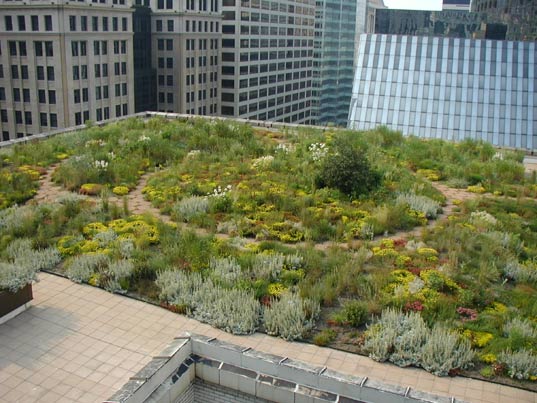
There’s No One-Size-Fits-All Green Roof, Studies Show
Two recent studies suggest that grasses or taller shrubs may actually be more effective than such typical green-roof plantings as sedums at reducing storm water runoff, often a major selling point for green roofs. These studies suggest there is no one-size-fits-all green roof.
-
New Course Offered on Global Food Systems
The Undergraduate Program in Sustainable Development will offer a course in Global Food Systems (SDEV W3200) in Fall 2012, taught by Dr. Cheryl Palm. Concerns about food shortages, land use, climate change and biodiversity have created an urgent need for interdisciplinary researchers, practitioners and policy-makers focused on agriculture. Developing sound solutions that improve agricultural production…


