State of the Planet

News from the Columbia Climate School

aerosols

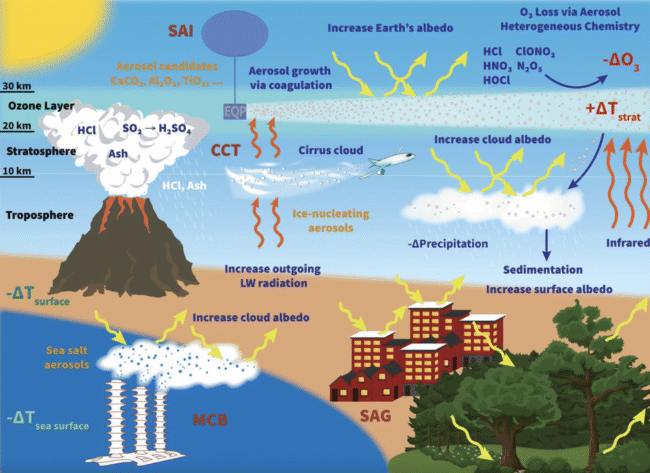
  • How Hard Is It to Dim the Sun?

    How Hard Is It to Dim the Sun?

    Solar radiation management is gaining traction as a climate intervention—but new research warns that real-world constraints make it riskier and more uncertain than most models suggest.

  • Dust May Beat Black Carbon at Speeding Up Snowmelt in the Himalayas

    Dust May Beat Black Carbon at Speeding Up Snowmelt in the Himalayas

    Tiny dust particles at high altitudes are having a greater effect on snow-darkening than previously thought, accelerating the loss of glaciers.

  • Tropical Cyclones on Track to Grow More Intense as Temperatures Rise

    Aerosols have compensated for greenhouse gases, but won’t in future

  • Have We Crossed the 9 Planetary Boundaries?

    Have We Crossed the 9 Planetary Boundaries?

    “The world needs to awaken itself to the looming catastrophe of global warming,” said Jeffrey Sachs, Director of the Earth Institute, at a recent meeting in Muscat. “We must provide a safe operating space where vested interest and lobby-driven policies will not see the world marching into disaster.”

  • Could Reducing Global Dimming Mean a Hotter, Dryer World?

    Despite concerns over global warming, scientists have discovered something that may have actually limited the impact of greenhouse gases in the atmosphere in recent years by reducing the amount of sunlight reaching the surface of the Earth. In research they published last year in the journal Geophysical Research Letters, a team led by Beate Liepert…

Overhead view of Columbia campus with text Columbia Climate School Class Day 2026: Congratulations Graduates

Congratulations to our Columbia Climate School Class of 2026 and all of our 2026 Columbia University graduates! Learn more about our May 15 Climate School Class Day celebration. 💙 #Columbia2026 #ColumbiaClimate2026

  • How Hard Is It to Dim the Sun?

    How Hard Is It to Dim the Sun?

    Solar radiation management is gaining traction as a climate intervention—but new research warns that real-world constraints make it riskier and more uncertain than most models suggest.

  • Dust May Beat Black Carbon at Speeding Up Snowmelt in the Himalayas

    Dust May Beat Black Carbon at Speeding Up Snowmelt in the Himalayas

    Tiny dust particles at high altitudes are having a greater effect on snow-darkening than previously thought, accelerating the loss of glaciers.

  • Tropical Cyclones on Track to Grow More Intense as Temperatures Rise

    Aerosols have compensated for greenhouse gases, but won’t in future

  • Have We Crossed the 9 Planetary Boundaries?

    Have We Crossed the 9 Planetary Boundaries?

    “The world needs to awaken itself to the looming catastrophe of global warming,” said Jeffrey Sachs, Director of the Earth Institute, at a recent meeting in Muscat. “We must provide a safe operating space where vested interest and lobby-driven policies will not see the world marching into disaster.”

  • Could Reducing Global Dimming Mean a Hotter, Dryer World?

    Despite concerns over global warming, scientists have discovered something that may have actually limited the impact of greenhouse gases in the atmosphere in recent years by reducing the amount of sunlight reaching the surface of the Earth. In research they published last year in the journal Geophysical Research Letters, a team led by Beate Liepert…