State of the Planet

News from the Columbia Climate School

air pollution7

  • With a Little Software Magic, Students Create Pollution Solutions

    With a Little Software Magic, Students Create Pollution Solutions

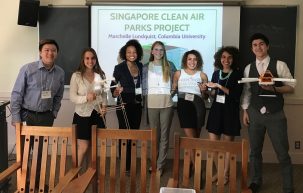
    Undergraduate sustainability students explored innovative software and 3D printing to create a set of possible solutions to help Singapore cope with a big problem: haze and air pollution drifting over the city state from burning forests in neighboring Indonesia.

  • Spring 2017 Undergraduate Research Assistant Opportunities

    Undergraduates from Columbia and Barnard will be able to serve as research assistants on research projects related to sustainable development and the environment with distinguished faculty and researchers at the cutting edge of this burgeoning field.

  • 2015 Indonesia Fires Killed 100,000 People, Says Study

    2015 Indonesia Fires Killed 100,000 People, Says Study

    In fall 2015, smoke from agricultural fires in Indonesia blanketed much of equatorial Asia. Schools and businesses closed, planes were grounded and tens of thousands of people sought treatment for respiratory illnesses. In a new study, researchers estimate that the smoke caused upward of 100,000 deaths across Indonesia, Malaysia, and Singapore.

  • By the Numbers: Air Quality and Pollution in New York City

    By the Numbers: Air Quality and Pollution in New York City

    New York City is known for many things, but having clean air isn’t one of them. Explore some of the issues and challenges the Big Apple faces in clearing NYC’s air through interactive maps and data.

  • The False Trade-Off Between Economic Growth and Environmental Protection

    The investment in environmental clean-up often stimulates other upgrades that enable businesses to more effectively compete in a global economy. Moreover, a clean environment reduces illness and that reduces the need for expensive health care.

  • A Major Source of Air Pollution: Farms

    Global Study Shows How Agriculture Interacts With Industry

  • Does Pollution Regulation Kill Jobs? Lessons for China from the U.S.

    Does Pollution Regulation Kill Jobs? Lessons for China from the U.S.

    The problem of air pollution in China continues to reach new heights. To combat the problem in any real way stringent regulation is needed. A new paper from Columbia University’s Earth Institute finds that this can be done without hurting job creation.

  • The Damaging Effects of Black Carbon

    The Damaging Effects of Black Carbon

    Air pollution, both outdoors and indoors, causes millions of premature deaths each year. The deaths are mainly caused by the inhalation of particulate matter, especially black carbon. But black carbon not only has impacts on human health, it also affects visibility, harms ecosystems, reduces agricultural productivity and exacerbates global warming.

  • The Changing Face of Air Quality

    The Changing Face of Air Quality

    Looking at regional differences in PM2.5 concentrations gives us a sense of the changing face of air quality throughout the world.

Photo of the Earth from space with the text "Lamont at AGU25" on top.

AGU25, the premier Earth and space science conference, takes place December 15-19, 2025 in New Orleans, Louisiana. This year’s theme—Where Science Connects Us—puts in focus how science depends on connection, from the lab to the field to the ballot box. Once again, Lamont-Doherty Earth Observatory and Columbia Climate School scientists, experts, students, and educators are playing an active role, sharing our research and helping shape the future of our planet. #AGU25 Learn More

  • With a Little Software Magic, Students Create Pollution Solutions

    With a Little Software Magic, Students Create Pollution Solutions

    Undergraduate sustainability students explored innovative software and 3D printing to create a set of possible solutions to help Singapore cope with a big problem: haze and air pollution drifting over the city state from burning forests in neighboring Indonesia.

  • Spring 2017 Undergraduate Research Assistant Opportunities

    Undergraduates from Columbia and Barnard will be able to serve as research assistants on research projects related to sustainable development and the environment with distinguished faculty and researchers at the cutting edge of this burgeoning field.

  • 2015 Indonesia Fires Killed 100,000 People, Says Study

    2015 Indonesia Fires Killed 100,000 People, Says Study

    In fall 2015, smoke from agricultural fires in Indonesia blanketed much of equatorial Asia. Schools and businesses closed, planes were grounded and tens of thousands of people sought treatment for respiratory illnesses. In a new study, researchers estimate that the smoke caused upward of 100,000 deaths across Indonesia, Malaysia, and Singapore.

  • By the Numbers: Air Quality and Pollution in New York City

    By the Numbers: Air Quality and Pollution in New York City

    New York City is known for many things, but having clean air isn’t one of them. Explore some of the issues and challenges the Big Apple faces in clearing NYC’s air through interactive maps and data.

  • The False Trade-Off Between Economic Growth and Environmental Protection

    The investment in environmental clean-up often stimulates other upgrades that enable businesses to more effectively compete in a global economy. Moreover, a clean environment reduces illness and that reduces the need for expensive health care.

  • A Major Source of Air Pollution: Farms

    Global Study Shows How Agriculture Interacts With Industry

  • Does Pollution Regulation Kill Jobs? Lessons for China from the U.S.

    Does Pollution Regulation Kill Jobs? Lessons for China from the U.S.

    The problem of air pollution in China continues to reach new heights. To combat the problem in any real way stringent regulation is needed. A new paper from Columbia University’s Earth Institute finds that this can be done without hurting job creation.

  • The Damaging Effects of Black Carbon

    The Damaging Effects of Black Carbon

    Air pollution, both outdoors and indoors, causes millions of premature deaths each year. The deaths are mainly caused by the inhalation of particulate matter, especially black carbon. But black carbon not only has impacts on human health, it also affects visibility, harms ecosystems, reduces agricultural productivity and exacerbates global warming.

  • The Changing Face of Air Quality

    The Changing Face of Air Quality

    Looking at regional differences in PM2.5 concentrations gives us a sense of the changing face of air quality throughout the world.