State of the Planet

News from the Columbia Climate School

Center for Climate Systems Research8

  • Where Will Sea-Level Rise Hurt the Most?

    Where Will Sea-Level Rise Hurt the Most?

    A study out yesterday says that the lives of up to 13 million people in the United States may be disrupted by sea-level rise in the next century. But another study says that while much hard infrastructure like houses, piers, seawalls and roads may have to be kissed goodbye, some 70 percent of natural landforms…

  • World Wildlife Fund, Earth Institute Form New Partnership

    World Wildlife Fund, Earth Institute Form New Partnership

    The World Wildlife Fund will collaborate with the Earth Institute’s Center for Climate Systems Research to advance adaptation to the impacts of climate change around the globe. The partners will create new ways of generating climate risk information and embedding it into the World Wildlife Fund’s conservation and development planning, policies and practice.

  • Cities Face Up to the Climate Challenge

    Cities Face Up to the Climate Challenge

    Millions of people living in cities around the world already feel the impacts of climate change: Heat waves, flooded streets, landslides and storms. All of these affect important infrastructure such as transportation and water supplies, ports and commerce, public health and people’s daily lives. And it is cities that are at the forefront of the…

  • Unforeseen Dangers in a Global Food System

    Unforeseen Dangers in a Global Food System

    Michael Puma considers what can happen when events such as long-lasting droughts or volcanic explosions interrupt production of these crops. He has begun to assess the fragility of the intricate network of trade relationships that move important basic food items across national borders.

  • Initiative on Extreme Weather and Climate Kick-Off

    Initiative on Extreme Weather and Climate Kick-Off

    This week marks the launch of the new Columbia Initiative on Extreme Weather and Climate, a cross-disciplinary collaboration between a variety of centers, research groups and individuals from across Columbia University. The Initiative, led by Adam Sobel, kicked off on Monday evening with a World Leaders Forum panel event in Low Library. Panelists discussed a…

  • Climate Effects on NYC May Move Faster Than Previously Forecast

    Climate Effects on NYC May Move Faster Than Previously Forecast

    The impact of climate change on New York City could be even more severe than previously thought, putting more people at risk from increasingly frequent floods and heat waves, according to a report by the New York City Panel on Climate Change that was released Monday.

  • ‘This is a wake-up call – don’t hit the snooze button’

    ‘This is a wake-up call – don’t hit the snooze button’

    For years before Hurricane Sandy charged ashore on Monday, researchers from the Earth Institute knew what was coming. As the region struggles to recover from this “superstorm,” we asked some of them to consider the lessons we can learn as we move forward.

  • Forecasting Climate’s Effects on Global Food Production

    Forecasting Climate’s Effects on Global Food Production

    The worst drought to hit the U.S. in decades has already brought corn yields to a 17-year low and will almost certainly raise food prices. Wealth will soften the blow in the U.S., but in sub-Saharan Africa and South Asia, prolonged drought has often had deadly consequences. Is there a better way to anticipate climate’s…

  • Daniel Hillel, Originator of High-Efficiency Irrigation, to Receive World Food Prize

    Daniel Hillel, Originator of High-Efficiency Irrigation, to Receive World Food Prize

    Daniel Hillel, an adjunct senior scientist at Columbia University’s Earth Institute, has been awarded the World Food Prize for his work in conceiving and promoting water-saving methods that have increased crop production on arid lands in 30 countries.

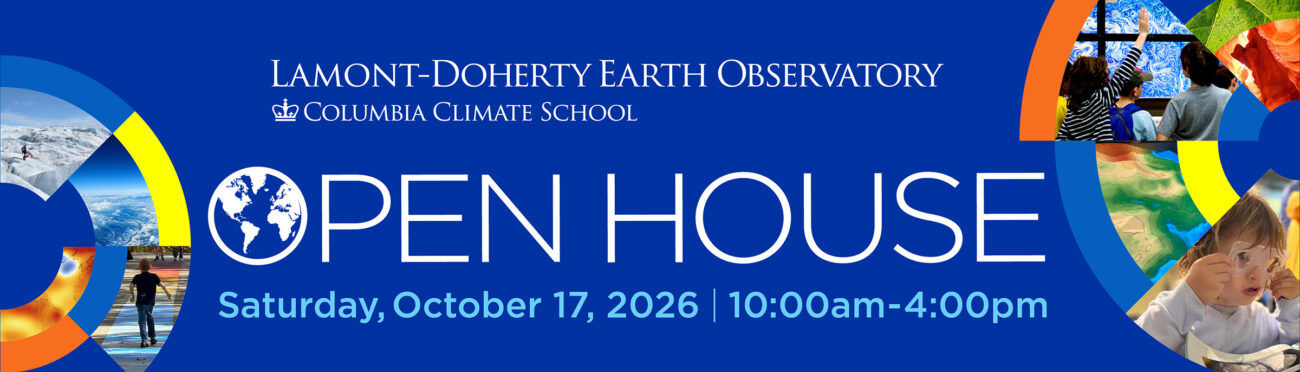
Blue banner with kids and Earth photos. Text: "Lamont-Doherty Earth Observatory Open House, Saturday, October 17, 2026, 10am-4pm.

On Saturday, October 17, 2026 from 10am to 4pm, Lamont-Doherty Earth Observatory Open House—our biggest, best science fun and discovery event of the year—will take place on our beautiful campus in Palisades, NY. Mark your calendar and join us for this free, family-friendly celebration of science! RSVP Today!

  • Where Will Sea-Level Rise Hurt the Most?

    Where Will Sea-Level Rise Hurt the Most?

    A study out yesterday says that the lives of up to 13 million people in the United States may be disrupted by sea-level rise in the next century. But another study says that while much hard infrastructure like houses, piers, seawalls and roads may have to be kissed goodbye, some 70 percent of natural landforms…

  • World Wildlife Fund, Earth Institute Form New Partnership

    World Wildlife Fund, Earth Institute Form New Partnership

    The World Wildlife Fund will collaborate with the Earth Institute’s Center for Climate Systems Research to advance adaptation to the impacts of climate change around the globe. The partners will create new ways of generating climate risk information and embedding it into the World Wildlife Fund’s conservation and development planning, policies and practice.

  • Cities Face Up to the Climate Challenge

    Cities Face Up to the Climate Challenge

    Millions of people living in cities around the world already feel the impacts of climate change: Heat waves, flooded streets, landslides and storms. All of these affect important infrastructure such as transportation and water supplies, ports and commerce, public health and people’s daily lives. And it is cities that are at the forefront of the…

  • Unforeseen Dangers in a Global Food System

    Unforeseen Dangers in a Global Food System

    Michael Puma considers what can happen when events such as long-lasting droughts or volcanic explosions interrupt production of these crops. He has begun to assess the fragility of the intricate network of trade relationships that move important basic food items across national borders.

  • Initiative on Extreme Weather and Climate Kick-Off

    Initiative on Extreme Weather and Climate Kick-Off

    This week marks the launch of the new Columbia Initiative on Extreme Weather and Climate, a cross-disciplinary collaboration between a variety of centers, research groups and individuals from across Columbia University. The Initiative, led by Adam Sobel, kicked off on Monday evening with a World Leaders Forum panel event in Low Library. Panelists discussed a…

  • Climate Effects on NYC May Move Faster Than Previously Forecast

    Climate Effects on NYC May Move Faster Than Previously Forecast

    The impact of climate change on New York City could be even more severe than previously thought, putting more people at risk from increasingly frequent floods and heat waves, according to a report by the New York City Panel on Climate Change that was released Monday.

  • ‘This is a wake-up call – don’t hit the snooze button’

    ‘This is a wake-up call – don’t hit the snooze button’

    For years before Hurricane Sandy charged ashore on Monday, researchers from the Earth Institute knew what was coming. As the region struggles to recover from this “superstorm,” we asked some of them to consider the lessons we can learn as we move forward.

  • Forecasting Climate’s Effects on Global Food Production

    Forecasting Climate’s Effects on Global Food Production

    The worst drought to hit the U.S. in decades has already brought corn yields to a 17-year low and will almost certainly raise food prices. Wealth will soften the blow in the U.S., but in sub-Saharan Africa and South Asia, prolonged drought has often had deadly consequences. Is there a better way to anticipate climate’s…

  • Daniel Hillel, Originator of High-Efficiency Irrigation, to Receive World Food Prize

    Daniel Hillel, Originator of High-Efficiency Irrigation, to Receive World Food Prize

    Daniel Hillel, an adjunct senior scientist at Columbia University’s Earth Institute, has been awarded the World Food Prize for his work in conceiving and promoting water-saving methods that have increased crop production on arid lands in 30 countries.