climate28
-
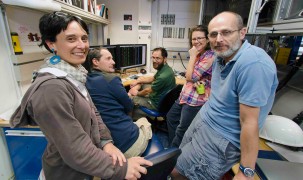
Mozambique Core Brings Up 7 Million Years of Climate History
With calm seas, the JOIDES Resolution’s latest sediment core comes up with what appears to be a fantastic, cyclic climate signal that is continuous back 7 million years, writes Sidney Hemming.
-

Attributing Extreme Weather to Causes—Including Climate Change
New research and more powerful computer models are advancing scientists’ ability to tease apart the forces that can worsen extreme weather. In a new report, a committee of the National Academy of Sciences that includes Columbia’s Adam Sobel assesses the young field of attribution studies.
-

Competition Challenges Students to Limit Global Warming
Can the global community devise a solution to save the planet from the worst impacts of global climate change? How about doing it in seven hours?
-

Trials & Tribulations of Coring the Agulhas Plateau
Trying to drill sediment cores while the ship rides large ocean swells off the coast of Africa isn’t easy, but it’s paying off for science, writes Sidney Hemming.
-

How Well is the World Protecting Ecosystems and Human Health?
The new global environmental report card is out. The 2016 Environmental Performance Index graded 180 countries on how well they are protecting human health and their ecosystems. While the world is making progress in some areas, it is seriously falling behind in others.
-

Without the Montreal Protocol, More Intense Tropical Cyclones
Using one of the most advanced atmospheric computer models available, scientists compared our expected future with a scenario in which ozone-depleting substances had never been regulated.
-

What Is Ocean Acidification & Why Does It Matter?
Excess carbon dioxide absorbed into the oceans is starting to have profound effects on marine life, from oysters to tiny snails at the base of the food chain. Our scientists explain the changes and what they are learning about ocean acidification in the past.
-

Partnering Best Minds in Science & Business to Take on Climate Change
While national governments can set goals for combating climate change, many of the decisions that lead to action will come from business leaders. The new Columbia Center for Climate and Life helps them build from a foundation of science.
-

Greenland Glaciers Retreating Faster than Any Time in Past 9,500 Years
A new study uses sediment cores to track the expansion and retreat of glaciers through time, and finds that they are retreating quickly and are more sensitive to temperature change than previously realized.


The first Earth Day in 1970 ignited a movement to stop polluting our planet. Today, our scientists and experts are tackling the most pressing challenges to achieve real-world impact. This Earth Day, join us in our commitment to realizing a just and sustainable future for our planet. Visit our Earth Day website for ideas, resources, and inspiration.
