economics12
-
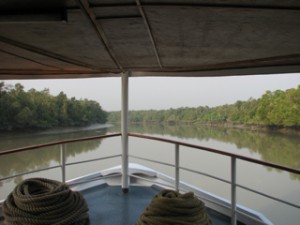
The Sundarbans
After finally reaching the Mongla and our boat, we settled into our new home. It is a similar design, but much larger than the one we used in September. As we ate dinner and explored the ship, it started the overnight journey to the southeastern part of the Sundarbans where the wildlife is most plentiful.…
-

Rivers and the Road
We spent a day on the islands (chars) in the Brahmaputra River seeing the geology and talking to the residents. Then after an evening of feasting and dancing in our new Saris and lungis, we hit the road for the trip to the Sundarbans.
-

Class Trip – to Bangladesh
To help my students in a class on hazards of Bangladesh better understand the country, I am taking them there to experience Bangladesh for themselves.
-

One Planet, Too Many People?
Can we manage the needs of 9 billion people for water, food and energy without depleting our resources and ruining the environment? “The solutions,” says Tim Fox, “are all within the capability of existing technology.”
-

Putting Wind in Trade’s Sails
International maritime trade represents a unique example of global cooperation. With the help of a growing number of renewable energy technologies, the global community can work towards progress in this limited area and use it as a model for addressing emissions in other areas of the global economy.
-

Energy Efficiency: A Great (But Dull) Way to Save
Cutting energy use in a home or small business can save consumers plenty of money, so how come more private citizens aren’t doing it? Speakers at an Earth Institute-sponsored panel said in part it’s because the information people need is not accessible enough.
-

A Climate Tipping Point for World Food Prices?
Increased growing-season heat due to climate change in coming decades could push staple U.S. crops off a cliff, and cause world food prices to jump, a Columbia University economist told a press briefing at a top scientific meeting this week. In a panel organized by the American Association for the Advancement of Science, economist Wolfram…
-

Can Intensive Farming Save Tropical Forests?
With 7 billion people on the planet and some 40 percent of earth’s land surface already covered with croplands and pastures, the only remaining frontiers for agricultural expansion are dwindling tropical forests. Some see high-yield industrial-scale farming as a way to take the pressure off; the theory goes that if more produce can be grown…
-

Online Course – Sustainability and Investing
We are excited to let you know that CERC is offering a piloted version of Sustainability and Investing online as part of our Executive Education Program in Conservation and Environmental Sustainability.


The first Earth Day in 1970 ignited a movement to stop polluting our planet. Today, our scientists and experts are tackling the most pressing challenges to achieve real-world impact. This Earth Day, join us in our commitment to realizing a just and sustainable future for our planet. Visit our Earth Day website for ideas, resources, and inspiration.
