State of the Planet

News from the Columbia Climate School

Geology5

  • Photo Essay: Exploring the Rocks That Join the Americas

    Photo Essay: Exploring the Rocks That Join the Americas

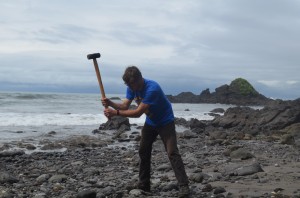
    The formation of the slender land bridge that joins South America and North America was a pivotal event in earth’s history. At its narrowest along the isthmus of Panama, it changed not just the world map, but the circulation of oceans, the course of biologic evolution, and global climate. Cornelia Class, a geochemist at Columbia…

  • Climate Scientist Is First Woman to Win Geology’s Storied Wollaston Medal

    A climate scientist who has suggested how mountain building can lower Earth’s thermostat and why ice ages sometimes wax and wane at different speeds has been awarded one of geology’s oldest and most coveted prizes: the British Wollaston Medal. The first woman to win a Wollaston in the prize’s 183-year history, Maureen Raymo, a researcher…

  • Photo Essay: High Desert, Deep Earth

    Photo Essay: High Desert, Deep Earth

    In the Arabian peninsula nation of Oman, geologists are studying the Hajar mountains–a range containing rocks that have been thrust up from the deep earth. Accessible to humans in only a few places on earth, these kinds of rocks offer clues to the planet’s deep history–and possible ways that natural processes may be harnessed to…

  • Ancient Rocks, Modern Purpose

    Ancient Rocks, Modern Purpose

    The desert sultanate of Oman is home to some of the weirdest—and possibly most useful—rocks on earth. The stark Hajar mountains, near the border with Saudi Arabia, contain a chunk of earth’s mantle—a zone that makes up most of earth’s mass, but normally lies inaccessible to humans, far below the surface. Here, though, a sliver…

  • In Ethiopian Desert, a Window into Rifting of Africa

    In Ethiopian Desert, a Window into Rifting of Africa

    A new study in the journal Nature provides fresh insight into deep-earth processes driving apart huge sections of the earth’s crust. This rifting mostly takes place on seabeds, but can be seen in a few places on land—nowhere more visibly than in the Afar region of northern Ethiopia.

  • Lessons From a Rock Fall

    Lessons From a Rock Fall

    A 500-foot-high sliver of the Palisades Cliff came crashing down May 12 at 7:28 p.m., jiggling our seismometer at the Lamont-Doherty Earth Observatory a few micrometers. Weighing about 10,000 tons, the rock smashed trees along the Hudson River and covered over a hiking trail, but fortunately caused no injuries.

  • Rock Fall Shakes New Jersey Palisades

    Rock Fall Shakes New Jersey Palisades

    A 500-foot rock face came crashing down from the Palisades cliffs along the Hudson River in Alpine, N.J. on Saturday night, shaking the ground for more than half a minute and dumping a fresh layer of boulders over a 100-yard strip of parkland below State Line Lookout. The shaking was strong enough to be registered…

  • Putting the ‘Death’ Back Into Death Valley?

    Popular Tourist Stop May Have More Potential to Explode Than Thought

  • Rocks Could Be Harnessed to Sponge Vast Amounts of Carbon Dioxide from Air, Say Researchers

    Proposed Method Would Speed Natural Reactions a Million Times

Photo of the Earth from space with the text "Lamont at AGU25" on top.

AGU25, the premier Earth and space science conference, takes place December 15-19, 2025 in New Orleans, Louisiana. This year’s theme—Where Science Connects Us—puts in focus how science depends on connection, from the lab to the field to the ballot box. Once again, Lamont-Doherty Earth Observatory and Columbia Climate School scientists, experts, students, and educators are playing an active role, sharing our research and helping shape the future of our planet. #AGU25 Learn More

  • Photo Essay: Exploring the Rocks That Join the Americas

    Photo Essay: Exploring the Rocks That Join the Americas

    The formation of the slender land bridge that joins South America and North America was a pivotal event in earth’s history. At its narrowest along the isthmus of Panama, it changed not just the world map, but the circulation of oceans, the course of biologic evolution, and global climate. Cornelia Class, a geochemist at Columbia…

  • Climate Scientist Is First Woman to Win Geology’s Storied Wollaston Medal

    A climate scientist who has suggested how mountain building can lower Earth’s thermostat and why ice ages sometimes wax and wane at different speeds has been awarded one of geology’s oldest and most coveted prizes: the British Wollaston Medal. The first woman to win a Wollaston in the prize’s 183-year history, Maureen Raymo, a researcher…

  • Photo Essay: High Desert, Deep Earth

    Photo Essay: High Desert, Deep Earth

    In the Arabian peninsula nation of Oman, geologists are studying the Hajar mountains–a range containing rocks that have been thrust up from the deep earth. Accessible to humans in only a few places on earth, these kinds of rocks offer clues to the planet’s deep history–and possible ways that natural processes may be harnessed to…

  • Ancient Rocks, Modern Purpose

    Ancient Rocks, Modern Purpose

    The desert sultanate of Oman is home to some of the weirdest—and possibly most useful—rocks on earth. The stark Hajar mountains, near the border with Saudi Arabia, contain a chunk of earth’s mantle—a zone that makes up most of earth’s mass, but normally lies inaccessible to humans, far below the surface. Here, though, a sliver…

  • In Ethiopian Desert, a Window into Rifting of Africa

    In Ethiopian Desert, a Window into Rifting of Africa

    A new study in the journal Nature provides fresh insight into deep-earth processes driving apart huge sections of the earth’s crust. This rifting mostly takes place on seabeds, but can be seen in a few places on land—nowhere more visibly than in the Afar region of northern Ethiopia.

  • Lessons From a Rock Fall

    Lessons From a Rock Fall

    A 500-foot-high sliver of the Palisades Cliff came crashing down May 12 at 7:28 p.m., jiggling our seismometer at the Lamont-Doherty Earth Observatory a few micrometers. Weighing about 10,000 tons, the rock smashed trees along the Hudson River and covered over a hiking trail, but fortunately caused no injuries.

  • Rock Fall Shakes New Jersey Palisades

    Rock Fall Shakes New Jersey Palisades

    A 500-foot rock face came crashing down from the Palisades cliffs along the Hudson River in Alpine, N.J. on Saturday night, shaking the ground for more than half a minute and dumping a fresh layer of boulders over a 100-yard strip of parkland below State Line Lookout. The shaking was strong enough to be registered…

  • Putting the ‘Death’ Back Into Death Valley?

    Popular Tourist Stop May Have More Potential to Explode Than Thought

  • Rocks Could Be Harnessed to Sponge Vast Amounts of Carbon Dioxide from Air, Say Researchers

    Proposed Method Would Speed Natural Reactions a Million Times