Joerg Michael Schaefer
-
Climate Change Stopped the Next Ice Age
New research shows that 2,000 years ago, remnants of an Arctic ice sheet began growing again, marking the start of a new glacial period—what we commonly call an ice age. But by the 1960s, global warming had raised summer temperatures enough to reverse that growth.
-
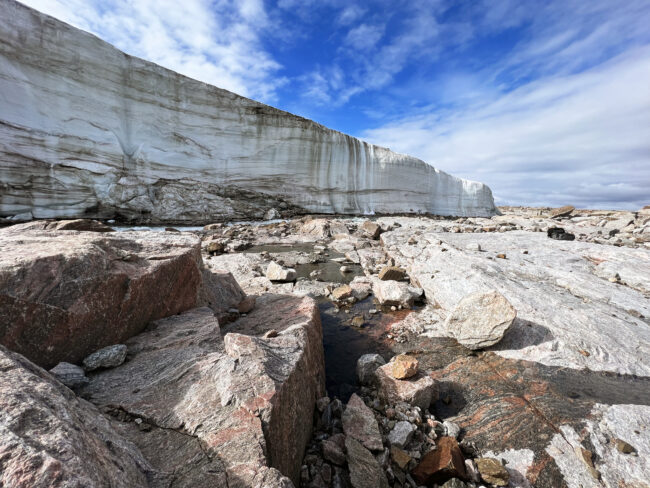
Greenland Ice Cap Vanished Just 7,000 Years Ago
The first study from GreenDrill finds that Greenland’s Prudhoe Dome ice cap had fully melted much more recently than previously thought.
-

A Collaborative Approach To Comprehending Glacial Retreat
Researchers at Lamont-Doherty Earth Observatory and Pontificia Universidad Católica in Chile have spent years collaborating to better understand the fluctuations of the Patagonian Ice Sheet and its societal impacts.
-

For Good Measure: Scientists Collaborate to Track Sea Level Rise From Glaciers in Greenland and Antarctica
Scientists who study both the ice sheets and nearby peripheral glaciers are working together to improve the accuracy of estimated sea level rise.
-

New Study Pins Time of Greenland’s Last Melting to Some 400,000 Years Ago
A study adds evidence that the Greenland Ice Sheet will be vulnerable to human-induced climate change in coming centuries.
-

What Lies Beneath Melting Glaciers and Thawing Permafrost?
As the planet’s ice disappears, it’s exposing new surfaces, opportunities, and threats — including valuable mineral deposits, archaeological relics, novel viruses, and more.



COP31, the 2026 United Nations Climate Change Conference, aims to advance dialogue, strengthen consensus, and accelerate climate action on a global scale. From November 9–20, 2026 in Antalya, Türkiye, heads of state, ministers, scientists, business leaders, and civil society will gather to advance efforts in emission targets, climate finance, and adaptation and resilience. Once again, our experts, students, and global thought leaders from Columbia Climate School and across Columbia University are contributing to key events, sharing insights, and helping shape the dialogue toward ambitious, science-based solutions. Learn More
