Lamont-Doherty Earth Observatory148
-
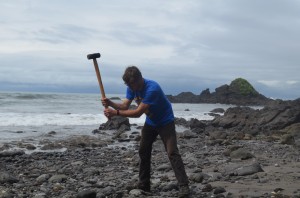
The Isthmus of Panama: Out of the Deep Earth
The creation of the narrow isthmus that joins North and South America changed not just the world map, but the circulation of oceans, the course of biologic evolution, and probably global climate. Scientists try to decipher the story behind its formation.
-

Photo Essay: Exploring the Rocks That Join the Americas
The formation of the slender land bridge that joins South America and North America was a pivotal event in earth’s history. At its narrowest along the isthmus of Panama, it changed not just the world map, but the circulation of oceans, the course of biologic evolution, and global climate. Cornelia Class, a geochemist at Columbia…
-

Gerry Iturrino: Oceanographer, Engineer, Friend
Gerardo Iturrino, a longtime engineer and ocean explorer at Lamont-Doherty Earth Observatory, passed away unexpectedly on March 12. A resident of nearby Nyack, he was 51; the cause was heart attack, said his family. His incessant curiosity about the structure and origin of the Earth drove his career, the last 18 years of which he…
-

Did New Zealand Dust Influence the Last Ice Age?
Bess Koffman, a postdoctoral researcher at Lamont-Doherty Earth Observatory, recently traveled to New Zealand to collect dust ground-up by glaciers during the last ice age. In this photo essay, she explains how she collected the dust, what analysis looks like in the lab and what she hopes to learn.
-

Keeping an Eye on Coastal Erosion
Searching for a fast, simple and low-cost way to monitor Earth’s changing coastlines, a team of scientists, including Lamont-Doherty Observatory postdoctoral researcher and marine scientist Alessio Rovere, has found an innovative use for drones.
-

Bricks, an Archeological Site and Home
It was time to pack up and leave. Shofiq, who is from Sylhet, was dropped off near his home and the fellowship of the rocks was broken. We settled in for another long drive. We made an impromptu stop at one of the numerous brick factories scattered across Bangladesh. Here, the workers immediately started snapping…
-

Field School: Sylhet Tectonics
Most field trips have a “death march” hiking a long way through forest, swamps, hills or deserts to get to a remote outcrop. We have a “death bus ride” instead.
-

Field School: The Brahmaputra River
The first day was very light for the jet-lagged students, just a short introduction to the field school and some background, and then introductions all around as we started to get to know each other. The final group of nine students finally arrived around 9 p.m. They were the most worn-out, bedraggled bunch of travelers…
-
Climate Scientist Is First Woman to Win Geology’s Storied Wollaston Medal
A climate scientist who has suggested how mountain building can lower Earth’s thermostat and why ice ages sometimes wax and wane at different speeds has been awarded one of geology’s oldest and most coveted prizes: the British Wollaston Medal. The first woman to win a Wollaston in the prize’s 183-year history, Maureen Raymo, a researcher…


The first Earth Day in 1970 ignited a movement to stop polluting our planet. Today, our scientists and experts are tackling the most pressing challenges to achieve real-world impact. This Earth Day, join us in our commitment to realizing a just and sustainable future for our planet. Visit our Earth Day website for ideas, resources, and inspiration.
