State of the Planet

News from the Columbia Climate School

Mars

  • October Research Roundup: Select Papers

    October Research Roundup: Select Papers

    In this month’s research roundup, we explore how delayed climate action could trigger abrupt changes in the Arctic; what ancient ocean sediments reveal about carbon storage during the last ice age; how fiber-optic cables are improving earthquake monitoring at geothermal sites; and a new timeline of Earth’s magnetic reversals.

  • Giant Canyon on Mars Is Still Tectonically Active Today

    Giant Canyon on Mars Is Still Tectonically Active Today

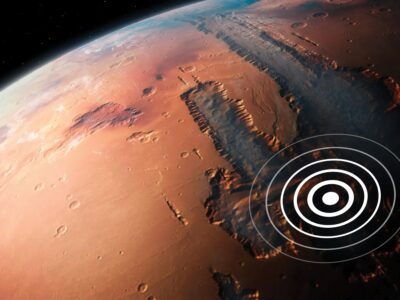
    Scientists at Columbia University and Imperial College London have found that the largest canyon system in the solar system is still active and shaping Mars today, billions of years after it first formed.

  • Space Glaciers: Carbon Dioxide Ice Forms Glaciers on Mars

    Space Glaciers: Carbon Dioxide Ice Forms Glaciers on Mars

    A modeling study recently found that the carbon dioxide ice deposits at the South Pole of Mars flow as glaciers do, highlighting the importance of understanding ice in outer space.

  • Can a New Type of Glacier on Mars Aid Future Astronauts?

    Can a New Type of Glacier on Mars Aid Future Astronauts?

    A recent publication identifies evidence of glacial activity and underground ice on Mars in an unusually flat and temperate area, which could serve as a future human landing site.

  • Fresh Evidence of Life on Mars?

    Fresh Evidence of Life on Mars?

    In a landscape shaped by wind and water, is it possible that microbial life was found on Mars in 1976? A new paper indicates life may be present, and a new mission to Mars may confirm the results.

Collage of Turkiye beach scene and Columbia University Campus with text: UN Climate Change Conference COP31, Antalya, Turkiye, Nov 9-20, 2026

COP31, the 2026 United Nations Climate Change Conference, aims to advance dialogue, strengthen consensus, and accelerate climate action on a global scale. From November 9–20, 2026 in Antalya, Türkiye, heads of state, ministers, scientists, business leaders, and civil society will gather to advance efforts in emission targets, climate finance, and adaptation and resilience. Once again, our experts, students, and global thought leaders from Columbia Climate School and across Columbia University are contributing to key events, sharing insights, and helping shape the dialogue toward ambitious, science-based solutions. Learn More

  • October Research Roundup: Select Papers

    October Research Roundup: Select Papers

    In this month’s research roundup, we explore how delayed climate action could trigger abrupt changes in the Arctic; what ancient ocean sediments reveal about carbon storage during the last ice age; how fiber-optic cables are improving earthquake monitoring at geothermal sites; and a new timeline of Earth’s magnetic reversals.

  • Giant Canyon on Mars Is Still Tectonically Active Today

    Giant Canyon on Mars Is Still Tectonically Active Today

    Scientists at Columbia University and Imperial College London have found that the largest canyon system in the solar system is still active and shaping Mars today, billions of years after it first formed.

  • Space Glaciers: Carbon Dioxide Ice Forms Glaciers on Mars

    Space Glaciers: Carbon Dioxide Ice Forms Glaciers on Mars

    A modeling study recently found that the carbon dioxide ice deposits at the South Pole of Mars flow as glaciers do, highlighting the importance of understanding ice in outer space.

  • Can a New Type of Glacier on Mars Aid Future Astronauts?

    Can a New Type of Glacier on Mars Aid Future Astronauts?

    A recent publication identifies evidence of glacial activity and underground ice on Mars in an unusually flat and temperate area, which could serve as a future human landing site.

  • Fresh Evidence of Life on Mars?

    Fresh Evidence of Life on Mars?

    In a landscape shaped by wind and water, is it possible that microbial life was found on Mars in 1976? A new paper indicates life may be present, and a new mission to Mars may confirm the results.