State of the Planet

News from the Columbia Climate School

NOAA3

  • 2013 Ranks in Top 10 Warmest Years

    2013 Ranks in Top 10 Warmest Years

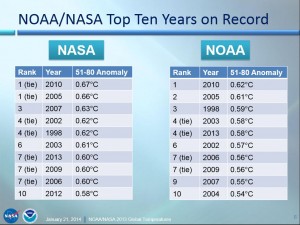
    Last year was one of the warmest on record, according to analyses of global temperature data by NASA and NOAA. Both federal agencies placed 2013 among the top 10 warmest years since records began in 1880, continuing a longer-term trend of global warming.

  • Making Sense of Climate’s Impact on Food Security

    Making Sense of Climate’s Impact on Food Security

    From warmer temperatures to natural disasters such as flooding and drought, changing patterns of climate are having billion-dollar impacts on our food-growing systems. But scientists are struggling to find ways to measure and predict what may happen in the future—and to translate that into policies to help feed a bulging world population.

  • Scientists Make Progress in Assessing Tornado Seasons

    Study Offers First Step in Short-Term Forecasting

  • 2010 Tied As Hottest Year, Say U.S. Researchers

    Two Separate Analyses Add Evidence of Long-Term Warming

  • Energy, Agriculture, and the Environment: Dead Zones and the Oil Spill in the Gulf of Mexico

    Energy, Agriculture, and the Environment: Dead Zones and the Oil Spill in the Gulf of Mexico

    Catastrophic, tragic, disastrous: these are all words that have been used to describe the BP oil spill in the Gulf of Mexico.  It is impossible to deny that these words apply – thick, goopy crude has already coated the beaches and estuaries of the Gulf, contaminating more than 120 miles of coastline.  The spill is…

  • New NOAA Administrator

    As of last week, the National Oceanic and Atmospheric Administration (NOAA) has a new leader. The U.S. Senate named Jane Lubchenco, Ph.D. Administrator of NOAA on March 19, 2009. As the first woman and the first marine ecologist to fulfill this position, Dr. Lubchenco is committed to using science to create sound policy. Her specific…

Columbia Climate School is bringing bold ideas, leading experts, and groundbreaking research to Climate Week NYC. Explore our events, stories, and updates as we help shape the conversation on climate action across New York City.

  • 2013 Ranks in Top 10 Warmest Years

    2013 Ranks in Top 10 Warmest Years

    Last year was one of the warmest on record, according to analyses of global temperature data by NASA and NOAA. Both federal agencies placed 2013 among the top 10 warmest years since records began in 1880, continuing a longer-term trend of global warming.

  • Making Sense of Climate’s Impact on Food Security

    Making Sense of Climate’s Impact on Food Security

    From warmer temperatures to natural disasters such as flooding and drought, changing patterns of climate are having billion-dollar impacts on our food-growing systems. But scientists are struggling to find ways to measure and predict what may happen in the future—and to translate that into policies to help feed a bulging world population.

  • Scientists Make Progress in Assessing Tornado Seasons

    Study Offers First Step in Short-Term Forecasting

  • 2010 Tied As Hottest Year, Say U.S. Researchers

    Two Separate Analyses Add Evidence of Long-Term Warming

  • Energy, Agriculture, and the Environment: Dead Zones and the Oil Spill in the Gulf of Mexico

    Energy, Agriculture, and the Environment: Dead Zones and the Oil Spill in the Gulf of Mexico

    Catastrophic, tragic, disastrous: these are all words that have been used to describe the BP oil spill in the Gulf of Mexico.  It is impossible to deny that these words apply – thick, goopy crude has already coated the beaches and estuaries of the Gulf, contaminating more than 120 miles of coastline.  The spill is…

  • New NOAA Administrator

    As of last week, the National Oceanic and Atmospheric Administration (NOAA) has a new leader. The U.S. Senate named Jane Lubchenco, Ph.D. Administrator of NOAA on March 19, 2009. As the first woman and the first marine ecologist to fulfill this position, Dr. Lubchenco is committed to using science to create sound policy. Her specific…