State of the Planet

News from the Columbia Climate School

sea level rise8

  • Study Downgrades Groundwater Contribution to Sea Level Rise

    Study Downgrades Groundwater Contribution to Sea Level Rise

    Some research suggests that, along with melting ice sheets and glaciers, the water pumped from underground for irrigation and other uses, on the rise worldwide, could contribute substantially to rising sea levels over the next 50 years. A new study published in Nature Climate Change says the magnitude is substantially lower.

  • Maureen Raymo Elected to National Academy of Sciences

    Maureen Raymo Elected to National Academy of Sciences

    Maureen Raymo, a marine geologist at Lamont-Doherty Earth Observatory whose name is connected with key theories about how ice ages wax and wane and how sea levels change, has been elected to the National Academy of Sciences, one of the highest honors awarded to scientists in the United States.

  • As Predicted: A Rising Tide of Migration

    As Predicted: A Rising Tide of Migration

    “With sea levels on the rise, several island nations are scrambling to stay above water and ensure citizens will have a place to go when the ocean engulfs their homeland. The humanitarian-crisis phase of climate change has officially begun.”

  • World Surf League Teams Up with Columbia to Support Ocean Science

    New philanthropy takes an innovative approach

  • Where Will Sea-Level Rise Hurt the Most?

    Where Will Sea-Level Rise Hurt the Most?

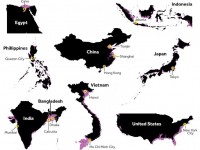
    A study out yesterday says that the lives of up to 13 million people in the United States may be disrupted by sea-level rise in the next century. But another study says that while much hard infrastructure like houses, piers, seawalls and roads may have to be kissed goodbye, some 70 percent of natural landforms…

  • Pump Meltwater Back on Antarctica? Do You Have 850,000 Wind Turbines?

    Pump Meltwater Back on Antarctica? Do You Have 850,000 Wind Turbines?

    A new study that looked at the feasibility of lowering sea levels by pumping water onto icy Antarctica offers a warning about the costs today’s greenhouse gas emissions may be creating for future generations.

  • Greenland’s Ice Is Getting Darker, Increasing Risk of Melting

    Feedback loops from melting itself are driving changes in reflectivity

  • A New Tool for Coastal Planners Preparing for Sea Level Rise

    A New Tool for Coastal Planners Preparing for Sea Level Rise

    Globally, the tool estimates at least 11 inches of sea level rise this century with ambitious efforts to lower greenhouse gas emissions and as much as 52 inches if greenhouse gas emissions continue to grow unchecked.

  • Climate Change Isn’t Just a 21st Century Problem

    Climate Change Isn’t Just a 21st Century Problem

    Humans have been burning fossil fuels for only about 150 years, yet that has started a cascade of profound changes that at their current pace will still be felt 10,000 years from now, a new study shows.

Composite banner with modern building at night and portrait of Dean Alexis Abramson that reads "Science for the Planet"

By studying thousands of buildings and analyzing their electricity use, Columbia Climate School Dean Alexis Abramson has been able to uncover ways to significantly cut energy consumption and emissions. Watch the Video: “Engineering a Cooler Future Through Smarter Buildings

  • Study Downgrades Groundwater Contribution to Sea Level Rise

    Study Downgrades Groundwater Contribution to Sea Level Rise

    Some research suggests that, along with melting ice sheets and glaciers, the water pumped from underground for irrigation and other uses, on the rise worldwide, could contribute substantially to rising sea levels over the next 50 years. A new study published in Nature Climate Change says the magnitude is substantially lower.

  • Maureen Raymo Elected to National Academy of Sciences

    Maureen Raymo Elected to National Academy of Sciences

    Maureen Raymo, a marine geologist at Lamont-Doherty Earth Observatory whose name is connected with key theories about how ice ages wax and wane and how sea levels change, has been elected to the National Academy of Sciences, one of the highest honors awarded to scientists in the United States.

  • As Predicted: A Rising Tide of Migration

    As Predicted: A Rising Tide of Migration

    “With sea levels on the rise, several island nations are scrambling to stay above water and ensure citizens will have a place to go when the ocean engulfs their homeland. The humanitarian-crisis phase of climate change has officially begun.”

  • World Surf League Teams Up with Columbia to Support Ocean Science

    New philanthropy takes an innovative approach

  • Where Will Sea-Level Rise Hurt the Most?

    Where Will Sea-Level Rise Hurt the Most?

    A study out yesterday says that the lives of up to 13 million people in the United States may be disrupted by sea-level rise in the next century. But another study says that while much hard infrastructure like houses, piers, seawalls and roads may have to be kissed goodbye, some 70 percent of natural landforms…

  • Pump Meltwater Back on Antarctica? Do You Have 850,000 Wind Turbines?

    Pump Meltwater Back on Antarctica? Do You Have 850,000 Wind Turbines?

    A new study that looked at the feasibility of lowering sea levels by pumping water onto icy Antarctica offers a warning about the costs today’s greenhouse gas emissions may be creating for future generations.

  • Greenland’s Ice Is Getting Darker, Increasing Risk of Melting

    Feedback loops from melting itself are driving changes in reflectivity

  • A New Tool for Coastal Planners Preparing for Sea Level Rise

    A New Tool for Coastal Planners Preparing for Sea Level Rise

    Globally, the tool estimates at least 11 inches of sea level rise this century with ambitious efforts to lower greenhouse gas emissions and as much as 52 inches if greenhouse gas emissions continue to grow unchecked.

  • Climate Change Isn’t Just a 21st Century Problem

    Climate Change Isn’t Just a 21st Century Problem

    Humans have been burning fossil fuels for only about 150 years, yet that has started a cascade of profound changes that at their current pace will still be felt 10,000 years from now, a new study shows.