201041
-
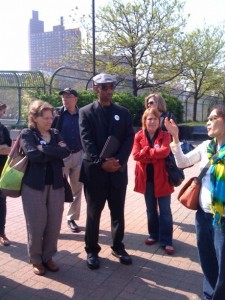
Harlem Shows its Green Thumb
On Earth Day, April 22nd, Faith Leaders for Environmental Justice came together with the CSSR and WeAct (West Harlem Environmental Action) to give a tour of Harlem using the new Healthy Living Harlem Green Map. The map is a public resource that shows the community where green spaces—such as community gardens, food coops, and parks—can…
-
42,225 Daily Temperature Readings, and Counting
A Rare 114-Year Record, Kept by Generations, Logs Changing Climate
-
Making mHealth a Reality
Last fall, under the direction of Dr. Patricia Mechael at The Earth Institute at Columbia University, our team of mHealth interns conducted a review of evidence-based studies on mobile health, or mHealth. The product of that work is being released today as part of the mHealth Alliance thought leadership series, and tied to the USAID,…
-
Triaging the Behindedness
Last fall, Lamont-Doherty Earth Observatory, honored my former advisor and boss, Bill Ryan. As my small contribution, I offered this essay that ends with a story about Bill. “Triage” is a term originating with medical personnel in the military. Its original meaning was the process of dividing wounded on the battlefield into three groups: those…
-
Earthquake Chasers in Upstate New York
Following a series of small, mysterious earthquakes in the rural town of Berne, southwest of Albany, N.Y., seismologists from Lamont-Doherty Earth Observatory have placed three temporary seismometers in the area, in an attempt to understand what is driving the tremors and assess whether there is a risk of larger events. Occasional small quakes have been recorded…
-

Racing to Save the Planet: Conservation Efforts in the Gulf Region
The April 20th explosion of the Deepwater Horizon oil rig off the coast of Louisiana continues to pour thousands of barrels of oil into the Gulf of Mexico each day. The spill—which is being heralded as the worst oil disaster in US history—is quickly encroaching upon the habitats of hundreds of species in the Gulf…
-
Seeing the Big Picture of Climate Change
L. Douglas James, a former Hydrologist for the National Science Foundation (retired), is a Big Picture guy. Concerned that scientific research and public policy are both too focused on isolated bits of the climate change issue, he had a go at inspiring attendees of a Columbia Water Center Seminar to branch out, make connections, and…
-
Hydraulic Fracturing – Potential for Contamination of Drinking Water Sources
Hydraulic fracturing is a technique used by the oil and gas industry to facilitate natural gas recovery in underground low permeability coalbed methane wells. This operation improves the extraction efficiency of methane by creating fissions or fractures in underground rock formations, generally 5,000 – 20,000 feet below the ground surface. Highly pressurized hydraulic fracturing fluids,…
-
Vote for the Earth Institute in the eBay Fundraising Tournament for the Environment
Do you share our belief that the world has the know-how and resources to solve our environmental challenges in a sustainable manner? Do you support efforts by the scientific community to help understand the effects of climate change, reduce environmental degradation, and advance renewable energy technologies? Then please vote for the Columbia Water Center’s parent…


AGU25, the premier Earth and space science conference, takes place December 15-19, 2025 in New Orleans, Louisiana. This year’s theme—Where Science Connects Us—puts in focus how science depends on connection, from the lab to the field to the ballot box. Once again, Lamont-Doherty Earth Observatory and Columbia Climate School scientists, experts, students, and educators are playing an active role, sharing our research and helping shape the future of our planet. #AGU25 Learn More
