201130
-
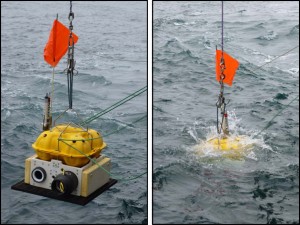
Deploying Ocean Bottom Seismometers off Alaska
On July 2, we finished deploying over twenty ocean-bottom seismometers as a part of our marine expedition to study a major tectonic boundary offshore Alaska. Ocean bottom seismometers (OBS’s) are autonomous instruments that sit on the seafloor and record sound waves traveling through the earth and the water. Floats made from glass balls and syntactic…
-

A typical day in the high Andes
Each morning starts the same in the Andes: the frost is heavy on the insides of our tents and falls with the slightest movement, while the realization that it´s going to be a freezing exit from the sleeping bag is tempered by gratitude that the thirteen hour night is over. Yes, sunrise in the Andes…
-

Climate News Roundup: Week of 6/26
Prodigal Plankton Returns to the Atlantic, Discovery News, Jun 26 According to researchers with the Sir Alister Hardy Foundation for Ocean Science, a species of plankton called Neodenticula seminae is an Atlantic resident again, 800,000 years after it became extinct in the ocean. The microscopic plant has been documented with sufficient frequency over the last…
-

Wasting Food = Wasting Water
The world is teetering on the edge of a food crisis due to the growing population, soaring food prices, and water scarcity, yet a shocking one third of the food produced around the world goes to waste.
-
Users Invited to Test New SEDAC Web Site
The NASA Socioeconomic Data and Applications Center (SEDAC) operated by CIESIN is a unique source of interdisciplinary data and related information and services related to the human dimensions of global environmental change. To help users more effectively find, access, and use these resources, SEDAC has redesigned its Web site with enhanced search tools, interactive mapping…
-

Heading to Sea off Alaska Aboard the R/V Langseth (at last)
Yesterday evening, we left Kodiak aboard the R/V Marcus G. Langseth and began our 38-day-long research cruise offshore Alaska. As we left port, we were treated to clear skies, calm seas and spectacular views of Kodiak – dark grey mountains tipped with snow emerging from the lush green landscape. Although Kodiak offered beautiful sights and…
-

Climate Forecasting: Oceans, Droughts, Climate Change and Other Tools of the Trade
At the International Research Institute for Climate and Society’s monthly climate briefing, talk often focuses on the role that El Niño or La Niña play in driving global climate. With the collapse of La Niña last month, though, IRI’s forecasters now have to rely on different tools to offer forecasts for the coming year. That’s…
-

Yes, We Can Afford to Remove Carbon from Air
Recently, the American Physical Society (APS) released a report on the direct capture of carbon dioxide from air. The report concludes that air capture could be a powerful tool for mopping up carbon dioxide emissions that otherwise would escape to the air, for providing carbon dioxide for synthetic liquid fuels in the transportation sector, and…
-

Understanding the Mind as the Temperature Climbs
Warnings of potentially cataclysmic climate change have reached nearly every newspaper front page and legislative chamber around the globe since the 1990s. So why has the human response been so limited?


AGU25, the premier Earth and space science conference, takes place December 15-19, 2025 in New Orleans, Louisiana. This year’s theme—Where Science Connects Us—puts in focus how science depends on connection, from the lab to the field to the ballot box. Once again, Lamont-Doherty Earth Observatory and Columbia Climate School scientists, experts, students, and educators are playing an active role, sharing our research and helping shape the future of our planet. #AGU25 Learn More
