State of the Planet

News from the Columbia Climate School

March 20163

  • A Surprise from the Zambezi River

    A Surprise from the Zambezi River

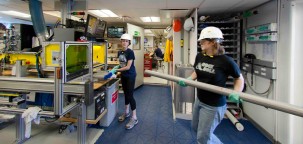
    Sidney Hemming and her team aboard the JOIDES Resolution got a surprise when they began taking sediment cores from their first river site off southern Africa—about 10 times more sediment than expected.

  • Navigating Governments’ Obligations in the Context of Land Investments

    Navigating Governments’ Obligations in the Context of Land Investments

    How should governments address the concerns of their citizens tied to land investments? And do their legal obligations constrain their options for doing so? These are increasingly complicated, and pressing, questions.

  • Are You Happier Now Than in Years Past?

    Are You Happier Now Than in Years Past?

    The World Happiness Report 2016 Update shows clearly that while income matters, it’s not the only thing.

  • Where Will Sea-Level Rise Hurt the Most?

    Where Will Sea-Level Rise Hurt the Most?

    A study out yesterday says that the lives of up to 13 million people in the United States may be disrupted by sea-level rise in the next century. But another study says that while much hard infrastructure like houses, piers, seawalls and roads may have to be kissed goodbye, some 70 percent of natural landforms…

  • Photo Essay: High in the Hills, Climate May Challenge Forests

    Photo Essay: High in the Hills, Climate May Challenge Forests

    Forests in the south-central United States are some of the country’s most productive and diverse. They also sit in a warming “hole”—an area where the progressive rise in temperature affecting most of the continent hasn’t yet taken hold. A team from Columbia University’s Lamont-Doherty Earth Observatory is studying how these forests might shift—or even disappear—when…

  • How Will Shifting Climate Change U.S. Forests?

    How Will Shifting Climate Change U.S. Forests?

    One foggy spring morning just after a hard rain, Park Williams was tromping through the woods deep in Arkansas’ Ozark Mountains. Toiling down a steep slope, he supposedly was keeping a simultaneous eye out for rattlesnakes, copperheads, poison ivy and big old trees. Williams seemed mostly focused on the trees, though; attention to the other…

  • Alumni Recruit Students for Sustainability Jobs

    Alumni Recruit Students for Sustainability Jobs

    Earth Institute alumni, who were on the job market only one or two years ago themselves, returned to the Columbia University campus in early March to recruit students for sustainability jobs.

  • The Technological World and the Risk of Nuclear Power

    The modern economy and our way of life depend on new and advancing technology. It especially depends on energy technology.

  • Drought in Papua New Guinea Heightens Tensions over Gold Mine

    Drought in Papua New Guinea Heightens Tensions over Gold Mine

    In the highlands of Papua New Guinea, tensions between local villagers and a gold mining operation over access to clean water are being heightened by a prolonged drought.

Composite banner with modern building at night and portrait of Dean Alexis Abramson that reads "Science for the Planet"

By studying thousands of buildings and analyzing their electricity use, Columbia Climate School Dean Alexis Abramson has been able to uncover ways to significantly cut energy consumption and emissions. Watch the Video: “Engineering a Cooler Future Through Smarter Buildings

  • A Surprise from the Zambezi River

    A Surprise from the Zambezi River

    Sidney Hemming and her team aboard the JOIDES Resolution got a surprise when they began taking sediment cores from their first river site off southern Africa—about 10 times more sediment than expected.

  • Navigating Governments’ Obligations in the Context of Land Investments

    Navigating Governments’ Obligations in the Context of Land Investments

    How should governments address the concerns of their citizens tied to land investments? And do their legal obligations constrain their options for doing so? These are increasingly complicated, and pressing, questions.

  • Are You Happier Now Than in Years Past?

    Are You Happier Now Than in Years Past?

    The World Happiness Report 2016 Update shows clearly that while income matters, it’s not the only thing.

  • Where Will Sea-Level Rise Hurt the Most?

    Where Will Sea-Level Rise Hurt the Most?

    A study out yesterday says that the lives of up to 13 million people in the United States may be disrupted by sea-level rise in the next century. But another study says that while much hard infrastructure like houses, piers, seawalls and roads may have to be kissed goodbye, some 70 percent of natural landforms…

  • Photo Essay: High in the Hills, Climate May Challenge Forests

    Photo Essay: High in the Hills, Climate May Challenge Forests

    Forests in the south-central United States are some of the country’s most productive and diverse. They also sit in a warming “hole”—an area where the progressive rise in temperature affecting most of the continent hasn’t yet taken hold. A team from Columbia University’s Lamont-Doherty Earth Observatory is studying how these forests might shift—or even disappear—when…

  • How Will Shifting Climate Change U.S. Forests?

    How Will Shifting Climate Change U.S. Forests?

    One foggy spring morning just after a hard rain, Park Williams was tromping through the woods deep in Arkansas’ Ozark Mountains. Toiling down a steep slope, he supposedly was keeping a simultaneous eye out for rattlesnakes, copperheads, poison ivy and big old trees. Williams seemed mostly focused on the trees, though; attention to the other…

  • Alumni Recruit Students for Sustainability Jobs

    Alumni Recruit Students for Sustainability Jobs

    Earth Institute alumni, who were on the job market only one or two years ago themselves, returned to the Columbia University campus in early March to recruit students for sustainability jobs.

  • The Technological World and the Risk of Nuclear Power

    The modern economy and our way of life depend on new and advancing technology. It especially depends on energy technology.

  • Drought in Papua New Guinea Heightens Tensions over Gold Mine

    Drought in Papua New Guinea Heightens Tensions over Gold Mine

    In the highlands of Papua New Guinea, tensions between local villagers and a gold mining operation over access to clean water are being heightened by a prolonged drought.