Climate144
-
How Can Changing Climate Affect a Civilization?
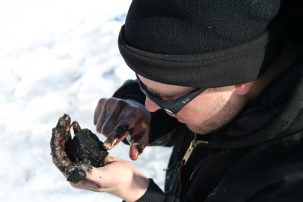
Billy D’Andrea is trying to understand Easter Island’s climate history over the last few thousand years and how communities dealt with past climate change.
-

Columbia Climate Scientist Joins Quest to ‘Make Our Planet Great Again’
The International Research Institute for Climate and Society’s Alessandra Giannini was selected as one of French President’s Macron’s climate laureates.
-

Tiny Losses of Ice at Antarctica’s Fringes May Hasten Declines in Interior
A new study shows that even minor deterioration of ice shelves can instantaneously hasten the decline of ice hundreds of miles landward.
-

The Greenland Ice Sheet Is Sponging Up Meltwater
As climate warms, the surface of the Greenland ice sheet is melting, and all that meltwater ends up in seasonal rivers that flow to the sea. At least that is what scientists have assumed until now. A new study has shown that some of the meltwater is actually being soaked into porous subsurface ice and…
-

Understanding Earth’s Geologic History to Predict the Future
Organic geochemist Pratigya Polissar is developing new tools to look at the history of plants and ecosystems on Earth over the past 20 million years.
-

American Geophysical Union 2017: Key Events From the Earth Institute
A chronological guide to key talks and other events presented by Columbia University’s Earth Institute at the American Geophysical Union 2017 meeting.
-
Spring 2018 Earth Institute Undergraduate Research Assistant Opportunities
By Chandler Precht The Earth Institute, Columbia University, is offering undergraduate students with research assistant opportunities during the spring 2018 semester. Undergraduates from Columbia and Barnard will be able to serve as research assistants on research projects related to sustainable development and the environment with distinguished faculty and researchers at the cutting edge of this…
-
Spring 2018 Earth Institute Internship Opportunities
By Chandler Precht The Earth Institute is offering undergraduate, graduate and PhD students with opportunities to intern in various departments and research centers in a variety of administration, communications and research roles. Interns work on a variety of sustainability-focused projects across The Earth Institute. These projects provide interns with hands-on workplace experience, allowing them to…
-

The Way We Were: Climate and Human Evolution
In a remote desert region around Kenya’s Lake Turkana, paleoecologist and geochemist Kevin Uno collects fossils and sediments, searching for evidence about past climate, vegetation, animals, and water. His goal: to understand how climate affected our ancestors millions of years ago.


The first Earth Day in 1970 ignited a movement to stop polluting our planet. Today, our scientists and experts are tackling the most pressing challenges to achieve real-world impact. This Earth Day, join us in our commitment to realizing a just and sustainable future for our planet. Visit our Earth Day website for ideas, resources, and inspiration.
