General154
-
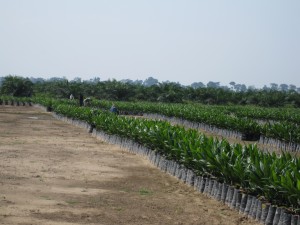
Can Intensive Farming Save Tropical Forests?
With 7 billion people on the planet and some 40 percent of earth’s land surface already covered with croplands and pastures, the only remaining frontiers for agricultural expansion are dwindling tropical forests. Some see high-yield industrial-scale farming as a way to take the pressure off; the theory goes that if more produce can be grown…
-

Collaborating on Policy and Practice with Garry Conille, Prime Minister of Haiti
The Earth Institute welcomed Prime Minister Garry Conille of Haiti on Dec. 2 for a day of policy discussions and a seminar with the students of the Master’s in Public Affairs Development Practice program at Columbia’s School of International and Public Affairs.
-

Did the Oceans Influence Human Evolution?
Scientists often invoke climate as a possible factor in human evolution; but only recently have they developed the ability to get enough information about past climates and related fossil evidence to see any details. A half-dozen leading paleontologists and climate scientists discussed recent advances in a symposium this week at the annual meeting of the…
-

Global Climate Modeling for the Masses: You Can Try This at Home
Since 2005, the Educational Global Climate Modeling Project has been downloaded 50,000 times, and adopted for teaching and research at hundreds of universities and other institutions.
-

MPA Student Complements Classroom Learning with Hydrofracking Policy Experience
“I had been very interested in hydrofracking before I started the MPA in Environmental Science and Policy (MPA-ESP) program, but really became passionate about the negative the environmental impacts of the practice through my workshop, which analyzed and created an implementation plan for the FRAC Act of 2011.” Josh Garrett, MPA-ESP Class of 2012 student,…
-

Extraordinary Support for Unprecedented Global Challenges
The Earth Institute’s annual donor report for fiscal year 2011 is now available in an interactive digital format. We remain committed to finding extraordinary support to unprecedented global challenges, many of which are outlined in this report. We have highlighted some of our innovative projects in research, policy, and education, as well as the partnerships…
-

What Darwin Saw
Sir Charles Darwin realized that humanity is interwoven with nature, that all of life is in a state of constant flux. The empowerment of nature, made possible by Darwin’s integration of human life into the whole, and grounded in his lived experience and profound humility, is the foundation of modern ecology.
-

Data’s Power to Spur Environmental Progress
In January, 132 countries received their environmental report cards. The Environmental Performance Index has goaded leaders into action by letting them see their countries’ strengths and weaknesses compared to other countries.
-

Climate Services: A Regional Perspective
“But we unfortunately are in one of the areas in which climate prediction is very difficult because we’re in the middle of two big oceans, and on the fringe between the interaction of Northern Hemisphere systems and Southern Hemisphere systems.” — Costa Rica’s Patricia Ramirez on the value of shared climate services across Central America…


By studying thousands of buildings and analyzing their electricity use, Columbia Climate School Dean Alexis Abramson has been able to uncover ways to significantly cut energy consumption and emissions. Watch the Video: “Engineering a Cooler Future Through Smarter Buildings“
