State of the Planet

News from the Columbia Climate School

General188

  • The Science Barge Demonstrates Sustainable Urban Farming

    The Science Barge Demonstrates Sustainable Urban Farming

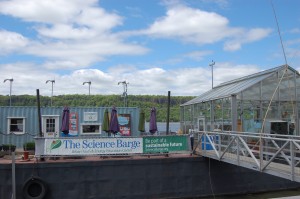
    Just a few miles north of Columbia University in Yonkers, the Science Barge floats on the Hudson River, demonstrating a fully functioning system of renewable energy based sustainable food production. Despite its river setting, however, the Science Barge is, in fact, a prototype for rooftop gardening.

  • Climate News Roundup: Week of 5/08

    Climate News Roundup: Week of 5/08

    In a Changing Antarctica, Some Penguins Thrive as Others Suffer, NY Times, May 9 Adelie penguins, inhabitants of the northern edge of Antarctica, are considered to be a “bellwether” of climate change. This Antarctic Peninsula is one of the fastest warming places on Earth: average winter air temperature has risen an alarming 10.8 degrees Fahrenheit…

  • Basic Health Care Doesn’t Have to Be of Basic Quality

    Basic Health Care Doesn’t Have to Be of Basic Quality

    While coordinating a Community Health Worker (CHW)-based asthma management program in New York City, I learned of the Millennium Villages Project (MVP), its CHW program, and of the opportunity to help build community health systems in sub-Saharan Africa. My diverse experience in healthcare gave me a unique understanding of the need for highly performing CHW…

  • Transporting Ice From Greenland’s Deep Interior

    Transporting Ice From Greenland’s Deep Interior

    The North East Ice Stream is a fast-flowing glacier transporting ice from deep in the interior of the Greenland Ice Sheet out to the coast (see image showing a deep penetration into central Greenland). When it reaches the coastline it feeds 79 N Glacier. This area is heavily crevassed, evidence of the rapid ice flow.…

  • Making Peace: New Book Provides Tools for Solving Intractable Conflicts

    Making Peace: New Book Provides Tools for Solving Intractable Conflicts

    Five percent of all difficult conflicts end in a destructive quagmire. Think of the current debate over global warming or the Israel-Palestine conflict. How can we overcome these? An Earth Institute psychologist, Peter T. Coleman, offers tactics in his new book, The Five Percent: Finding Solutions to Seemingly Impossible Conflicts. Coleman, who also heads Columbia’s…

  • A chorus of bloggers passes the 1,000 mark on the Earth Institute’s State of the Planet

    A chorus of bloggers passes the 1,000 mark on the Earth Institute’s State of the Planet

    As the State of the Planet blog surpassed 1,000 entries, we decided to take a look at the numbers and compile a list of the 10 most visited pages. Some are individual postings; others are pages that highlight our coverage of conferences, expeditions or programs. Since our launch, we’ve brought you posts from expeditions in…

  • British Royals’ Green Wedding

    British Royals’ Green Wedding

    The Royal wedding used up a lot of resources, but Will and Kate did their best to keep it green.

  • Professor Jeffrey Sachs Extends Term as Director of the Earth Institute

    Professor Jeffrey Sachs Extends Term as Director of the Earth Institute

    The Earth Institute, Columbia University announced that Professor Jeffrey Sachs has agreed to extend his term as its director. Since his tenure began in 2002, Sachs has led the Earth Institute to become a leading scientific authority on sustainable development while simultaneously expanding its reach worldwide. Through his guidance, the Earth Institute and its scientists…

  • Keeping America Competitive by Sparking Curiosity in the Classroom

    Keeping America Competitive by Sparking Curiosity in the Classroom

    To keep America competitive in science, technology, engineering and mathematics (the STEM disciplines), a report from the National Academy of Sciences calls for strengthening the skills of some 250,000 teachers across the United States through university-run science training programs. The report asserts that when teachers gain laboratory experience and conduct fieldwork alongside active researchers, they…

Collage of Turkiye beach scene and Columbia University Campus with text: UN Climate Change Conference COP31, Antalya, Turkiye, Nov 9-20, 2026

COP31, the 2026 United Nations Climate Change Conference, aims to advance dialogue, strengthen consensus, and accelerate climate action on a global scale. From November 9–20, 2026 in Antalya, Türkiye, heads of state, ministers, scientists, business leaders, and civil society will gather to advance efforts in emission targets, climate finance, and adaptation and resilience. Once again, our experts, students, and global thought leaders from Columbia Climate School and across Columbia University are contributing to key events, sharing insights, and helping shape the dialogue toward ambitious, science-based solutions. Learn More

  • The Science Barge Demonstrates Sustainable Urban Farming

    The Science Barge Demonstrates Sustainable Urban Farming

    Just a few miles north of Columbia University in Yonkers, the Science Barge floats on the Hudson River, demonstrating a fully functioning system of renewable energy based sustainable food production. Despite its river setting, however, the Science Barge is, in fact, a prototype for rooftop gardening.

  • Climate News Roundup: Week of 5/08

    Climate News Roundup: Week of 5/08

    In a Changing Antarctica, Some Penguins Thrive as Others Suffer, NY Times, May 9 Adelie penguins, inhabitants of the northern edge of Antarctica, are considered to be a “bellwether” of climate change. This Antarctic Peninsula is one of the fastest warming places on Earth: average winter air temperature has risen an alarming 10.8 degrees Fahrenheit…

  • Basic Health Care Doesn’t Have to Be of Basic Quality

    Basic Health Care Doesn’t Have to Be of Basic Quality

    While coordinating a Community Health Worker (CHW)-based asthma management program in New York City, I learned of the Millennium Villages Project (MVP), its CHW program, and of the opportunity to help build community health systems in sub-Saharan Africa. My diverse experience in healthcare gave me a unique understanding of the need for highly performing CHW…

  • Transporting Ice From Greenland’s Deep Interior

    Transporting Ice From Greenland’s Deep Interior

    The North East Ice Stream is a fast-flowing glacier transporting ice from deep in the interior of the Greenland Ice Sheet out to the coast (see image showing a deep penetration into central Greenland). When it reaches the coastline it feeds 79 N Glacier. This area is heavily crevassed, evidence of the rapid ice flow.…

  • Making Peace: New Book Provides Tools for Solving Intractable Conflicts

    Making Peace: New Book Provides Tools for Solving Intractable Conflicts

    Five percent of all difficult conflicts end in a destructive quagmire. Think of the current debate over global warming or the Israel-Palestine conflict. How can we overcome these? An Earth Institute psychologist, Peter T. Coleman, offers tactics in his new book, The Five Percent: Finding Solutions to Seemingly Impossible Conflicts. Coleman, who also heads Columbia’s…

  • A chorus of bloggers passes the 1,000 mark on the Earth Institute’s State of the Planet

    A chorus of bloggers passes the 1,000 mark on the Earth Institute’s State of the Planet

    As the State of the Planet blog surpassed 1,000 entries, we decided to take a look at the numbers and compile a list of the 10 most visited pages. Some are individual postings; others are pages that highlight our coverage of conferences, expeditions or programs. Since our launch, we’ve brought you posts from expeditions in…

  • British Royals’ Green Wedding

    British Royals’ Green Wedding

    The Royal wedding used up a lot of resources, but Will and Kate did their best to keep it green.

  • Professor Jeffrey Sachs Extends Term as Director of the Earth Institute

    Professor Jeffrey Sachs Extends Term as Director of the Earth Institute

    The Earth Institute, Columbia University announced that Professor Jeffrey Sachs has agreed to extend his term as its director. Since his tenure began in 2002, Sachs has led the Earth Institute to become a leading scientific authority on sustainable development while simultaneously expanding its reach worldwide. Through his guidance, the Earth Institute and its scientists…

  • Keeping America Competitive by Sparking Curiosity in the Classroom

    Keeping America Competitive by Sparking Curiosity in the Classroom

    To keep America competitive in science, technology, engineering and mathematics (the STEM disciplines), a report from the National Academy of Sciences calls for strengthening the skills of some 250,000 teachers across the United States through university-run science training programs. The report asserts that when teachers gain laboratory experience and conduct fieldwork alongside active researchers, they…