State of the Planet

News from the Columbia Climate School

Health34

  • This Dance Class Could Be Worth $1 Million

    This Dance Class Could Be Worth $1 Million

    You could be dancing a Dollu Kunitha in Karnataka, or a Kpanlogo in Ghana, or a samba in Rio. Dance is integral to most cultures, and it’s also a social and fun way to improve physical fitness. It can help prevent cardiovascular disease and control weight, among other health benefits. And that is the point…

  • From the Atmosphere to Asthma: Exploring the Field of Environmental Health

    The Undergraduate Program in Sustainable Development kicked off their Spring 2014 Speaker Series with Dr. Regina Santella, Center Director of the NIEHS Center for Environmental Health in Northern Manhattan, who spoke on the Center’s mission as well as her own research against deadly diseases.

  • Website Maps the Flu, and Predicts Its Progress

    Website Maps the Flu, and Predicts Its Progress

    Infectious disease experts at Columbia’s Mailman School of Public Health have launched a website that reports weekly predictions for rates of seasonal influenza in 94 cities in the United States.

  • Genetic Modifications You May Not Know About

    Genetic Modifications You May Not Know About

    While much attention is focused on genetically modified foods, fewer people are aware that many other genetically modified organisms and cells are in development. Columbia University’s Shaheed Naeem and Matthew Palmer offer their perspectives.

  • Why Conservation is Not Condescension: A Case Against Eco-imperialism

    Why Conservation is Not Condescension: A Case Against Eco-imperialism

    Western ecologists and conservationists have been portrayed at times as modern imperialists, forcefully imposing a radical ideology of environmentalism on the developing world. These so-called “eco-imperialists” are depicted as arrogant and uncaring elites, concerned with the protection of pristine nature, but indifferent to human welfare. But the future of wild places is entwined with human…

  • Map Your Food

    Map Your Food

    Where does London get its fruit? Where are the “food swamps” in Los Angeles? Where do tomatoes from Spain wind up? Where are the composters in New York City? For lovers of geography, and of the sociology of food, “Food: an atlas” offers lots of informative and curious distraction.

  • IRI@AGU: Schedule of Events + Q&As

    IRI@AGU: Schedule of Events + Q&As

    Four scientists and one PhD student from the International Research Institute for Climate and Society are attending the 2013 American Geophysical Union’s Fall Meeting. Below are links to Q&As with each of the presenters and the schedule of their posters and presentations.

  • GlaxoSmithKline Supports African Health Workers Campaign

    GlaxoSmithKline Supports African Health Workers Campaign

    The Earth Institute and its corporate partner, global healthcare company GlaxoSmithKline are embarking on a new project to broadly expand the reach of healthcare services in sub-Saharan Africa. In collaboration with the One Million Community Health Workers Campaign, the new project will develop an online information dashboard that will help streamline community health worker operations…

  • On Nov. 12, Meet Climate Models in New York City

    On Nov. 12, Meet Climate Models in New York City

    Who’s studying Earth’s climate? Why? Where? How? And what are they learning? Panelists will explore these questions and discuss creative methods that can be used to better communicate climate science to the public.

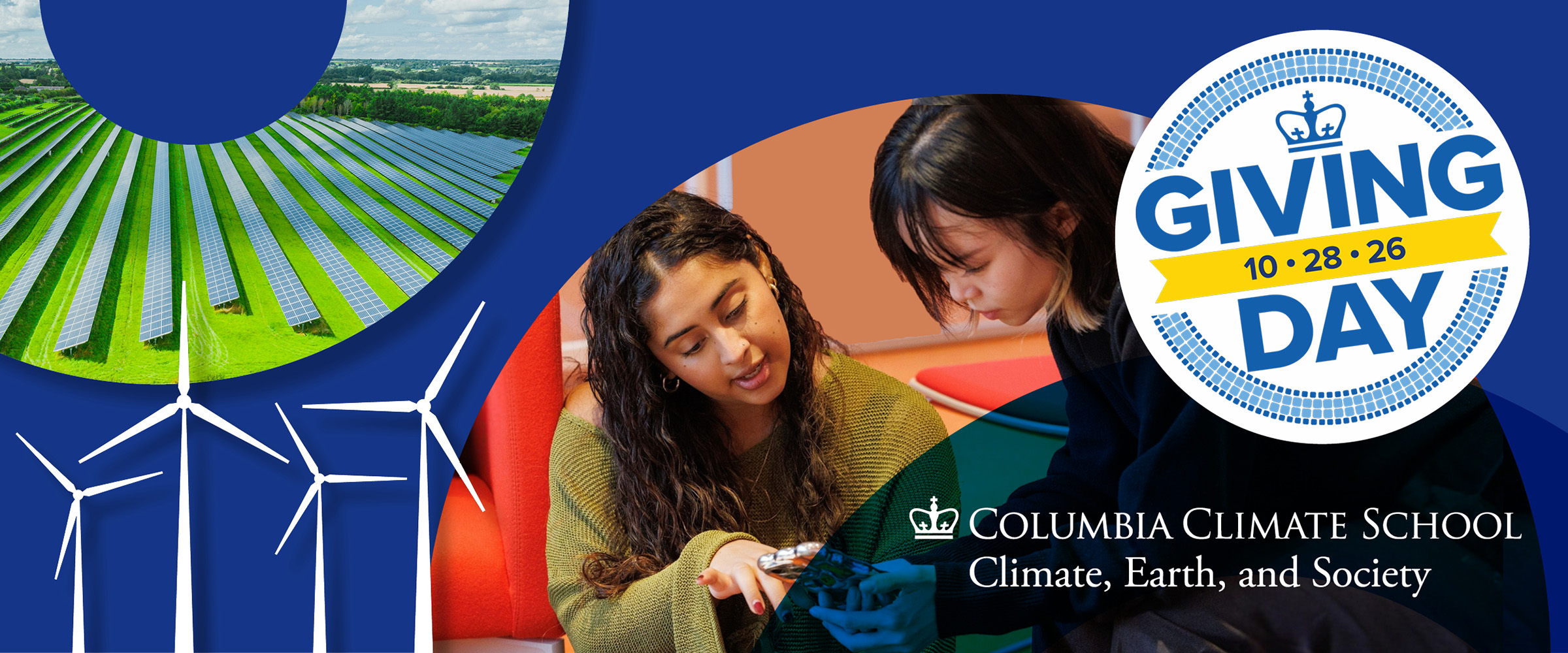
Columbia Climate School Giving Day on October 28, 2026, featuring students and renewable energy imagery

October 28, 2026 is Columbia Giving Day! Your gift to Columbia Climate School helps advance interdisciplinary research, educate the next generation of leaders, and transform bold ideas into real-world solutions for climate, Earth, and society.

  • This Dance Class Could Be Worth $1 Million

    This Dance Class Could Be Worth $1 Million

    You could be dancing a Dollu Kunitha in Karnataka, or a Kpanlogo in Ghana, or a samba in Rio. Dance is integral to most cultures, and it’s also a social and fun way to improve physical fitness. It can help prevent cardiovascular disease and control weight, among other health benefits. And that is the point…

  • From the Atmosphere to Asthma: Exploring the Field of Environmental Health

    The Undergraduate Program in Sustainable Development kicked off their Spring 2014 Speaker Series with Dr. Regina Santella, Center Director of the NIEHS Center for Environmental Health in Northern Manhattan, who spoke on the Center’s mission as well as her own research against deadly diseases.

  • Website Maps the Flu, and Predicts Its Progress

    Website Maps the Flu, and Predicts Its Progress

    Infectious disease experts at Columbia’s Mailman School of Public Health have launched a website that reports weekly predictions for rates of seasonal influenza in 94 cities in the United States.

  • Genetic Modifications You May Not Know About

    Genetic Modifications You May Not Know About

    While much attention is focused on genetically modified foods, fewer people are aware that many other genetically modified organisms and cells are in development. Columbia University’s Shaheed Naeem and Matthew Palmer offer their perspectives.

  • Why Conservation is Not Condescension: A Case Against Eco-imperialism

    Why Conservation is Not Condescension: A Case Against Eco-imperialism

    Western ecologists and conservationists have been portrayed at times as modern imperialists, forcefully imposing a radical ideology of environmentalism on the developing world. These so-called “eco-imperialists” are depicted as arrogant and uncaring elites, concerned with the protection of pristine nature, but indifferent to human welfare. But the future of wild places is entwined with human…

  • Map Your Food

    Map Your Food

    Where does London get its fruit? Where are the “food swamps” in Los Angeles? Where do tomatoes from Spain wind up? Where are the composters in New York City? For lovers of geography, and of the sociology of food, “Food: an atlas” offers lots of informative and curious distraction.

  • IRI@AGU: Schedule of Events + Q&As

    IRI@AGU: Schedule of Events + Q&As

    Four scientists and one PhD student from the International Research Institute for Climate and Society are attending the 2013 American Geophysical Union’s Fall Meeting. Below are links to Q&As with each of the presenters and the schedule of their posters and presentations.

  • GlaxoSmithKline Supports African Health Workers Campaign

    GlaxoSmithKline Supports African Health Workers Campaign

    The Earth Institute and its corporate partner, global healthcare company GlaxoSmithKline are embarking on a new project to broadly expand the reach of healthcare services in sub-Saharan Africa. In collaboration with the One Million Community Health Workers Campaign, the new project will develop an online information dashboard that will help streamline community health worker operations…

  • On Nov. 12, Meet Climate Models in New York City

    On Nov. 12, Meet Climate Models in New York City

    Who’s studying Earth’s climate? Why? Where? How? And what are they learning? Panelists will explore these questions and discuss creative methods that can be used to better communicate climate science to the public.