Natural Disasters60
-

Scientific Publisher to Provide Easy Access to Study Data
Modern society is awash in data. By one estimate, as much information today is created in 48 hours as was produced in the last 30,000 years. The challenge now is making all those megabytes public. This month, Elsevier, publisher of The Lancet and Cell, announced that it would establish reciprocal linking between its geochemistry journals…
-

Migration in the Face of Global Environmental Change
Over the past 40 years, coastal and inland water ecosystems experienced the greatest levels of net in-migration, vs. mountain, forest, cultivated, and dryland ecosystems, which experienced the greatest levels of net out-migration, says a new report.
-
Open House: Earth Institute Graduate Programs
The Environmental and Sustainable Development Programs Open House is a wonderful opportunity for you to find out more about Columbia’s cutting-edge graduate degrees in sustainable development and environmental studies. We invite you to come explore our diverse offering of programs, have your application questions answered, and meet with current Columbia students and faculty. Attend the…
-

Partnership in Action: Lessons Learned Following Haiti Floods
Flood relief efforts, immediate needs assessments, and coordinated damage assessments in Haiti’s Côte Sud region are underway following the rains and flooding that began October 9 and continued through October 11. The Earth Institute Haiti team, working through the CSI partnership, Millennium Village Project (MVP) sector leads, and with the Government of Haiti, are jointly…
-

Partnership Framework Supports Haiti Flood Relief
Recent heavy rains and consequent flooding in Haiti’s Côte Sud region—the site of the Côte Sud Initiative (CSI) and Port-à-Piment, designated as the first Millennium Village in the Western Hemisphere— required the not yet fully formed team to leverage the CSI partnership framework to help coordinate an immediate and ultimately lifesaving emergency response. The first…
-

Open House: Earth Institute Undergraduate Programs
Whether you are interested in global poverty alleviation, sustainable development, sustainability management, ecology or environmental policy, Columbia University has a program for you. Attend the Environmental and Sustainable Development Programs Open House from 4-7 p.m. on Monday, Oct. 24, Low Memorial Library, Columbia University (116th & Broadway) to learn more.
-

Hybrid Climate Data for East Africa
In our latest video interview, climate scientist Tufa Dinku talks about his work on combining weather station data with satellite information to generate high-resolution data sets. These data could be used for making more accurate forecasts and can feed into other climate risk management activities, such as early-warning systems. With funding from Google.org, Dinku and…
-

Jumping Ship
As we finally reached our prime target area, it was time for me to leave the ship and return home. Despite initial struggles on navigating the Brahmaputra River, we have worked together with the ship’s crew and pilots for a successful method. And now as I leave with many new friends, the best data is…
-

Cruising up the Brahmaputra
Rejoining the ship, we sailed up the Padma and Jamuna (Brahmaputra) Rivers. Hurrying to our primary area with the help of pilots, we finally collected good seismic data.


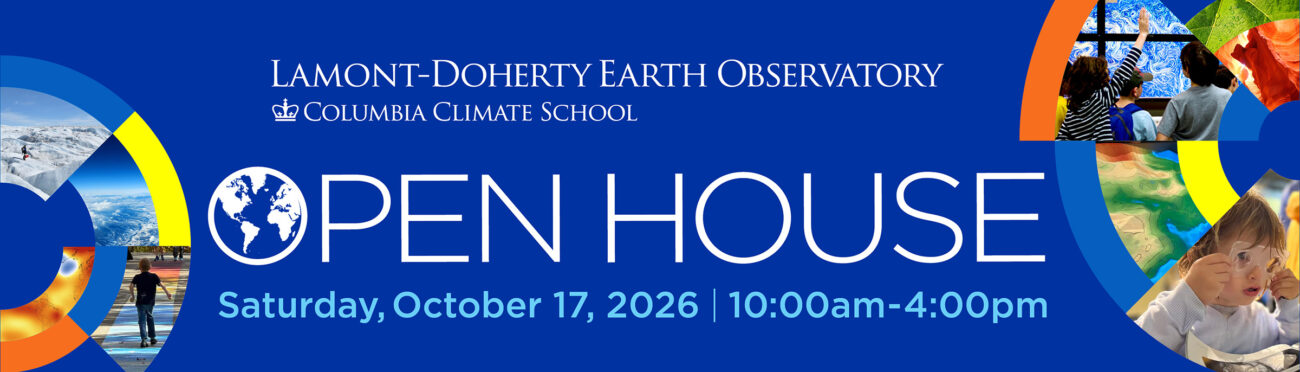
On Saturday, October 17, 2026 from 10am to 4pm, Lamont-Doherty Earth Observatory Open House—our biggest, best science fun and discovery event of the year—will take place on our beautiful campus in Palisades, NY. Mark your calendar and join us for this free, family-friendly celebration of science! RSVP Today!
