State of the Planet

News from the Columbia Climate School

Africa6

  • We’re Headed for Mozambique!

    We’re Headed for Mozambique!

    After weeks of anticipation, permission arrived just in time to core off Mozambique. Sidney Hemming and her team of scientists aboard the JOIDES Resolution are excited about what they might learn from the ocean sediment.

  • Trials & Tribulations of Coring the Agulhas Plateau

    Trials & Tribulations of Coring the Agulhas Plateau

    Trying to drill sediment cores while the ship rides large ocean swells off the coast of Africa isn’t easy, but it’s paying off for science, writes Sidney Hemming.

  • Sailing into a Storm as We Head for the Agulhas Plateau

    Sailing into a Storm as We Head for the Agulhas Plateau

    The team aboard the JOIDES Resolution just finished at their first coring site off southern Africa. The first results? “Awesome.” Sidney Hemming describes the process in words and photos.

  • 6 Million Years of Sediment, Studded with Tiny Fossils

    6 Million Years of Sediment, Studded with Tiny Fossils

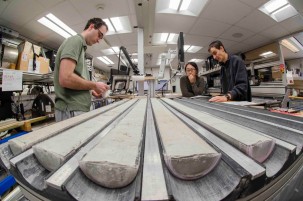
    Sidney Hemming and her team have started examining their first sediment core from off southern Africa. It appears to contain about 6 million years of history.

  • Gearing Up for Our First Cores

    Gearing Up for Our First Cores

    As they get to know their ship, the scientists aboard the JOIDES Resolution prepare to drill their first sediment cores along the Natal Valley off the coast of southern Africa.

  • Map & App Help People Track Transit in Nairobi

    Map & App Help People Track Transit in Nairobi

    Commuters and others traveling in and around Nairobi often rely on an unofficial network of minibuses and minivans, called matatus, that have no centrally controlled schedules, fares or route plans. But a new application developed for use on cellphones with Google Maps can now help them find their way.

  • Has the Green Revolution Really Succeeded?

    Has the Green Revolution Really Succeeded?

    Over the past 50 years, human population has more than doubled, but cereal-crop production has grown even faster. Unfortunately, newer high-yield crops are less nutritious.

  • Photo Essay: Sleeping Giant off West Africa Awakes

    Photo Essay: Sleeping Giant off West Africa Awakes

    Nearly 20 years after its last eruption, in 1995, Fogo volcano off West Africa awoke on Nov. 26. Within a week, it had buried two villages under scorching lava, leaving 1,200 people homeless. Lamont-Doherty geologist Ricardo Ramalho was there to document the action and help advise local government.

  • Will Africa Finally Achieve a Green Revolution?

    Will Africa Finally Achieve a Green Revolution?

    Earth Institute agricultural scientist Pedro A. Sanchez argues in a new essay that new developments in both science and politics give him hope that sub-Saharan Africa will be able to feed itself by 2050, even with a projected population by then of about 2 billion people.

Banner with collage of ecosystems and the Empire State Building with text "Climate Week NYC: Columbia Climate School."

Columbia Climate School is bringing bold ideas, leading experts, and groundbreaking research to Climate Week NYC. Explore our events, stories, and updates as we help shape the conversation on climate action across New York City.

  • We’re Headed for Mozambique!

    We’re Headed for Mozambique!

    After weeks of anticipation, permission arrived just in time to core off Mozambique. Sidney Hemming and her team of scientists aboard the JOIDES Resolution are excited about what they might learn from the ocean sediment.

  • Trials & Tribulations of Coring the Agulhas Plateau

    Trials & Tribulations of Coring the Agulhas Plateau

    Trying to drill sediment cores while the ship rides large ocean swells off the coast of Africa isn’t easy, but it’s paying off for science, writes Sidney Hemming.

  • Sailing into a Storm as We Head for the Agulhas Plateau

    Sailing into a Storm as We Head for the Agulhas Plateau

    The team aboard the JOIDES Resolution just finished at their first coring site off southern Africa. The first results? “Awesome.” Sidney Hemming describes the process in words and photos.

  • 6 Million Years of Sediment, Studded with Tiny Fossils

    6 Million Years of Sediment, Studded with Tiny Fossils

    Sidney Hemming and her team have started examining their first sediment core from off southern Africa. It appears to contain about 6 million years of history.

  • Gearing Up for Our First Cores

    Gearing Up for Our First Cores

    As they get to know their ship, the scientists aboard the JOIDES Resolution prepare to drill their first sediment cores along the Natal Valley off the coast of southern Africa.

  • Map & App Help People Track Transit in Nairobi

    Map & App Help People Track Transit in Nairobi

    Commuters and others traveling in and around Nairobi often rely on an unofficial network of minibuses and minivans, called matatus, that have no centrally controlled schedules, fares or route plans. But a new application developed for use on cellphones with Google Maps can now help them find their way.

  • Has the Green Revolution Really Succeeded?

    Has the Green Revolution Really Succeeded?

    Over the past 50 years, human population has more than doubled, but cereal-crop production has grown even faster. Unfortunately, newer high-yield crops are less nutritious.

  • Photo Essay: Sleeping Giant off West Africa Awakes

    Photo Essay: Sleeping Giant off West Africa Awakes

    Nearly 20 years after its last eruption, in 1995, Fogo volcano off West Africa awoke on Nov. 26. Within a week, it had buried two villages under scorching lava, leaving 1,200 people homeless. Lamont-Doherty geologist Ricardo Ramalho was there to document the action and help advise local government.

  • Will Africa Finally Achieve a Green Revolution?

    Will Africa Finally Achieve a Green Revolution?

    Earth Institute agricultural scientist Pedro A. Sanchez argues in a new essay that new developments in both science and politics give him hope that sub-Saharan Africa will be able to feed itself by 2050, even with a projected population by then of about 2 billion people.
