State of the Planet

News from the Columbia Climate School

Africa8

  • In Ethiopian Desert, a Window into Rifting of Africa

    In Ethiopian Desert, a Window into Rifting of Africa

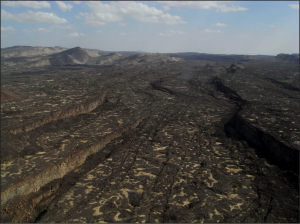
    A new study in the journal Nature provides fresh insight into deep-earth processes driving apart huge sections of the earth’s crust. This rifting mostly takes place on seabeds, but can be seen in a few places on land—nowhere more visibly than in the Afar region of northern Ethiopia.

  • Farmers in Senegal Use Forecasts to Combat Climate Risks

    Farmers in Senegal Use Forecasts to Combat Climate Risks

    Recent trainings in Senegal have improved trust between farmers and researchers, leading to increased use of climate forecasts and other information.

  • The Sahel Is Getting Wetter, But Will It Last?

    The Sahel Is Getting Wetter, But Will It Last?

    New research gives a unifying explanation of the Sahel’s past, present and future climate patterns.

  • With 1,000 Days Left to Reach MDGs, a Look Back and Forward

    With 1,000 Days Left to Reach MDGs, a Look Back and Forward

    The 1,000-day milestone to achieve the Millennium Development Goals (MDGs) gathered professors Jeffrey Sachs, Prabhjot Singh, and Vijay Modi on April 4 for the Sustainable Development Seminar Series to take a critical look at how far the Millennium Villages Project (MVP) has come in the eight years since its founding and analyze what still needs…

  • Improving Seeds to Meet Future Challenges

    Improving Seeds to Meet Future Challenges

    Scientists and agronomists are racing to develop seeds that are higher yielding, more nutritious, and both drought and climate resilient to meet the challenge of feeding the world in the future.

  • Poor Ethiopian Farmers Receive ‘Unprecedented’ Insurance Payout

    Poor Ethiopian Farmers Receive ‘Unprecedented’ Insurance Payout

    Thanks to a groundbreaking new program that relies on advanced satellite technology, a weather index insurance payout of unprecedented scale will benefit poor African farmers.

  • Visualizing Malaria from Space

    Visualizing Malaria from Space

    Public health professionals are increasingly concerned about the impact climate variability and change can have on infectious diseases such as malaria, dengue fever and bacterial meningitis. However, in order to study the relationships between climate and …

  • Health Systems Expert Wins Young Leader Award

    Health Systems Expert Wins Young Leader Award

    Dr. Prabhjot Singh, an international health systems expert at the Earth Institute who helped design community health worker systems for the Millennium Villages Project across 10 African countries, has won a $40,000 Young Leader Award from the Robert Wood Johnson Foundation.

  • A Forest Reserve Is Not an Island

    A Forest Reserve Is Not an Island

    Biologist Marina Cords has been studying monkey social behavior in western Kenya’s protected Kakamega Forest since 1979. Her work has led to insights about how primates manage conflicts, mate and carry out other social functions closely related to human behavior.

Colorful icons representing nature, sustainable living, and renewable energy with text "Earth Day 2026"

The first Earth Day in 1970 ignited a movement to stop polluting our planet. Today, our scientists and experts are tackling the most pressing challenges to achieve real-world impact. This Earth Day, join us in our commitment to realizing a just and sustainable future for our planet. Visit our Earth Day website for ideas, resources, and inspiration.

  • In Ethiopian Desert, a Window into Rifting of Africa

    In Ethiopian Desert, a Window into Rifting of Africa

    A new study in the journal Nature provides fresh insight into deep-earth processes driving apart huge sections of the earth’s crust. This rifting mostly takes place on seabeds, but can be seen in a few places on land—nowhere more visibly than in the Afar region of northern Ethiopia.

  • Farmers in Senegal Use Forecasts to Combat Climate Risks

    Farmers in Senegal Use Forecasts to Combat Climate Risks

    Recent trainings in Senegal have improved trust between farmers and researchers, leading to increased use of climate forecasts and other information.

  • The Sahel Is Getting Wetter, But Will It Last?

    The Sahel Is Getting Wetter, But Will It Last?

    New research gives a unifying explanation of the Sahel’s past, present and future climate patterns.

  • With 1,000 Days Left to Reach MDGs, a Look Back and Forward

    With 1,000 Days Left to Reach MDGs, a Look Back and Forward

    The 1,000-day milestone to achieve the Millennium Development Goals (MDGs) gathered professors Jeffrey Sachs, Prabhjot Singh, and Vijay Modi on April 4 for the Sustainable Development Seminar Series to take a critical look at how far the Millennium Villages Project (MVP) has come in the eight years since its founding and analyze what still needs…

  • Improving Seeds to Meet Future Challenges

    Improving Seeds to Meet Future Challenges

    Scientists and agronomists are racing to develop seeds that are higher yielding, more nutritious, and both drought and climate resilient to meet the challenge of feeding the world in the future.

  • Poor Ethiopian Farmers Receive ‘Unprecedented’ Insurance Payout

    Poor Ethiopian Farmers Receive ‘Unprecedented’ Insurance Payout

    Thanks to a groundbreaking new program that relies on advanced satellite technology, a weather index insurance payout of unprecedented scale will benefit poor African farmers.

  • Visualizing Malaria from Space

    Visualizing Malaria from Space

    Public health professionals are increasingly concerned about the impact climate variability and change can have on infectious diseases such as malaria, dengue fever and bacterial meningitis. However, in order to study the relationships between climate and …

  • Health Systems Expert Wins Young Leader Award

    Health Systems Expert Wins Young Leader Award

    Dr. Prabhjot Singh, an international health systems expert at the Earth Institute who helped design community health worker systems for the Millennium Villages Project across 10 African countries, has won a $40,000 Young Leader Award from the Robert Wood Johnson Foundation.

  • A Forest Reserve Is Not an Island

    A Forest Reserve Is Not an Island

    Biologist Marina Cords has been studying monkey social behavior in western Kenya’s protected Kakamega Forest since 1979. Her work has led to insights about how primates manage conflicts, mate and carry out other social functions closely related to human behavior.