State of the Planet

News from the Columbia Climate School

archaeology2

  • Ancient Peoples in Patagonia Who Adapted to Changing Climate Offer Insights for Today

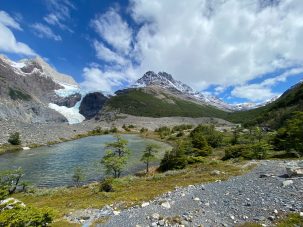
    Ancient Peoples in Patagonia Who Adapted to Changing Climate Offer Insights for Today

    Fish bones reveal the seasonal fishing patterns of Patagonians thousands of years ago, illustrating how prehistoric communities adapted to their environments.

  • Melting Ice Reveals an Ancient Thriving Trade Route

    Melting Ice Reveals an Ancient Thriving Trade Route

    Artifacts from a receding ice patch provide a glimpse of Iron Age and Viking activity along a mountain pass.

  • Switch From Hunting to Herding Recorded in Ancient Pee

    Switch From Hunting to Herding Recorded in Ancient Pee

    In a new study, scientists use urine salts to reconstruct the timing and scale of the Neolithic revolution at a Turkish archaeological site.

  • Photo Essay: Seeking Humanity’s Roots

    Photo Essay: Seeking Humanity’s Roots

    East Africa’s rift valley is considered by many to be the cradle of humanity. In the Turkana region of northwest Kenya, researchers Christopher Lepre and Tanzhuo Liu of Columbia University’s Lamont-Doherty Earth Observatory are cooperating with colleagues to study questions of human evolution, from the creation of the earliest stone tools to climate swings that…

  • Seeking Humanity’s Roots

    Seeking Humanity’s Roots

    Who were our earliest ancestors? How and when did they evolve into modern humans? And how do we define “human,” anyway? Scientists are exploring Kenya’s Lake Turkana basin to help answer these questions.

  • Scientists Discover World’s Oldest Stone Tools

    Finds Challenge Ideas about Who Were the First Toolmakers

  • Ancestors

    Ancestors

    We are high mountain people, hunters and artists, Our view from this base camp is brilliant and clear. Cold, thin air sweeps the rocky plateau; You need a strong heart to live here.

  • The New World

    The New World

    On a man in the mountains, dusk falls; Shadows seep upward and spread. Scaling the black, chiseled walls, He silently seeks the dead.

Photo of the Earth from space with the text "Lamont at AGU25" on top.

AGU25, the premier Earth and space science conference, takes place December 15-19, 2025 in New Orleans, Louisiana. This year’s theme—Where Science Connects Us—puts in focus how science depends on connection, from the lab to the field to the ballot box. Once again, Lamont-Doherty Earth Observatory and Columbia Climate School scientists, experts, students, and educators are playing an active role, sharing our research and helping shape the future of our planet. #AGU25 Learn More

  • Ancient Peoples in Patagonia Who Adapted to Changing Climate Offer Insights for Today

    Ancient Peoples in Patagonia Who Adapted to Changing Climate Offer Insights for Today

    Fish bones reveal the seasonal fishing patterns of Patagonians thousands of years ago, illustrating how prehistoric communities adapted to their environments.

  • Melting Ice Reveals an Ancient Thriving Trade Route

    Melting Ice Reveals an Ancient Thriving Trade Route

    Artifacts from a receding ice patch provide a glimpse of Iron Age and Viking activity along a mountain pass.

  • Switch From Hunting to Herding Recorded in Ancient Pee

    Switch From Hunting to Herding Recorded in Ancient Pee

    In a new study, scientists use urine salts to reconstruct the timing and scale of the Neolithic revolution at a Turkish archaeological site.

  • Photo Essay: Seeking Humanity’s Roots

    Photo Essay: Seeking Humanity’s Roots

    East Africa’s rift valley is considered by many to be the cradle of humanity. In the Turkana region of northwest Kenya, researchers Christopher Lepre and Tanzhuo Liu of Columbia University’s Lamont-Doherty Earth Observatory are cooperating with colleagues to study questions of human evolution, from the creation of the earliest stone tools to climate swings that…

  • Seeking Humanity’s Roots

    Seeking Humanity’s Roots

    Who were our earliest ancestors? How and when did they evolve into modern humans? And how do we define “human,” anyway? Scientists are exploring Kenya’s Lake Turkana basin to help answer these questions.

  • Scientists Discover World’s Oldest Stone Tools

    Finds Challenge Ideas about Who Were the First Toolmakers

  • Ancestors

    Ancestors

    We are high mountain people, hunters and artists, Our view from this base camp is brilliant and clear. Cold, thin air sweeps the rocky plateau; You need a strong heart to live here.

  • The New World

    The New World

    On a man in the mountains, dusk falls; Shadows seep upward and spread. Scaling the black, chiseled walls, He silently seeks the dead.