State of the Planet

News from the Columbia Climate School

El Niño3

  • It’s Beginning to Look Not a Lot Like Christmas

    It’s Beginning to Look Not a Lot Like Christmas

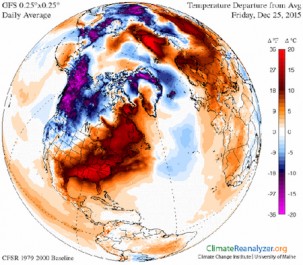
    Much of the eastern two-thirds of the United States was balmy on Christmas Day, with high temperatures more than 20°F above average from Texas to Maine. According to NOAA, 789 daily high temperature records were tied or broken on Christmas Eve and Christmas Day in the continental United States. What’s behind this unusual weather?

  • How Bad Will this El Niño Be? Worse Than You May Think

    How Bad Will this El Niño Be? Worse Than You May Think

    Today’s El Niño is unfolding over a world that is in many ways more vulnerable than the world of 1997-1998. Just as today’s climate continues to generate extremes without historical precedent, we are starting to see elements of social vulnerability also without historical precedent. That is an alarming combination.

  • With El Niño, Be Careful What You Wish for

    With El Niño, Be Careful What You Wish for

    In Southern California, a strong El Niño usually signals rain. Given that California is now in the throes of a severe drought, it seems like that should be a good thing, even if it comes with risk of floods. But the reality of climate is more complex and counter-intuitive than it first appears.

  • International Conference on El Niño, Nov. 17-18

    International Conference on El Niño, Nov. 17-18

    A live-streamed international conference on El Niño takes place on Nov. 17 and 18 at the International Research Institute for Climate and Society.

  • El Niño: Resources for Journalists

    El Niño: Resources for Journalists

    El Niño is earth’s most powerful climate cycle, influencing weather and affecting crops, water supplies and public health globally. What may be the strongest El Niño ever measured is now getting underway, and is already affecting parts of the world.

  • Translating Nature’s Historians: The Tree Ring Lab Turns 40

    Translating Nature’s Historians: The Tree Ring Lab Turns 40

    In its first 40 years, the Lamont Tree Ring Lab tracked changing climates around the world, building an international reputation as a global leader in research, training and technology.

  • Tree Rings on Hawai’i Could Hold New Knowledge About El Niño

    Tree Rings on Hawai’i Could Hold New Knowledge About El Niño

    Annual tree rings are a rare find in the tropical islands of the eastern Pacific. The new discovery of trees with annual rings on a Hawaiian volcano could provide new climate data from a part of the world where much of the variability of the El Niño-Southern Oscillation originates.

  • The Extreme Pacific Climate Now

    The Extreme Pacific Climate Now

    The climate over the tropical Pacific is in an extreme state at the moment. That explains some of the extreme anomalies affecting the United States right now. It also gives us a window through which we can glimpse how even more dramatic and long-term climates of the distant past might have worked.

  • Behind the Expected Quiet 2015 Hurricane Season

    Behind the Expected Quiet 2015 Hurricane Season

    On May 27, 2015, NOAA officially announced a likely below-normal Atlantic Hurricane season is coming up. The range for the possible numbers of major hurricanes is 0-2. What are the reasons behind it? How precise are these numbers?

Photo of the Earth from space with the text "Lamont at AGU25" on top.

AGU25, the premier Earth and space science conference, takes place December 15-19, 2025 in New Orleans, Louisiana. This year’s theme—Where Science Connects Us—puts in focus how science depends on connection, from the lab to the field to the ballot box. Once again, Lamont-Doherty Earth Observatory and Columbia Climate School scientists, experts, students, and educators are playing an active role, sharing our research and helping shape the future of our planet. #AGU25 Learn More

  • It’s Beginning to Look Not a Lot Like Christmas

    It’s Beginning to Look Not a Lot Like Christmas

    Much of the eastern two-thirds of the United States was balmy on Christmas Day, with high temperatures more than 20°F above average from Texas to Maine. According to NOAA, 789 daily high temperature records were tied or broken on Christmas Eve and Christmas Day in the continental United States. What’s behind this unusual weather?

  • How Bad Will this El Niño Be? Worse Than You May Think

    How Bad Will this El Niño Be? Worse Than You May Think

    Today’s El Niño is unfolding over a world that is in many ways more vulnerable than the world of 1997-1998. Just as today’s climate continues to generate extremes without historical precedent, we are starting to see elements of social vulnerability also without historical precedent. That is an alarming combination.

  • With El Niño, Be Careful What You Wish for

    With El Niño, Be Careful What You Wish for

    In Southern California, a strong El Niño usually signals rain. Given that California is now in the throes of a severe drought, it seems like that should be a good thing, even if it comes with risk of floods. But the reality of climate is more complex and counter-intuitive than it first appears.

  • International Conference on El Niño, Nov. 17-18

    International Conference on El Niño, Nov. 17-18

    A live-streamed international conference on El Niño takes place on Nov. 17 and 18 at the International Research Institute for Climate and Society.

  • El Niño: Resources for Journalists

    El Niño: Resources for Journalists

    El Niño is earth’s most powerful climate cycle, influencing weather and affecting crops, water supplies and public health globally. What may be the strongest El Niño ever measured is now getting underway, and is already affecting parts of the world.

  • Translating Nature’s Historians: The Tree Ring Lab Turns 40

    Translating Nature’s Historians: The Tree Ring Lab Turns 40

    In its first 40 years, the Lamont Tree Ring Lab tracked changing climates around the world, building an international reputation as a global leader in research, training and technology.

  • Tree Rings on Hawai’i Could Hold New Knowledge About El Niño

    Tree Rings on Hawai’i Could Hold New Knowledge About El Niño

    Annual tree rings are a rare find in the tropical islands of the eastern Pacific. The new discovery of trees with annual rings on a Hawaiian volcano could provide new climate data from a part of the world where much of the variability of the El Niño-Southern Oscillation originates.

  • The Extreme Pacific Climate Now

    The Extreme Pacific Climate Now

    The climate over the tropical Pacific is in an extreme state at the moment. That explains some of the extreme anomalies affecting the United States right now. It also gives us a window through which we can glimpse how even more dramatic and long-term climates of the distant past might have worked.

  • Behind the Expected Quiet 2015 Hurricane Season

    Behind the Expected Quiet 2015 Hurricane Season

    On May 27, 2015, NOAA officially announced a likely below-normal Atlantic Hurricane season is coming up. The range for the possible numbers of major hurricanes is 0-2. What are the reasons behind it? How precise are these numbers?