Lamont-Doherty Earth Observatory110
-
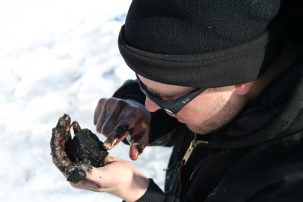
How Can Changing Climate Affect a Civilization?
Billy D’Andrea is trying to understand Easter Island’s climate history over the last few thousand years and how communities dealt with past climate change.
-

Tiny Losses of Ice at Antarctica’s Fringes May Hasten Declines in Interior
A new study shows that even minor deterioration of ice shelves can instantaneously hasten the decline of ice hundreds of miles landward.
-

The Greenland Ice Sheet Is Sponging Up Meltwater
As climate warms, the surface of the Greenland ice sheet is melting, and all that meltwater ends up in seasonal rivers that flow to the sea. At least that is what scientists have assumed until now. A new study has shown that some of the meltwater is actually being soaked into porous subsurface ice and…
-

Understanding Earth’s Geologic History to Predict the Future
Organic geochemist Pratigya Polissar is developing new tools to look at the history of plants and ecosystems on Earth over the past 20 million years.
-

Studying Bioluminescent Blooms in the Arabian Sea
A plankton-like species is attacking the base of the food chain in the Arabian sea, disrupting water quality and killing fish. Researchers at the Lamont-Doherty Earth Observatory are learning how to fight back.
-

American Geophysical Union 2017: Key Events From the Earth Institute
A chronological guide to key talks and other events presented by Columbia University’s Earth Institute at the American Geophysical Union 2017 meeting.
-

Want to Save the World? Start by Eating Less Beef
If we ate half as many burgers and steaks each week, a new study calculates that it could have a profound effect on carbon emissions and the environment.
-

The Way We Were: Climate and Human Evolution
In a remote desert region around Kenya’s Lake Turkana, paleoecologist and geochemist Kevin Uno collects fossils and sediments, searching for evidence about past climate, vegetation, animals, and water. His goal: to understand how climate affected our ancestors millions of years ago.
-

Why Do Floods Sometimes Happen on Sunny Days?
Some towns and cities can get soaked even when the skies are dry—and these so-called sunny day floods are on the rise thanks to climate change.


October 28, 2026 is Columbia Giving Day! Your gift to Columbia Climate School helps advance interdisciplinary research, educate the next generation of leaders, and transform bold ideas into real-world solutions for climate, Earth, and society.
