Lamont-Doherty Earth Observatory108
-
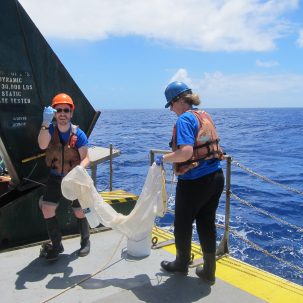
Exploring the Microbiome of an Ocean Bacteria
Braving the high seas and a curious shark, a team of scientists taps into the secret social life of a microbe that’s crucial for marine ecosystems.
-

Primary Schools to the Rescue
Up ahead was a school, perfect for a GPS installation. Schools proved to be the best sites in the hills, which we covered in either tea plantations or woods.
-

Installing the First Two GPS Sites
From our base in Srimongal, now came the challenging work of finding appropriate locations to install the GPS. It requires a combination of the right tectonic setting and reinforced concrete buildings.
-

Tracing Our Roots
High school students in a science communication class blog about research from Lamont-Doherty Earth Observatory.
-

Fellowship of the Seismometers
I am back in Bangladesh to start deployment of seismometers and GPS for a large new project that crosses 3 countries: Bangladesh, India and Myanmar.
-

Scientists Find Strong Link Between Climate Change and Wildfires
High school students in a science communication class blog about research from Lamont-Doherty Earth Observatory.
-

The Path to Our Evolution
High school students in a science communication class blog about research from Lamont-Doherty Earth Observatory.
-

Live from Antarctica: Scientists #TakeoverNSF
On January 31 at 1:00 p.m. EST, Lamont-Doherty’s Hugh Ducklow and his colleagues will use National Science Foundation social media to discuss their research on Antarctic ecology.
-

Fire Modeling: A New Approach to Wildfire Prevention
High school students in a science communication class blog about research from Lamont-Doherty Earth Observatory.


October 28, 2026 is Columbia Giving Day! Your gift to Columbia Climate School helps advance interdisciplinary research, educate the next generation of leaders, and transform bold ideas into real-world solutions for climate, Earth, and society.
