Lamont-Doherty Earth Observatory97
-
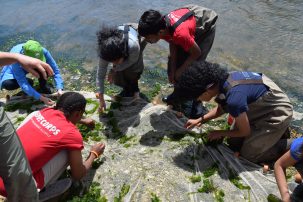
New York’s Waterways are WILD: Come Explore at the Great Fish Count!
On June 2nd, residents in and around New York City can join scientists in exploring our estuary and assessing the diversity of our local waterways.
-

Former Lamont-Doherty Intern Takes Home Fourth Place In Intel Science Fair
Alexandria Ang takes home the prestigious recognition for her research on a climate change-driven algae whose greenish blooms plague the Arabian Sea.
-

Photos and Videos From Hawaii’s Volcanic Eruption
Volcanologist Einat Lev shares incredible footage of steam plumes, lava fountains, and more from the Kilauea eruption.
-

What Happens to All The Carbon We Emit?
A new website provides an interesting and easy-to-understand primer on the carbon cycle.
-

Machine Listening for Earthquakes
In a new study, researchers show that machine learning algorithms can pick out different types of earthquakes from three years of data at Geysers in California. The repeating patterns of earthquakes appear to match the seasonal rise and fall of water-injection flows into the hot rocks below.
-

Tracking the Kilauea Eruption
Volcanologist Einat Lev is tracking lava flows at Hawaii’s volcanic eruption. Here, she describes what conditions are like on the ground—and in the sky.
-

How Australia Got Planted
A new study has uncovered when and why the native vegetation that today dominates much of Australia first expanded across the continent.
-

New Round of Funding Supports Earth Institute Research Around the Globe
The President’s Global Innovation Fund will provide grants to four Earth Institute research projects.
-

In India, Dirty Air Kills as Easily in the Country as in the City
A forthcoming study of northern India suggests that people living in rural areas are as likely to die prematurely from the effects of poor air quality as those living in cities.


The first Earth Day in 1970 ignited a movement to stop polluting our planet. Today, our scientists and experts are tackling the most pressing challenges to achieve real-world impact. This Earth Day, join us in our commitment to realizing a just and sustainable future for our planet. Visit our Earth Day website for ideas, resources, and inspiration.
