Sustainability38
-

How We Put Our Spreadsheets Where Our Stomachs Are
Right off the bat, we were faced with the difficult question of what “sustainable” actually means. Students were well-versed in the triple bottom line of sustainability – economic, environmental and social. Then one of the students, a hefty young man on Columbia’s wrestling team, spoke up in defense of his right to make a decision…
-

The State and Future of Congestion Pricing in China
To combat urban air pollution and traffic problems, some propose congestion pricing as a cost-effective policy to reduce pollution and improve productivity through improved travel speeds. Cities in China could implement this policy and ameliorate some of the negative effects of congestion-caused pollution. So why is congestion pricing dead on arrival in China?
-

CUriosity3: Intersection Between Arts and Sciences
Join instructors from our Executive Education Certificate Program in Conservation and Environmental Sustainability including Dr. Shahid Naeem, Dr. Matt Palmer, and Dr. Eric Sanderson. for a FREE public seminar program addressing the intersection between Arts and Science with the goal of initiating discussions and debate around the common ground of creative practice and scientific discovery.
-

Sustainability Certification in Aquaculture: Put Your Money Where Your Mouth Is?
Should we certify aquaculture? A look at mounting challenges in the push for sustainable seafood.
-

Riding for Climate with Mom and Mr. Shark
Katy Mixter will ride with “Mr. Shark” on her handlebars, the result of a $75 donation from her boss. Pamela Quinlan is joining the 300-mile Climate Ride to mark her 30th birthday. Jennifer Hurford will ride beside her mother.
-

Q&A: Climate Change, Drought and the Future
“One of the ways that climate change is going to manifest is through warmer temperatures. … What we are seeing, in line with our projections, is that even if you assume constant precipitation, the temperature effects are so large that it is going to dry things out. This is going to have really big impacts…
-

Science in the Streets
What motivates artists may be different than what motivates scientists, but they can investigate similar ideas. Artists interested in sustainability issues might team up with scientists to make sure their work is accurate. Scientists benefit from art projects that communicate their research to a broader audience than would normally read a journal article. However, the…
-

The Environment as a Tool for Peace in the Middle East
Understanding the Middle East conflict is not an easy task, and adding an environmental component to the puzzle doesn’t make it any easier. Students in the Regional Environmental Sustainability in the Middle East program, having gone through 16 days of an 18-day trip to the region, now see clearly how complex the issues actually are.…
-

A Sustainable Strategy to Deal with Urban Poverty
When architect Fernando Arias first arrived in Kumasi, Ghana last year, he saw unpaved roads, trash burning, garbage everywhere, and shoeless children running all around. He knew he needed to act on their behalf.


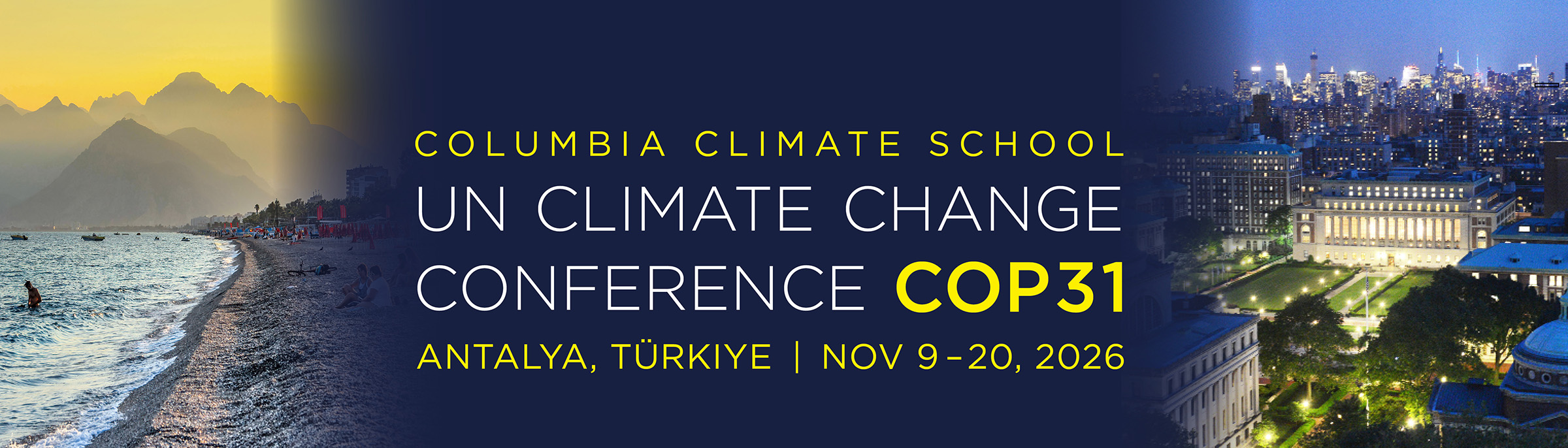
COP31, the 2026 United Nations Climate Change Conference, aims to advance dialogue, strengthen consensus, and accelerate climate action on a global scale. From November 9–20, 2026 in Antalya, Türkiye, heads of state, ministers, scientists, business leaders, and civil society will gather to advance efforts in emission targets, climate finance, and adaptation and resilience. Once again, our experts, students, and global thought leaders from Columbia Climate School and across Columbia University are contributing to key events, sharing insights, and helping shape the dialogue toward ambitious, science-based solutions. Learn More
