volcanoes6
-
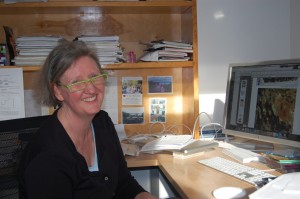
Terry Plank: Volcano Maven
“It just looked like black rock, but every once in awhile a boulder at the end would fall off and you’d see it was completely red inside. And it made all these cool sounds and you’d feel these little earthquakes… It was totally cool. How could you not like that?”
-

In Ethiopian Desert, a Window into Rifting of Africa
A new study in the journal Nature provides fresh insight into deep-earth processes driving apart huge sections of the earth’s crust. This rifting mostly takes place on seabeds, but can be seen in a few places on land—nowhere more visibly than in the Afar region of northern Ethiopia.
-
Volcano Expert Wins MacArthur ‘Genius Grant’
A geochemist who studies the workings of the deep earth and their influence on some of the world’s most explosive volcanoes has been awarded a $500,000 MacArthur Fellowship. Terry Plank, a researcher at Columbia University’s Lamont-Doherty Earth Observatory, joins novelist Junot Diaz, war correspondent David Finkel and filmmaker Natalia Almada in this year’s batch of…
-

An Interactive Map of Scientific Fieldwork
Earth Institute scientists explore how the physical world works on every continent — over and under the arctic ice, in the grasslands of Mongolia, on volcanoes in Patagonia, over subduction zones in Papua New Guinea, and on the streets of New York City.
-

Time and Technology and the Really Down Deep
Two years before Google Earth was launched, Bill Ryan and Suzanne Carbotte, oceanographers at the Lamont-Doherty Earth Observatory, began a project to transform the way we look at the ocean. They started collecting reams of data that had been gathered by scientists sailing on research vessels all over the world since the 1980s, one ship…
-

Maybe Ben Franklin Was Wrong
A new study says that for all of its ill effects, the Laki volcanic eruption of 1783-84 probably was not the main culprit behind one of the coldest winters in hundreds of years, as many scientists — and contemporary observer Benjamin Franklin — have speculated.
-
Year Without a Summer? Not this Time.
You may have heard about the Year Without the Summer, 1816, when severe climate anomalies linked to the eruption of Indonesia’s Mt Tambora provoked widespread famine, the westward expansion of the United States, the invention of the bicycle, and Frankenstein. So epic, so influential: Tales of the dramatic climate impacts of that fateful year got…


The first Earth Day in 1970 ignited a movement to stop polluting our planet. Today, our scientists and experts are tackling the most pressing challenges to achieve real-world impact. This Earth Day, join us in our commitment to realizing a just and sustainable future for our planet. Visit our Earth Day website for ideas, resources, and inspiration.
