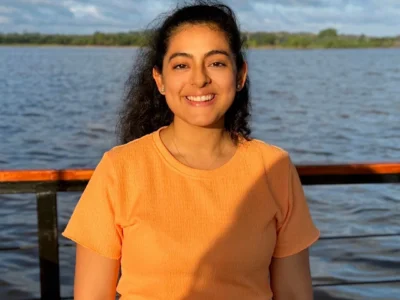
A team of M.S. in Climate Finance students participated in the prestigious Columbia Business School and KKR Private Equity Case Competition—and won.
As students in an inaugural program, the Climate Finance students competed with more than 30 other Columbia Business School student teams, including M.S., MBA and EMBA students. Each team identified and pitched a company as a leveraged buyout (LBO) candidate in which one company acquires another primarily through borrowed funds, including bonds or loans. The finalists then had to present to an “investment committee” composed of executives from global investment firm KKR. One of the finalist teams consisted of M.S. in Climate Finance students Alan Havelka, Ananya Mathur, Grace Taylor, Peter Makey and Sophie Maher, who were declared the winners at the end of the competition.
“The competition is open to Columbia Business School students of all backgrounds. The only strict rule is that teams cannot be comprised entirely of students with private equity backgrounds. This gives students who are unfamiliar with the industry an opportunity to gain hands-on experience preparing a pitch,” said Greta Larson, senior director in the private equity program at Columbia Business School. “The competition is also designed to demonstrate the fundamental importance and value of working with team members with different perspectives and skill sets, and how important those perspectives can be in identifying investment ideas.”
“Having the M.S. in Climate Finance students win this competition demonstrates how particular industry expertise is crucial in private equity transactions, and how valuable their unique perspectives are in an industry like private equity. The M.S. in Climate Finance students were able to draw on their varied backgrounds in tech, finance and infrastructure to win this incredibly competitive challenge,” Larson added.
The students reflected on their experience and what they learned in the Q&A below.
Can you describe the competition framework and your project?
Havelka: The case competition asked teams to evaluate an investment opportunity in a publicly traded company to be taken private. We were allowed to choose from a wide variety of industries, so we naturally settled on a company that sat at the intersection of energy and tech. Our team was excited to pitch Itron as we saw the company to be at the forefront of grid modernization, which is a topic we are all deeply interested in.
Makey: We had to consider market attractiveness, financial performance, value creation opportunities and the prospective buyer universe, which made for a holistic and thoughtful challenge.
Mathur: We landed on Itron, a grid intelligence company that makes the smart meters and software underpinning modern utility infrastructure. What made it compelling was the disconnect: the public market was treating Itron as a declining hardware business, when underneath it was a high-margin software transition with a deeply defensible installed base. Our job was to show that the mispricing represented an opportunity for KKR.
Taylor: The KKR competition asked us to build an investment strategy that could generate real returns, so our project was less about climate idealism and more about identifying where the financial opportunity lies.
What was your experience preparing for that day? What was a key takeaway?
Maher: Preparing for the competition was both challenging and rewarding, especially coming from the inaugural Climate Finance cohort and competing against experienced M.B.A. students. One of my biggest takeaways was not to underestimate the value of your own perspective. You do not need to feel fully ready before pursuing opportunities like this, and a lot of the learning comes from stepping into unfamiliar environments and challenging yourself.
Havelka: I was anxious waiting for my part of the pitch, but watching my teammates who went before me gave me a confidence boost. The main takeaway for me is that preparation can take a lot of the uncertainty out of these situations.
Mathur: The biggest lesson was that conviction has to survive contact with hard questions. We had built a beautiful model, but the judges were way more interested in whether we understood the business well enough to defend every assumption in it. My main takeaway was that the quality of a thesis is really in how it holds up when someone who allocates capital for a living tries to take it apart.
What did your background in climate finance add to the event and why do you think it was important your group was included?
Makey: Our climate finance background and training provides us with differentiated expertise in climate and sustainability market trends, enabling us uniquely to identify financially-attractive opportunities amid a vast opportunity set.
Havelka: We were all set on the sector we wanted to target and were all genuinely excited about the company. Each team member had a unique background, which allowed us to capture all the important nuances across climate and finance topics.
Maher: Climate finance requires understanding infrastructure, policy, markets, technology and capital allocation all at once, and that allowed us to approach the case from a perspective that was different from many traditional finance teams. [We] showed that specialized climate knowledge is becoming increasingly valuable in private equity and infrastructure investing. As the energy transition continues, investors who understand both the technical and financial sides of these businesses will be really important.
Taylor: Our background gave us a unique ability to understand the grid—how energy infrastructure, capital flows and policy incentives interconnect—which allowed us to build an investment case that was both technically grounded and financially compelling.
Mathur: Itron sits at the center of grid modernization, so to underwrite it we had to hold the infrastructure, the regulation driving utility spending and the financial story in view at the same time. I think it mattered that we were in the room because climate finance students are trained to find where the financial opportunity and the energy transition point in the same direction, and that is a very different way of looking at an investment.
How will this experience and win contribute to your future education and/or career goals?
Havelka: I am personally interested in pursuing energy finance after graduation and this competition gave me the opportunity to better understand the dealmaking process within the sector. On a broader note, I really believe this experience reinforced the importance of teamwork. I cannot stress enough how incredible our team was.
Maher: This experience reinforced my interest in private markets and showed me how valuable specialized climate expertise can be within investing. It also gave me confidence in applying the skills from the Climate Finance program in highly competitive and technical environments, which is something I hope to continue building on in my career.
Makey: The competition win strengthened my conviction that specialist perspectives are increasingly valuable in private markets, especially as AI becomes ubiquitous in the industry and can supplement, if not supplant generalist analysis.
Mathur: I’m heading into energy and infrastructure investing after graduation, and this competition was a great way to explore my growing interest in private equity along the way. More than the technical practice, it reinforced something I really care about: the most durable climate outcomes come from investments that are financially rigorous first. Itron is a business with a real moat and real cash flows that happens to be essential to decarbonizing the grid, and that intersection is really where I want to build my career.
Taylor: Winning the KKR competition validated my interest in impact investing and gave me concrete experience to build on as I pursue a career at the intersection of private capital and climate solutions.
Do you have any advice for fellow climate finance students who want to enter this competition or one like it?
Maher: There is very little downside to participating in opportunities like this. Best case, you perform well and open new doors professionally. Worst case, you gain valuable experience and strengthen your technical and presentation skills.
Havelka: The climate finance program is full of diverse people who bring together unique perspectives, so the product is always going to be more than the sum of its parts.
Makey: You can learn as much from experiential opportunities as you can from your coursework—make sure you weave both into your experience at Columbia!
Mathur: Lead with the finance and not the mission. The strongest climate cases never ask anyone to accept a worse return for a better outcome. They show that the better outcome and the better return are the same thing. If you can make that argument rigorously, you will be taken seriously!
The Master of Science in Climate Finance is a one-year, 39-credit professional degree program offered by the Columbia Climate School in close collaboration with the Columbia Business School.