State of the Planet

News from the Columbia Climate School

Climate208

  • Dissolving the Future of Coral Reefs

    Dissolving the Future of Coral Reefs

    Coral reefs, some of the planet’s most beautiful and biodiverse ecosystems, face many natural and anthropogenic threats. Tremendous effort has gone into protecting and rehabilitating these reefs worldwide, but the mounting problem of ocean acidification has the potential to obliterate all progress made by marine scientists, conservationists, and policy-makers thus far.

  • Columbia Students Win Environmental Policy Competition

    Columbia Students Win Environmental Policy Competition

    Three Columbia students recently won the top prize in the Columbia Economics Review’s annual environmental policy competition, which challenged students from eight universities to make policy recommendations addressing climate change.

  • Scientists Speak Out on Climate: Is Anyone Listening?

    Scientists Speak Out on Climate: Is Anyone Listening?

    In the light of recent varied efforts to focus public attention on the risks of climate change, we asked Earth Institute scientists what they want the public to understand about the issue and how they see their roles.

  • From Theory to Reality: Closing the Carbon Loop

    From Theory to Reality: Closing the Carbon Loop

    Carbon capture, storage and reuse has the potential to help us reduce CO2 emissions and combat global warming. The Lenfest Center for Sustainable Energy is bringing together experts from an array of fields to assess the state of the technology April 14-16.

  • Climate Change: a Matter of Public Health

    Climate Change: a Matter of Public Health

    People have tried to cast climate change as an environmental issue, a social justice issue and a development issue. Madeleine Thomson of the International Research Institute for Climate and Society argues climate change can be understood much better if we consider it an issue of global public health.

  • Student Research Showcase 2014

    Student Research Showcase 2014

    The Earth Institute, Columbia University was proud to support student research in the areas of environment and sustainable development at the annual Student Research Showcase on April 25, 2014. Student interns, research assistants and travel grant recipients, and their Faculty and Research Advisors, were honored for their research contributions that ranged in topics from biodiversity,…

  • IPCC Says Managing Risks of Climate Change is Critical

    IPCC Says Managing Risks of Climate Change is Critical

    Among the key findings of the WGII AR5 Report chapter on human security, a topic highlighted in the Report for the first time, is that societies in conflict are more vulnerable to climate change.

  • The Isthmus of Panama: Out of the Deep Earth

    The Isthmus of Panama: Out of the Deep Earth

    The creation of the narrow isthmus that joins North and South America changed not just the world map, but the circulation of oceans, the course of biologic evolution, and probably global climate. Scientists try to decipher the story behind its formation.

  • Photo Essay: Exploring the Rocks That Join the Americas

    Photo Essay: Exploring the Rocks That Join the Americas

    The formation of the slender land bridge that joins South America and North America was a pivotal event in earth’s history. At its narrowest along the isthmus of Panama, it changed not just the world map, but the circulation of oceans, the course of biologic evolution, and global climate. Cornelia Class, a geochemist at Columbia…

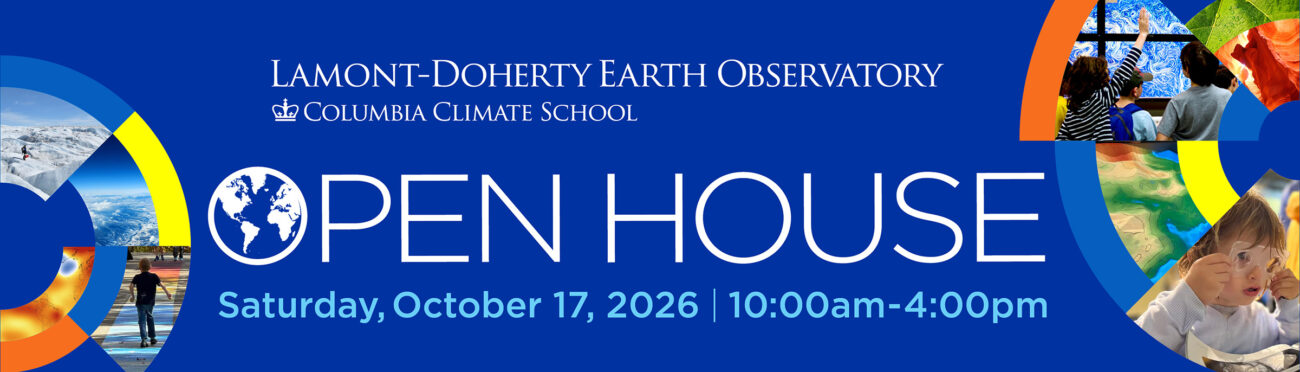
Blue banner with kids and Earth photos. Text: "Lamont-Doherty Earth Observatory Open House, Saturday, October 17, 2026, 10am-4pm.

On Saturday, October 17, 2026 from 10am to 4pm, Lamont-Doherty Earth Observatory Open House—our biggest, best science fun and discovery event of the year—will take place on our beautiful campus in Palisades, NY. Mark your calendar and join us for this free, family-friendly celebration of science! RSVP Today!

  • Dissolving the Future of Coral Reefs

    Dissolving the Future of Coral Reefs

    Coral reefs, some of the planet’s most beautiful and biodiverse ecosystems, face many natural and anthropogenic threats. Tremendous effort has gone into protecting and rehabilitating these reefs worldwide, but the mounting problem of ocean acidification has the potential to obliterate all progress made by marine scientists, conservationists, and policy-makers thus far.

  • Columbia Students Win Environmental Policy Competition

    Columbia Students Win Environmental Policy Competition

    Three Columbia students recently won the top prize in the Columbia Economics Review’s annual environmental policy competition, which challenged students from eight universities to make policy recommendations addressing climate change.

  • Scientists Speak Out on Climate: Is Anyone Listening?

    Scientists Speak Out on Climate: Is Anyone Listening?

    In the light of recent varied efforts to focus public attention on the risks of climate change, we asked Earth Institute scientists what they want the public to understand about the issue and how they see their roles.

  • From Theory to Reality: Closing the Carbon Loop

    From Theory to Reality: Closing the Carbon Loop

    Carbon capture, storage and reuse has the potential to help us reduce CO2 emissions and combat global warming. The Lenfest Center for Sustainable Energy is bringing together experts from an array of fields to assess the state of the technology April 14-16.

  • Climate Change: a Matter of Public Health

    Climate Change: a Matter of Public Health

    People have tried to cast climate change as an environmental issue, a social justice issue and a development issue. Madeleine Thomson of the International Research Institute for Climate and Society argues climate change can be understood much better if we consider it an issue of global public health.

  • Student Research Showcase 2014

    Student Research Showcase 2014

    The Earth Institute, Columbia University was proud to support student research in the areas of environment and sustainable development at the annual Student Research Showcase on April 25, 2014. Student interns, research assistants and travel grant recipients, and their Faculty and Research Advisors, were honored for their research contributions that ranged in topics from biodiversity,…

  • IPCC Says Managing Risks of Climate Change is Critical

    IPCC Says Managing Risks of Climate Change is Critical

    Among the key findings of the WGII AR5 Report chapter on human security, a topic highlighted in the Report for the first time, is that societies in conflict are more vulnerable to climate change.

  • The Isthmus of Panama: Out of the Deep Earth

    The Isthmus of Panama: Out of the Deep Earth

    The creation of the narrow isthmus that joins North and South America changed not just the world map, but the circulation of oceans, the course of biologic evolution, and probably global climate. Scientists try to decipher the story behind its formation.

  • Photo Essay: Exploring the Rocks That Join the Americas

    Photo Essay: Exploring the Rocks That Join the Americas

    The formation of the slender land bridge that joins South America and North America was a pivotal event in earth’s history. At its narrowest along the isthmus of Panama, it changed not just the world map, but the circulation of oceans, the course of biologic evolution, and global climate. Cornelia Class, a geochemist at Columbia…